{"title":"Thiacalix[4]arene-capped Ln(iii) aggregates with “hand in hand” structures and their luminescence properties†","authors":"Hongbo Gao, Hao Wang, Chenxing Liu, Qicao Yan, Yanyan Wang, Herui Wen, Hongpeng You, Zhaomin Hao and Wuping Liao","doi":"10.1039/D4DT03308F","DOIUrl":null,"url":null,"abstract":"<p >Two isostructural thiacalix[4]arene-capped Ln<small><sub>8</sub></small> aggregates with a “hand in hand” structure, denoted as {Ln<small><sub>8</sub></small>(μ<small><sub>4</sub></small>-OH)<small><sub>2</sub></small>Cl<small><sub>2</sub></small>(TC4A)<small><sub>4</sub></small>(BCT)<small><sub>2</sub></small>(DMF)<small><sub>6−-<em>x</em></sub></small>(CH<small><sub>3</sub></small>OH)<small><sub>2+<em>x</em></sub></small>(H<small><sub>2</sub></small>O)<small><sub>2</sub></small>}·<em>m</em>CH<small><sub>3</sub></small>OH·<em>n</em>DMF (Ln = Tb (<strong>1</strong>), Eu (<strong>2</strong>); H<small><sub>4</sub></small>TC4A = <em>p-tert</em>-butylthiacalix[4]arene; H<small><sub>2</sub></small>BCT = 3,5-bis(4′-carboxy-phenyl)-1,2,4-triazole; DMF = <em>N</em>,<em>N</em>′-dimethylformamide), were constructed from two sandwich-like Ln<small><sub>4</sub></small>-(TC4A)<small><sub>2</sub></small> entities bridged <em>via</em> two BCT<small><sup>2−</sup></small> linkers. These aggregates present a layer-like structure on the <em>ac</em> plane, with poly-nuclear secondary building units (PSBUs) staggered and assembled in three-dimensional space. <strong>1</strong> exhibits green photoluminescence under 379 nm excitation, with an average decay time of approximately 1.15 ms. Notably, the metal-centered luminescence of <strong>1</strong> remains nearly stable even after replacing the DMF molecules with methanol. The structural stability of <strong>1</strong> in various solvents, along with its excellent photoluminescence properties after being immersed in water for several months, suggests that it could effectively resist luminescence quenching. This makes it a promising candidate for applications in anti-counterfeiting and luminescence detection. In contrast, <strong>2</strong> does not show visible luminescence under the irradiation of a portable ultraviolet lamp (<em>λ</em> = 326 nm), which could be attributed to the slight difference in ligand-based energy levels. Collectively, these findings enhance the understanding of the structural diversity and application scenarios of thiacalix[4]arene-capped Ln(<small>III</small>) aggregates.</p>","PeriodicalId":71,"journal":{"name":"Dalton Transactions","volume":" 10","pages":" 4332-4337"},"PeriodicalIF":3.3000,"publicationDate":"2025-02-04","publicationTypes":"Journal Article","fieldsOfStudy":null,"isOpenAccess":false,"openAccessPdf":"","citationCount":"0","resultStr":null,"platform":"Semanticscholar","paperid":null,"PeriodicalName":"Dalton Transactions","FirstCategoryId":"92","ListUrlMain":"https://pubs.rsc.org/en/content/articlelanding/2025/dt/d4dt03308f","RegionNum":3,"RegionCategory":"化学","ArticlePicture":[],"TitleCN":null,"AbstractTextCN":null,"PMCID":null,"EPubDate":"","PubModel":"","JCR":"Q2","JCRName":"CHEMISTRY, INORGANIC & NUCLEAR","Score":null,"Total":0}
引用次数: 0
Abstract
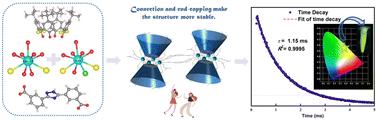
Two isostructural thiacalix[4]arene-capped Ln8 aggregates with a “hand in hand” structure, denoted as {Ln8(μ4-OH)2Cl2(TC4A)4(BCT)2(DMF)6−-x(CH3OH)2+x(H2O)2}·mCH3OH·nDMF (Ln = Tb (1), Eu (2); H4TC4A = p-tert-butylthiacalix[4]arene; H2BCT = 3,5-bis(4′-carboxy-phenyl)-1,2,4-triazole; DMF = N,N′-dimethylformamide), were constructed from two sandwich-like Ln4-(TC4A)2 entities bridged via two BCT2− linkers. These aggregates present a layer-like structure on the ac plane, with poly-nuclear secondary building units (PSBUs) staggered and assembled in three-dimensional space. 1 exhibits green photoluminescence under 379 nm excitation, with an average decay time of approximately 1.15 ms. Notably, the metal-centered luminescence of 1 remains nearly stable even after replacing the DMF molecules with methanol. The structural stability of 1 in various solvents, along with its excellent photoluminescence properties after being immersed in water for several months, suggests that it could effectively resist luminescence quenching. This makes it a promising candidate for applications in anti-counterfeiting and luminescence detection. In contrast, 2 does not show visible luminescence under the irradiation of a portable ultraviolet lamp (λ = 326 nm), which could be attributed to the slight difference in ligand-based energy levels. Collectively, these findings enhance the understanding of the structural diversity and application scenarios of thiacalix[4]arene-capped Ln(III) aggregates.
期刊介绍:
Dalton Transactions is a journal for all areas of inorganic chemistry, which encompasses the organometallic, bioinorganic and materials chemistry of the elements, with applications including synthesis, catalysis, energy conversion/storage, electrical devices and medicine. Dalton Transactions welcomes high-quality, original submissions in all of these areas and more, where the advancement of knowledge in inorganic chemistry is significant.




 京公网安备 11010802042870号
京ICP备2023020795号-1
京公网安备 11010802042870号
京ICP备2023020795号-1

 分享
分享
 求助内容:
求助内容: 应助结果提醒方式:
 扫码关注我们
