Xiangkai Yin , Boyang Li , Hong Liu , Bo Wen , Jia Liu , Meiqi Bai , Yanan Zhang , Yuanjun Zhao , Xiaofeng Cui , Yaqiong Su , Guoxin Gao , Shujiang Ding , Wei Yu
{"title":"Solvent-derived organic-rich SEI enables capacity enhancement for low-temperature lithium metal batteries","authors":"Xiangkai Yin , Boyang Li , Hong Liu , Bo Wen , Jia Liu , Meiqi Bai , Yanan Zhang , Yuanjun Zhao , Xiaofeng Cui , Yaqiong Su , Guoxin Gao , Shujiang Ding , Wei Yu","doi":"10.1016/j.joule.2025.101823","DOIUrl":null,"url":null,"abstract":"<div><div>Anion-derived inorganic-rich solid electrolyte interface (SEI) is generally considered beneficial for lithium metal batteries (LMBs). Surprisingly, an anomaly was observed in this study that the inorganic-rich SEI can cause severe capacity degradation in low-temperature (LT) LMBs due to sluggish interfacial transport kinetics. Herein, the solvent-derived organic-rich SEI was demonstrated to exhibit lower interfacial impedance due to weak interfacial force and rapid pore diffusion mechanism. As a proof of concept, an organosilicon electrolyte, combined with LT formation cycling, successfully constructed solvent-derived SEI with a 16.51-fold increase in organic components, ultimately resulting in a 22.5% capacity enhancement of LMBs at −40°C. Consequently, Li||NCM811 cells miraculously maintained discharge functionality even at −114.05°C, and 1.2 Ah pouch cells maintained 92.1% capacity retention over 50 cycles at −20°C with the lean electrolyte (2.5 mL Ah<sup>−1</sup>). This strategy of increasing battery capacity through organic-rich SEI opens up a new era of research on LT batteries.</div></div>","PeriodicalId":343,"journal":{"name":"Joule","volume":"9 4","pages":"Article 101823"},"PeriodicalIF":35.4000,"publicationDate":"2025-04-16","publicationTypes":"Journal Article","fieldsOfStudy":null,"isOpenAccess":false,"openAccessPdf":"","citationCount":"0","resultStr":null,"platform":"Semanticscholar","paperid":null,"PeriodicalName":"Joule","FirstCategoryId":"88","ListUrlMain":"https://www.sciencedirect.com/science/article/pii/S2542435125000042","RegionNum":1,"RegionCategory":"材料科学","ArticlePicture":[],"TitleCN":null,"AbstractTextCN":null,"PMCID":null,"EPubDate":"2025/2/4 0:00:00","PubModel":"Epub","JCR":"Q1","JCRName":"CHEMISTRY, PHYSICAL","Score":null,"Total":0}
引用次数: 0
Abstract
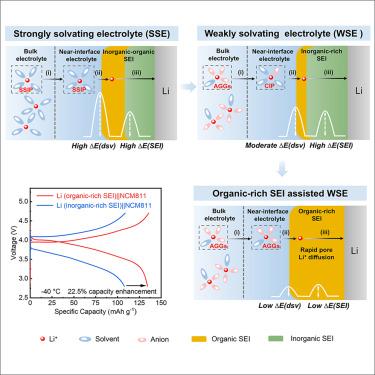
Anion-derived inorganic-rich solid electrolyte interface (SEI) is generally considered beneficial for lithium metal batteries (LMBs). Surprisingly, an anomaly was observed in this study that the inorganic-rich SEI can cause severe capacity degradation in low-temperature (LT) LMBs due to sluggish interfacial transport kinetics. Herein, the solvent-derived organic-rich SEI was demonstrated to exhibit lower interfacial impedance due to weak interfacial force and rapid pore diffusion mechanism. As a proof of concept, an organosilicon electrolyte, combined with LT formation cycling, successfully constructed solvent-derived SEI with a 16.51-fold increase in organic components, ultimately resulting in a 22.5% capacity enhancement of LMBs at −40°C. Consequently, Li||NCM811 cells miraculously maintained discharge functionality even at −114.05°C, and 1.2 Ah pouch cells maintained 92.1% capacity retention over 50 cycles at −20°C with the lean electrolyte (2.5 mL Ah−1). This strategy of increasing battery capacity through organic-rich SEI opens up a new era of research on LT batteries.
期刊介绍:
Joule is a sister journal to Cell that focuses on research, analysis, and ideas related to sustainable energy. It aims to address the global challenge of the need for more sustainable energy solutions. Joule is a forward-looking journal that bridges disciplines and scales of energy research. It connects researchers and analysts working on scientific, technical, economic, policy, and social challenges related to sustainable energy. The journal covers a wide range of energy research, from fundamental laboratory studies on energy conversion and storage to global-level analysis. Joule aims to highlight and amplify the implications, challenges, and opportunities of novel energy research for different groups in the field.





 京公网安备 11010802042870号
京ICP备2023020795号-1
京公网安备 11010802042870号
京ICP备2023020795号-1

 分享
分享
 求助内容:
求助内容: 应助结果提醒方式:
 扫码关注我们
