{"title":"Size Effect and Interfacial Synergy Enhancement of 2D Ultrathin CoxZn1−x-MOF/rGO for Boosting Lithium–Sulfur Battery Performance","authors":"Yutao Dong, Ziqian Jin, Huaiqi Peng, Meili Wang, Shiyu Ma, Xin Li, Yunlai Ren, Lixia Xie, Jianmin Zhang","doi":"10.1002/smll.202412186","DOIUrl":null,"url":null,"abstract":"<p>Advanced cathode materials are developed to tackle the challenges of the polysulfide shuttle effect and slow sulfur redox kinetics in Li–S batteries. A particularly effective strategy is the creation of nanostructured sulfur-host, which boast high levels of conductivity and catalytic activity. Here, a series of ultrathin cobalt–zinc bimetallic MOFs with varying ratios are synthesized on rGO via a one-pot hydrothermal process. Furthermore, graphene's high specific surface area enhances electrical conductivity and structural integrity, thereby promoting the growth of 2D MOFs and synergistically optimizing sulfur contact and conversion kinetics. The Co<sub>x</sub>Zn<sub>1-x</sub>-MOF/rGO has a disordered structure, resulting from the fine-tuned ratio of cobalt to zinc in the bimetallic centers, generates active sites and modulates the electronic properties, thereby enhancing LiPSs adsorption and catalysis serve as sulfur hosts. Among the composites, the Co<sub>0.75</sub>Zn<sub>0.25</sub>-MOF/rGO demonstrated exceptional LiPSs adsorption and catalytic activity, resulting in a high capacity of 649.69 mA h g<sup>−1</sup> after the 250th cycle with an E/S ratio of 12.56 µL mg<sup>−1</sup> at 0.2 C. This work deepens the insights into the controlled design of defective MOFs, modulating their structure-activity correlations, and is expected to facilitate the integration of ultrathin defective MOFs with carbonaceous composites, thereby advancing the development of Li–S batteries.</p>","PeriodicalId":228,"journal":{"name":"Small","volume":"21 11","pages":""},"PeriodicalIF":12.1000,"publicationDate":"2025-02-03","publicationTypes":"Journal Article","fieldsOfStudy":null,"isOpenAccess":false,"openAccessPdf":"","citationCount":"0","resultStr":null,"platform":"Semanticscholar","paperid":null,"PeriodicalName":"Small","FirstCategoryId":"88","ListUrlMain":"https://onlinelibrary.wiley.com/doi/10.1002/smll.202412186","RegionNum":2,"RegionCategory":"材料科学","ArticlePicture":[],"TitleCN":null,"AbstractTextCN":null,"PMCID":null,"EPubDate":"","PubModel":"","JCR":"Q1","JCRName":"CHEMISTRY, MULTIDISCIPLINARY","Score":null,"Total":0}
引用次数: 0
Abstract
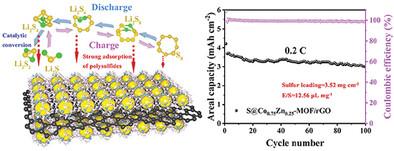
Advanced cathode materials are developed to tackle the challenges of the polysulfide shuttle effect and slow sulfur redox kinetics in Li–S batteries. A particularly effective strategy is the creation of nanostructured sulfur-host, which boast high levels of conductivity and catalytic activity. Here, a series of ultrathin cobalt–zinc bimetallic MOFs with varying ratios are synthesized on rGO via a one-pot hydrothermal process. Furthermore, graphene's high specific surface area enhances electrical conductivity and structural integrity, thereby promoting the growth of 2D MOFs and synergistically optimizing sulfur contact and conversion kinetics. The CoxZn1-x-MOF/rGO has a disordered structure, resulting from the fine-tuned ratio of cobalt to zinc in the bimetallic centers, generates active sites and modulates the electronic properties, thereby enhancing LiPSs adsorption and catalysis serve as sulfur hosts. Among the composites, the Co0.75Zn0.25-MOF/rGO demonstrated exceptional LiPSs adsorption and catalytic activity, resulting in a high capacity of 649.69 mA h g−1 after the 250th cycle with an E/S ratio of 12.56 µL mg−1 at 0.2 C. This work deepens the insights into the controlled design of defective MOFs, modulating their structure-activity correlations, and is expected to facilitate the integration of ultrathin defective MOFs with carbonaceous composites, thereby advancing the development of Li–S batteries.
为了解决锂硫电池中多硫穿梭效应和硫氧化还原动力学缓慢的挑战,开发了先进的正极材料。一个特别有效的策略是创造纳米结构的硫宿主,它具有高水平的导电性和催化活性。本文采用一锅水热法在氧化石墨烯上合成了一系列不同比例的超薄钴锌双金属mof。此外,石墨烯的高比表面积提高了导电性和结构完整性,从而促进了二维mof的生长,并协同优化了硫接触和转化动力学。CoxZn1-x-MOF/rGO具有无序结构,通过在双金属中心微调钴锌比,产生活性位点并调节电子性质,从而增强LiPSs作为硫宿主的吸附和催化作用。在这些复合材料中,Co0.75Zn0.25-MOF/rGO表现出了优异的LiPSs吸附和催化活性,在0.2℃下,250次循环后的电容量高达649.69 mA h g−1,E/S比为12.56µL mg−1。这项工作加深了对缺陷mof的控制设计的认识,调节了它们的结构-活性相关性,并有望促进超薄缺陷mof与碳基复合材料的整合。从而推动锂电池的发展。
期刊介绍:
Small serves as an exceptional platform for both experimental and theoretical studies in fundamental and applied interdisciplinary research at the nano- and microscale. The journal offers a compelling mix of peer-reviewed Research Articles, Reviews, Perspectives, and Comments.
With a remarkable 2022 Journal Impact Factor of 13.3 (Journal Citation Reports from Clarivate Analytics, 2023), Small remains among the top multidisciplinary journals, covering a wide range of topics at the interface of materials science, chemistry, physics, engineering, medicine, and biology.
Small's readership includes biochemists, biologists, biomedical scientists, chemists, engineers, information technologists, materials scientists, physicists, and theoreticians alike.



 京公网安备 11010802042870号
京ICP备2023020795号-1
京公网安备 11010802042870号
京ICP备2023020795号-1

 分享
分享
 求助内容:
求助内容: 应助结果提醒方式:
 扫码关注我们
