Yue Wang , Jing Li , Pengfei Yang , Hongdong Li , Guangrui Xu , Yunmei Du , Caixia Li , Wei Jin , Tianyi Ma , Zexing Wu , Lei Wang
{"title":"Interfacial Ru nanoclusters in tandem with single atoms on oxygen-vacancy regulated CeO2 for anion exchange membrane seawater-splitting","authors":"Yue Wang , Jing Li , Pengfei Yang , Hongdong Li , Guangrui Xu , Yunmei Du , Caixia Li , Wei Jin , Tianyi Ma , Zexing Wu , Lei Wang","doi":"10.1016/j.jechem.2024.11.017","DOIUrl":null,"url":null,"abstract":"<div><div>A hydrogen spillover-bridged water dissociation/hydrogen formation could concurrently promote Volmer/Tafel process and improve the efficiency of hydrogen evolution reaction (HER) under alkaline conditions. However, it is still challenging to promote occurrence of hydrogen spillover for the large interfacial transport barriers of H<sub>2</sub>O and hydrogen on active sites. Herein, the strategy of energy barrier gradient to induce hydrogen spillover was proposed by constructing Ru nanoclusters coupled with single atom onto oxygen vacancy cerium dioxide (Ru/CeO<sub>2</sub>-Ov-2). Density functional theory (DFT) calculations uncover that the adsorption/desorption of H<sub>2</sub>O occurs at the Ru clusters sites and then the dissociated H* spontaneously overflows from Ru clusters with high binding energy into the adjacent Ru single atom sites with low binding energy, which facilitate the hydrogen formation. Consequently, the synthesized Ru/CeO<sub>2</sub>-Ov-2 exhibits a small overpotential of 41 mV at 10 mA cm<sup>−2</sup> and good stability at 500 mA cm<sup>−2</sup> for 100 h in alkaline seawater, which could be ascribed to the rapid hydrogen spillover and strong coupling interaction between Ru and CeO<sub>2</sub>-O<sub>V</sub>. This work provides a novel insight that synthesizing cooperative sites with energy barrier gradient helps to promote hydrogen spillover and accelerate the Volmer/Tafel process of HER.</div></div>","PeriodicalId":15728,"journal":{"name":"Journal of Energy Chemistry","volume":"102 ","pages":"Pages 618-627"},"PeriodicalIF":14.9000,"publicationDate":"2025-03-01","publicationTypes":"Journal Article","fieldsOfStudy":null,"isOpenAccess":false,"openAccessPdf":"","citationCount":"0","resultStr":null,"platform":"Semanticscholar","paperid":null,"PeriodicalName":"Journal of Energy Chemistry","FirstCategoryId":"92","ListUrlMain":"https://www.sciencedirect.com/science/article/pii/S2095495624007861","RegionNum":1,"RegionCategory":"化学","ArticlePicture":[],"TitleCN":null,"AbstractTextCN":null,"PMCID":null,"EPubDate":"2024/11/22 0:00:00","PubModel":"Epub","JCR":"Q1","JCRName":"Energy","Score":null,"Total":0}
引用次数: 0
Abstract
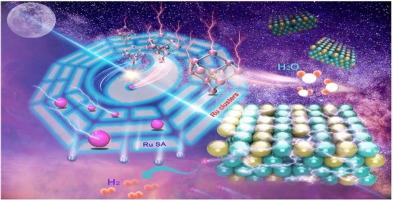
A hydrogen spillover-bridged water dissociation/hydrogen formation could concurrently promote Volmer/Tafel process and improve the efficiency of hydrogen evolution reaction (HER) under alkaline conditions. However, it is still challenging to promote occurrence of hydrogen spillover for the large interfacial transport barriers of H2O and hydrogen on active sites. Herein, the strategy of energy barrier gradient to induce hydrogen spillover was proposed by constructing Ru nanoclusters coupled with single atom onto oxygen vacancy cerium dioxide (Ru/CeO2-Ov-2). Density functional theory (DFT) calculations uncover that the adsorption/desorption of H2O occurs at the Ru clusters sites and then the dissociated H* spontaneously overflows from Ru clusters with high binding energy into the adjacent Ru single atom sites with low binding energy, which facilitate the hydrogen formation. Consequently, the synthesized Ru/CeO2-Ov-2 exhibits a small overpotential of 41 mV at 10 mA cm−2 and good stability at 500 mA cm−2 for 100 h in alkaline seawater, which could be ascribed to the rapid hydrogen spillover and strong coupling interaction between Ru and CeO2-OV. This work provides a novel insight that synthesizing cooperative sites with energy barrier gradient helps to promote hydrogen spillover and accelerate the Volmer/Tafel process of HER.
在碱性条件下,氢溢出桥式水解离/制氢可同时促进Volmer/Tafel过程,提高析氢反应(HER)效率。然而,由于活性位点上H2O和氢气的界面输运障碍较大,促进氢溢出的发生仍然具有挑战性。本文提出了在氧空位二氧化铈(Ru/CeO2-Ov-2)上构建单原子钌纳米团簇,利用能量势垒梯度诱导氢溢出的策略。密度泛函理论(DFT)计算发现,H2O的吸附/解吸发生在Ru团簇的位置,然后解离的H*自发地从具有高结合能的Ru团簇中溢出到相邻的具有低结合能的Ru单原子位置,从而促进了氢的形成。结果表明,Ru/ CeO2-OV -2在10 mA cm -2条件下具有41 mV的过电位,在500 mA cm -2条件下具有良好的稳定性,可在碱性海水中维持100 h,这可归因于Ru与CeO2-OV之间的快速氢溢出和强耦合作用。本研究提供了一个新的见解,即合成具有能量势垒梯度的合作位点有助于促进氢溢出和加速HER的Volmer/Tafel过程。
期刊介绍:
The Journal of Energy Chemistry, the official publication of Science Press and the Dalian Institute of Chemical Physics, Chinese Academy of Sciences, serves as a platform for reporting creative research and innovative applications in energy chemistry. It mainly reports on creative researches and innovative applications of chemical conversions of fossil energy, carbon dioxide, electrochemical energy and hydrogen energy, as well as the conversions of biomass and solar energy related with chemical issues to promote academic exchanges in the field of energy chemistry and to accelerate the exploration, research and development of energy science and technologies.
This journal focuses on original research papers covering various topics within energy chemistry worldwide, including:
Optimized utilization of fossil energy
Hydrogen energy
Conversion and storage of electrochemical energy
Capture, storage, and chemical conversion of carbon dioxide
Materials and nanotechnologies for energy conversion and storage
Chemistry in biomass conversion
Chemistry in the utilization of solar energy



 京公网安备 11010802042870号
京ICP备2023020795号-1
京公网安备 11010802042870号
京ICP备2023020795号-1

 分享
分享
 求助内容:
求助内容: 应助结果提醒方式:
 扫码关注我们
