{"title":"The meaning of Benthic Ecological Quality status through a warm temperate South African estuary and in a contained blind-ending marina","authors":"R.S.K. Barnes , J.L. Seath","doi":"10.1016/j.ocecoaman.2025.107550","DOIUrl":null,"url":null,"abstract":"<div><div>Successful management relies on accurate information on local environmental health. A typical macrofaunal assemblage-composition index, the BO2A (Benthic Opportunist Annelids Amphipods) considered to quantify benthic estuarine quality particularly well, was measured throughout the Knysna estuarine system (the one with the highest South African biodiversity and conservation rating, and considered 'largely natural with few modifications'), including in a blind-ending small-boat harbour. All index levels were represented across its intertidal and subtidal areas of bare sediment and seagrass beds, from <0.001 (='high' quality) to 0.240 (='poor' quality). Overall, BO2A did indeed suggest 'good' ecological quality. Nevertheless, only 25% of individual sites displayed 'high' quality; most were rated at the lower levels normally taken to indicate some degree of environmental degradation. The abundance of opportunistic annelids, which averaged 1153 m<sup>−2</sup> (16% of total macrofaunal numbers), did not vary along its longitudinal axis, and neither did the index. BO2A proved directly related to log[<em>p</em>/(1-<em>p</em>)] where <em>p</em> = proportion of just the opportunistic annelids. As in other equivalent marinas, these annelids also dominated the small-boat harbour, and this showed some evidence of faunal impoverishment relative to adjacent backwaters but its benthos displayed little relationship with the degree of faunal confinement. The record of a spadellid chaetognath from the harbour access channel appears to be the first from Africa. As predicted by the Estuarine Quality Paradox, being based on the questionable assumption that the presence of certain animals considered to be opportunistic indicates unnatural, degraded conditions, macrofaunal composition indices do not contribute unambiguous data to the environmental assessment of brackish-water habitats.</div></div>","PeriodicalId":54698,"journal":{"name":"Ocean & Coastal Management","volume":"262 ","pages":"Article 107550"},"PeriodicalIF":5.4000,"publicationDate":"2025-03-01","publicationTypes":"Journal Article","fieldsOfStudy":null,"isOpenAccess":false,"openAccessPdf":"","citationCount":"0","resultStr":null,"platform":"Semanticscholar","paperid":null,"PeriodicalName":"Ocean & Coastal Management","FirstCategoryId":"93","ListUrlMain":"https://www.sciencedirect.com/science/article/pii/S0964569125000122","RegionNum":2,"RegionCategory":"环境科学与生态学","ArticlePicture":[],"TitleCN":null,"AbstractTextCN":null,"PMCID":null,"EPubDate":"2025/1/24 0:00:00","PubModel":"Epub","JCR":"Q1","JCRName":"OCEANOGRAPHY","Score":null,"Total":0}
引用次数: 0
Abstract
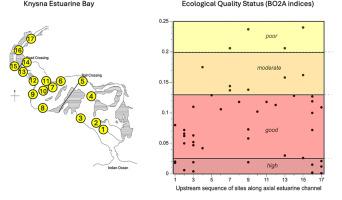
Successful management relies on accurate information on local environmental health. A typical macrofaunal assemblage-composition index, the BO2A (Benthic Opportunist Annelids Amphipods) considered to quantify benthic estuarine quality particularly well, was measured throughout the Knysna estuarine system (the one with the highest South African biodiversity and conservation rating, and considered 'largely natural with few modifications'), including in a blind-ending small-boat harbour. All index levels were represented across its intertidal and subtidal areas of bare sediment and seagrass beds, from <0.001 (='high' quality) to 0.240 (='poor' quality). Overall, BO2A did indeed suggest 'good' ecological quality. Nevertheless, only 25% of individual sites displayed 'high' quality; most were rated at the lower levels normally taken to indicate some degree of environmental degradation. The abundance of opportunistic annelids, which averaged 1153 m−2 (16% of total macrofaunal numbers), did not vary along its longitudinal axis, and neither did the index. BO2A proved directly related to log[p/(1-p)] where p = proportion of just the opportunistic annelids. As in other equivalent marinas, these annelids also dominated the small-boat harbour, and this showed some evidence of faunal impoverishment relative to adjacent backwaters but its benthos displayed little relationship with the degree of faunal confinement. The record of a spadellid chaetognath from the harbour access channel appears to be the first from Africa. As predicted by the Estuarine Quality Paradox, being based on the questionable assumption that the presence of certain animals considered to be opportunistic indicates unnatural, degraded conditions, macrofaunal composition indices do not contribute unambiguous data to the environmental assessment of brackish-water habitats.
期刊介绍:
Ocean & Coastal Management is the leading international journal dedicated to the study of all aspects of ocean and coastal management from the global to local levels.
We publish rigorously peer-reviewed manuscripts from all disciplines, and inter-/trans-disciplinary and co-designed research, but all submissions must make clear the relevance to management and/or governance issues relevant to the sustainable development and conservation of oceans and coasts.
Comparative studies (from sub-national to trans-national cases, and other management / policy arenas) are encouraged, as are studies that critically assess current management practices and governance approaches. Submissions involving robust analysis, development of theory, and improvement of management practice are especially welcome.



 京公网安备 11010802042870号
京ICP备2023020795号-1
京公网安备 11010802042870号
京ICP备2023020795号-1

 分享
分享
 求助内容:
求助内容: 应助结果提醒方式:
 扫码关注我们
