Lei Xu;Danya Xu;Xinlei Yi;Chao Deng;Tianyou Chai;Tao Yang
{"title":"Decentralized Federated Learning Algorithm Under Adversary Eavesdropping","authors":"Lei Xu;Danya Xu;Xinlei Yi;Chao Deng;Tianyou Chai;Tao Yang","doi":"10.1109/JAS.2024.125079","DOIUrl":null,"url":null,"abstract":"In this paper, we study the decentralized federated learning problem, which involves the collaborative training of a global model among multiple devices while ensuring data privacy. In classical federated learning, the communication channel between the devices poses a potential risk of compromising private information. To reduce the risk of adversary eavesdropping in the communication channel, we propose TRADE (transmit difference weight) concept. This concept replaces the decentralized federated learning algorithm's transmitted weight parameters with differential weight parameters, enhancing the privacy data against eavesdropping. Subsequently, by integrating the TRADE concept with the primal-dual stochastic gradient descent (SGD) algorithm, we propose a decentralized TRADE primal-dual SGD algorithm. We demonstrate that our proposed algorithm's convergence properties are the same as those of the primal-dual SGD algorithm while providing enhanced privacy protection. We validate the algorithm's performance on fault diagnosis task using the Case Western Reserve University dataset, and image classification tasks using the CIFAR-10 and CIFAR-100 datasets, revealing model accuracy comparable to centralized federated learning. Additionally, the experiments confirm the algorithm's privacy protection capability.","PeriodicalId":54230,"journal":{"name":"Ieee-Caa Journal of Automatica Sinica","volume":"12 2","pages":"448-456"},"PeriodicalIF":19.2000,"publicationDate":"2025-01-20","publicationTypes":"Journal Article","fieldsOfStudy":null,"isOpenAccess":false,"openAccessPdf":"","citationCount":"0","resultStr":null,"platform":"Semanticscholar","paperid":null,"PeriodicalName":"Ieee-Caa Journal of Automatica Sinica","FirstCategoryId":"94","ListUrlMain":"https://ieeexplore.ieee.org/document/10846932/","RegionNum":1,"RegionCategory":"计算机科学","ArticlePicture":[],"TitleCN":null,"AbstractTextCN":null,"PMCID":null,"EPubDate":"","PubModel":"","JCR":"Q1","JCRName":"AUTOMATION & CONTROL SYSTEMS","Score":null,"Total":0}
引用次数: 0
Abstract
In this paper, we study the decentralized federated learning problem, which involves the collaborative training of a global model among multiple devices while ensuring data privacy. In classical federated learning, the communication channel between the devices poses a potential risk of compromising private information. To reduce the risk of adversary eavesdropping in the communication channel, we propose TRADE (transmit difference weight) concept. This concept replaces the decentralized federated learning algorithm's transmitted weight parameters with differential weight parameters, enhancing the privacy data against eavesdropping. Subsequently, by integrating the TRADE concept with the primal-dual stochastic gradient descent (SGD) algorithm, we propose a decentralized TRADE primal-dual SGD algorithm. We demonstrate that our proposed algorithm's convergence properties are the same as those of the primal-dual SGD algorithm while providing enhanced privacy protection. We validate the algorithm's performance on fault diagnosis task using the Case Western Reserve University dataset, and image classification tasks using the CIFAR-10 and CIFAR-100 datasets, revealing model accuracy comparable to centralized federated learning. Additionally, the experiments confirm the algorithm's privacy protection capability.
期刊介绍:
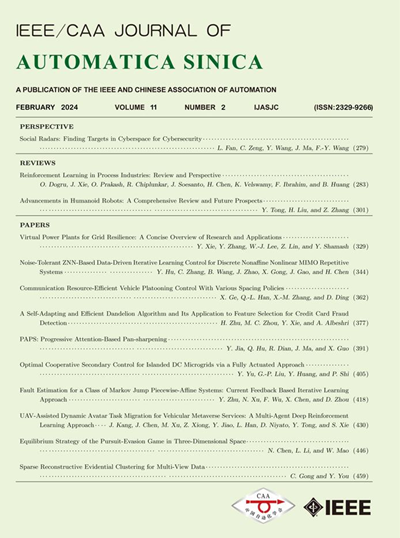
The IEEE/CAA Journal of Automatica Sinica is a reputable journal that publishes high-quality papers in English on original theoretical/experimental research and development in the field of automation. The journal covers a wide range of topics including automatic control, artificial intelligence and intelligent control, systems theory and engineering, pattern recognition and intelligent systems, automation engineering and applications, information processing and information systems, network-based automation, robotics, sensing and measurement, and navigation, guidance, and control.
Additionally, the journal is abstracted/indexed in several prominent databases including SCIE (Science Citation Index Expanded), EI (Engineering Index), Inspec, Scopus, SCImago, DBLP, CNKI (China National Knowledge Infrastructure), CSCD (Chinese Science Citation Database), and IEEE Xplore.



 京公网安备 11010802042870号
京ICP备2023020795号-1
京公网安备 11010802042870号
京ICP备2023020795号-1

 分享
分享
 求助内容:
求助内容: 应助结果提醒方式:
 扫码关注我们
