{"title":"Exploring the efficacy of green nanoparticles in enhancing plant defense: a mechanistic investigation into immune response activation","authors":"Himanshu Joshi","doi":"10.1007/s11051-025-06226-0","DOIUrl":null,"url":null,"abstract":"<div><p>Green nanoparticles (GNPs), biosynthesized using environment-friendly means, are attractive candidates for enhancing plant productivity and boosting sustainable agriculture. The article discusses the significant benefits that green nanoparticles bring to plant health by enhancing their defense mechanisms. GNPs, derived from natural sources, can interact with plant cells, leading to the induction of a cascade of defense responses. Entry of GNPs in plant cells leads to activation pattern recognition receptors (PRRs), leading to the production of reactive oxygen species (ROS) and the subsequent activation of defense-related genes. In addition, GNPs also induce systemic acquired resistance (SAR) as well as induced systemic resistance (ISR), priming the plant for augmenting defense against a wide range of pathogens. Additionally, GNPs interact with plant hormone pathways, altering the levels of phytohormones, including salicylic acid, jasmonic acid, and ethylene, resulting in optimized immune response. Additionally, the current review also elucidates the advantages of using green nanoparticles to increase disease resistance, improve pest management, and advance sustainable agriculture, highlighting their edge over traditional methods. The article discusses the challenges of formulating green nanoparticles for their optimization to make them cost-effective and points out promising future directions in this field. Furthermore, the review focuses on the beneficial role of gold nanoparticles in protecting plants, including their role in the plant’s immune system. The present study also highlights the relation between systemic acquired resistance and induced systemic resistance and its role in prompting these plant responses.</p></div>","PeriodicalId":653,"journal":{"name":"Journal of Nanoparticle Research","volume":"27 2","pages":""},"PeriodicalIF":2.6000,"publicationDate":"2025-01-24","publicationTypes":"Journal Article","fieldsOfStudy":null,"isOpenAccess":false,"openAccessPdf":"https://link.springer.com/content/pdf/10.1007/s11051-025-06226-0.pdf","citationCount":"0","resultStr":null,"platform":"Semanticscholar","paperid":null,"PeriodicalName":"Journal of Nanoparticle Research","FirstCategoryId":"88","ListUrlMain":"https://link.springer.com/article/10.1007/s11051-025-06226-0","RegionNum":4,"RegionCategory":"材料科学","ArticlePicture":[],"TitleCN":null,"AbstractTextCN":null,"PMCID":null,"EPubDate":"","PubModel":"","JCR":"Q3","JCRName":"CHEMISTRY, MULTIDISCIPLINARY","Score":null,"Total":0}
引用次数: 0
Abstract
Green nanoparticles (GNPs), biosynthesized using environment-friendly means, are attractive candidates for enhancing plant productivity and boosting sustainable agriculture. The article discusses the significant benefits that green nanoparticles bring to plant health by enhancing their defense mechanisms. GNPs, derived from natural sources, can interact with plant cells, leading to the induction of a cascade of defense responses. Entry of GNPs in plant cells leads to activation pattern recognition receptors (PRRs), leading to the production of reactive oxygen species (ROS) and the subsequent activation of defense-related genes. In addition, GNPs also induce systemic acquired resistance (SAR) as well as induced systemic resistance (ISR), priming the plant for augmenting defense against a wide range of pathogens. Additionally, GNPs interact with plant hormone pathways, altering the levels of phytohormones, including salicylic acid, jasmonic acid, and ethylene, resulting in optimized immune response. Additionally, the current review also elucidates the advantages of using green nanoparticles to increase disease resistance, improve pest management, and advance sustainable agriculture, highlighting their edge over traditional methods. The article discusses the challenges of formulating green nanoparticles for their optimization to make them cost-effective and points out promising future directions in this field. Furthermore, the review focuses on the beneficial role of gold nanoparticles in protecting plants, including their role in the plant’s immune system. The present study also highlights the relation between systemic acquired resistance and induced systemic resistance and its role in prompting these plant responses.
期刊介绍:
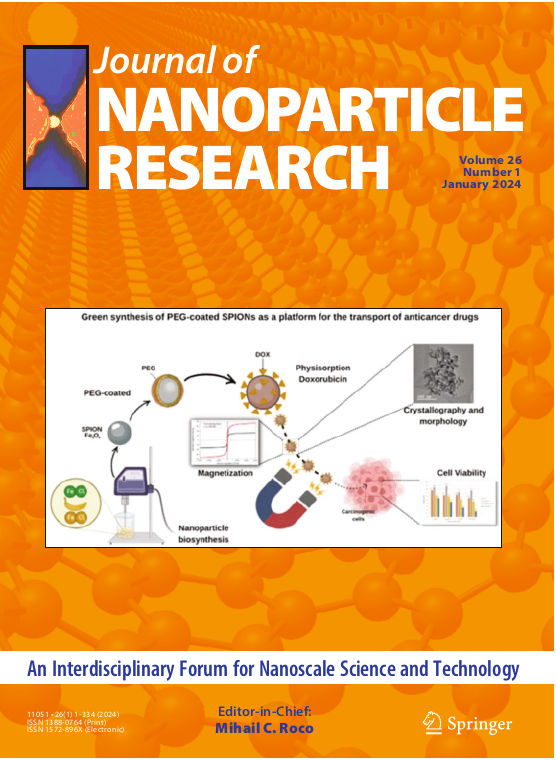
The objective of the Journal of Nanoparticle Research is to disseminate knowledge of the physical, chemical and biological phenomena and processes in structures that have at least one lengthscale ranging from molecular to approximately 100 nm (or submicron in some situations), and exhibit improved and novel properties that are a direct result of their small size.
Nanoparticle research is a key component of nanoscience, nanoengineering and nanotechnology.
The focus of the Journal is on the specific concepts, properties, phenomena, and processes related to particles, tubes, layers, macromolecules, clusters and other finite structures of the nanoscale size range. Synthesis, assembly, transport, reactivity, and stability of such structures are considered. Development of in-situ and ex-situ instrumentation for characterization of nanoparticles and their interfaces should be based on new principles for probing properties and phenomena not well understood at the nanometer scale. Modeling and simulation may include atom-based quantum mechanics; molecular dynamics; single-particle, multi-body and continuum based models; fractals; other methods suitable for modeling particle synthesis, assembling and interaction processes. Realization and application of systems, structures and devices with novel functions obtained via precursor nanoparticles is emphasized. Approaches may include gas-, liquid-, solid-, and vacuum-based processes, size reduction, chemical- and bio-self assembly. Contributions include utilization of nanoparticle systems for enhancing a phenomenon or process and particle assembling into hierarchical structures, as well as formulation and the administration of drugs. Synergistic approaches originating from different disciplines and technologies, and interaction between the research providers and users in this field, are encouraged.



 京公网安备 11010802042870号
京ICP备2023020795号-1
京公网安备 11010802042870号
京ICP备2023020795号-1

 分享
分享
 求助内容:
求助内容: 应助结果提醒方式:
 扫码关注我们
