{"title":"Rapid Dye Loading Techniques in Dye-Sensitized Solar Cells","authors":"Ganapathi Rao Kandregula, Sudip Mandal, Vasudevarao Pasala","doi":"10.1002/slct.202400082","DOIUrl":null,"url":null,"abstract":"<p>Dye-sensitized solar cells (DSSCs) greatly impacted researchers because of their inexpensive materials (organic/inorganic-based molecules) and relatively simple fabrication process. The fabrication of DSSCs possesses donor-acceptor type light-harvesting materials and simple manufacturing techniques; the technology is the most environmentally friendly. In the process of preparing photoanode, adsorption of dye on the TiO<sub>2</sub> is one of the crucial and time-consuming processes. The conventional method of dye adsorption is carried out by dipping the FTO/TiO<sub>2</sub> electrodes in dye solution for 12 to 48 h. In the DSSCs literature, very few techniques were explored to reduce the dye loading time. This review focuses on various dye loading methods, such as electrical adsorption, spray coating, microwave-assisted ultrasonication, functionalized carboxylate deposition, solution dropping, and electrosorption, and so on. and their consequences in influencing the power conversion efficiency of DSSCs. Dipping and evaporation, solution dropping method, and gas bubbling soaking are inexpensive methods for dye loading. However, the electrochemical methods provide enhanced dye loading within an optimum duration resulting in the improvement of PCE as compared to rest of the methods.</p>","PeriodicalId":146,"journal":{"name":"ChemistrySelect","volume":"10 5","pages":""},"PeriodicalIF":2.0000,"publicationDate":"2025-02-03","publicationTypes":"Journal Article","fieldsOfStudy":null,"isOpenAccess":false,"openAccessPdf":"","citationCount":"0","resultStr":null,"platform":"Semanticscholar","paperid":null,"PeriodicalName":"ChemistrySelect","FirstCategoryId":"92","ListUrlMain":"https://chemistry-europe.onlinelibrary.wiley.com/doi/10.1002/slct.202400082","RegionNum":4,"RegionCategory":"化学","ArticlePicture":[],"TitleCN":null,"AbstractTextCN":null,"PMCID":null,"EPubDate":"","PubModel":"","JCR":"Q3","JCRName":"CHEMISTRY, MULTIDISCIPLINARY","Score":null,"Total":0}
引用次数: 0
Abstract
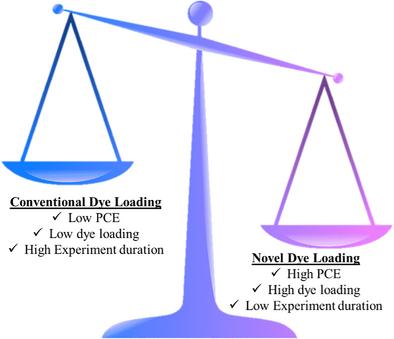
Dye-sensitized solar cells (DSSCs) greatly impacted researchers because of their inexpensive materials (organic/inorganic-based molecules) and relatively simple fabrication process. The fabrication of DSSCs possesses donor-acceptor type light-harvesting materials and simple manufacturing techniques; the technology is the most environmentally friendly. In the process of preparing photoanode, adsorption of dye on the TiO2 is one of the crucial and time-consuming processes. The conventional method of dye adsorption is carried out by dipping the FTO/TiO2 electrodes in dye solution for 12 to 48 h. In the DSSCs literature, very few techniques were explored to reduce the dye loading time. This review focuses on various dye loading methods, such as electrical adsorption, spray coating, microwave-assisted ultrasonication, functionalized carboxylate deposition, solution dropping, and electrosorption, and so on. and their consequences in influencing the power conversion efficiency of DSSCs. Dipping and evaporation, solution dropping method, and gas bubbling soaking are inexpensive methods for dye loading. However, the electrochemical methods provide enhanced dye loading within an optimum duration resulting in the improvement of PCE as compared to rest of the methods.
期刊介绍:
ChemistrySelect is the latest journal from ChemPubSoc Europe and Wiley-VCH. It offers researchers a quality society-owned journal in which to publish their work in all areas of chemistry. Manuscripts are evaluated by active researchers to ensure they add meaningfully to the scientific literature, and those accepted are processed quickly to ensure rapid online publication.







 京公网安备 11010802042870号
京ICP备2023020795号-1
京公网安备 11010802042870号
京ICP备2023020795号-1

 分享
分享
 求助内容:
求助内容: 应助结果提醒方式:
 扫码关注我们
