Humberto Blanco-Canqui, Sabrina J. Ruis, Mitiku Mamo, Charles A. Shapiro, Christopher Proctor, Jay Parsons, Laura Thompson
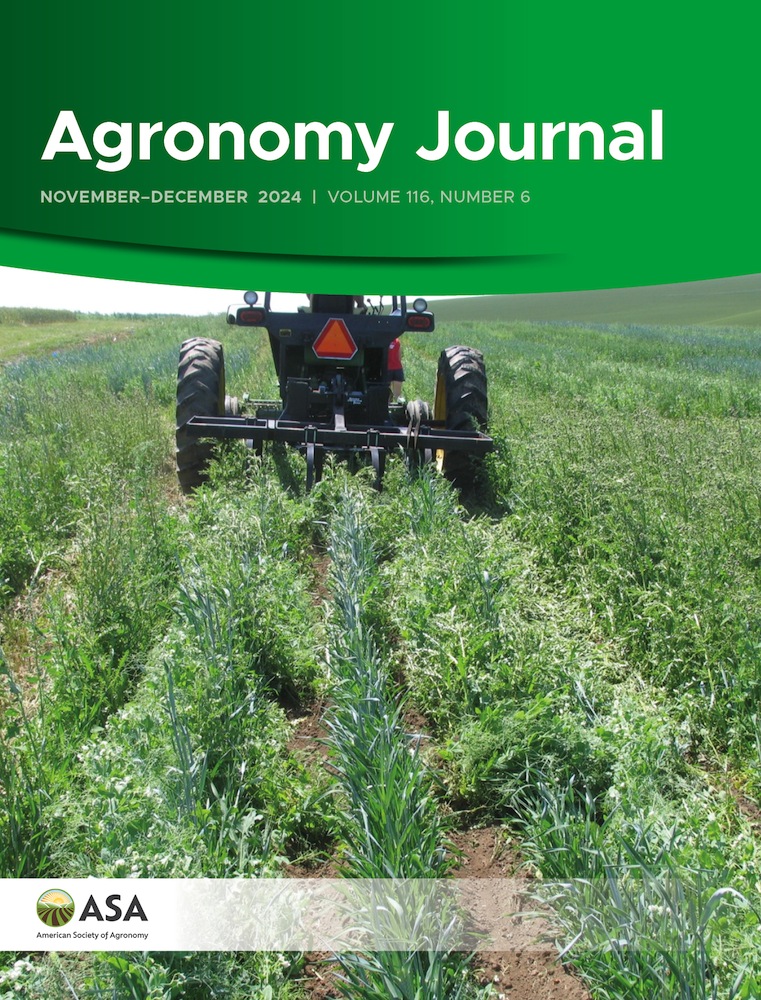
{"title":"Interseeding cover crop into an irrigated sandy loam for 6 years: Soil, crop, and economic response","authors":"Humberto Blanco-Canqui, Sabrina J. Ruis, Mitiku Mamo, Charles A. Shapiro, Christopher Proctor, Jay Parsons, Laura Thompson","doi":"10.1002/agj2.70013","DOIUrl":null,"url":null,"abstract":"<p>Interseeding cover crops (CCs) may be a potential strategy to manage sandy soils, which are highly prone to degradation. However, how this practice affects CC biomass production and other ecosystem services in sandy soils over the traditional CC planting system (post-harvest drilling) is still unclear. We studied how broadcast interseeded (32–67 days before crop harvest) winter rye (<i>Secale cereale</i> L.) CC affected CC biomass production, nitrate leaching potential, soil properties, crop yields, and farm income compared with post-harvest drilled CC in an on-farm irrigated no-till corn (<i>Zea mays</i> L.)–soybean (<i>Glycine max</i> L.) experiment in a sandy loam in the western US Corn Belt for 6 years. Across the 6 years, interseeded CC produced 0.57 Mg ha<sup>−1</sup> of biomass, while post-harvest drilled CC produced 0.37 Mg ha<sup>−1</sup>. Nitrate leaching is a concern in sandy soils, but interseeded CC had mixed effects on soil nitrate concentration. Interseeded CC did not affect soil properties (particulate organic matter and organic C concentrations, and wet aggregate stability) and crop yields. Further, interseeded CC did not reduce farm income more than post-harvest drilled CC. The limited effect of interseeded CCs is likely due to the relatively small increase in CC biomass production over the traditional CC planting system. Additional strategies including irrigation, drill interseeding, and planting green may boost interseeded CC biomass production and thus soil services in sandy soils. After 6 years, interseeded CC slightly boosted CC biomass production but minimally affected soils and crops, and both interseeded and post-harvest-drilled CCs reduced net income.</p>","PeriodicalId":7522,"journal":{"name":"Agronomy Journal","volume":"117 1","pages":""},"PeriodicalIF":2.0000,"publicationDate":"2025-01-19","publicationTypes":"Journal Article","fieldsOfStudy":null,"isOpenAccess":false,"openAccessPdf":"https://onlinelibrary.wiley.com/doi/epdf/10.1002/agj2.70013","citationCount":"0","resultStr":null,"platform":"Semanticscholar","paperid":null,"PeriodicalName":"Agronomy Journal","FirstCategoryId":"97","ListUrlMain":"https://acsess.onlinelibrary.wiley.com/doi/10.1002/agj2.70013","RegionNum":3,"RegionCategory":"农林科学","ArticlePicture":[],"TitleCN":null,"AbstractTextCN":null,"PMCID":null,"EPubDate":"","PubModel":"","JCR":"Q2","JCRName":"AGRONOMY","Score":null,"Total":0}
引用次数: 0
Abstract
Interseeding cover crops (CCs) may be a potential strategy to manage sandy soils, which are highly prone to degradation. However, how this practice affects CC biomass production and other ecosystem services in sandy soils over the traditional CC planting system (post-harvest drilling) is still unclear. We studied how broadcast interseeded (32–67 days before crop harvest) winter rye (Secale cereale L.) CC affected CC biomass production, nitrate leaching potential, soil properties, crop yields, and farm income compared with post-harvest drilled CC in an on-farm irrigated no-till corn (Zea mays L.)–soybean (Glycine max L.) experiment in a sandy loam in the western US Corn Belt for 6 years. Across the 6 years, interseeded CC produced 0.57 Mg ha−1 of biomass, while post-harvest drilled CC produced 0.37 Mg ha−1. Nitrate leaching is a concern in sandy soils, but interseeded CC had mixed effects on soil nitrate concentration. Interseeded CC did not affect soil properties (particulate organic matter and organic C concentrations, and wet aggregate stability) and crop yields. Further, interseeded CC did not reduce farm income more than post-harvest drilled CC. The limited effect of interseeded CCs is likely due to the relatively small increase in CC biomass production over the traditional CC planting system. Additional strategies including irrigation, drill interseeding, and planting green may boost interseeded CC biomass production and thus soil services in sandy soils. After 6 years, interseeded CC slightly boosted CC biomass production but minimally affected soils and crops, and both interseeded and post-harvest-drilled CCs reduced net income.
间种覆盖作物(CCs)可能是治理沙质土壤的一种潜在策略,沙质土壤极易退化。然而,与传统的CC种植系统(收获后钻孔)相比,这种做法如何影响砂质土壤中CC的生物量生产和其他生态系统服务仍不清楚。研究了冬黑麦(Secale cereale L.)在收获前32 ~ 67天播撒间种的方法。在美国西部玉米带的砂质壤土中进行了为期6年的免耕玉米(Zea mays L.) -大豆(Glycine max L.)试验,与收获后钻施免耕玉米(CC)相比,CC影响了CC生物量、硝酸盐淋溶潜力、土壤性质、作物产量和农场收入。6年间,杂交CC产生的生物量为0.57 Mg ha - 1,而收获后钻孔CC产生的生物量为0.37 Mg ha - 1。硝态氮的淋溶是沙质土壤中一个值得关注的问题,但杂交CC对土壤硝态氮浓度的影响是混合的。间种CC对土壤性质(颗粒有机质和有机C浓度、湿团聚体稳定性)和作物产量没有影响。此外,间种CC对农场收入的减少并不比收获后钻孔CC多。间种CC的有限影响可能是由于与传统CC种植系统相比,间种CC的生物量产量增加相对较小。其他策略包括灌溉、钻孔间种和绿色种植,可以提高间种的CC生物量产量,从而提高沙质土壤的土壤服务。6年后,间种的CC略微提高了CC的生物量,但对土壤和作物的影响最小,间种和收获后钻取的CC都减少了净收入。
期刊介绍:
After critical review and approval by the editorial board, AJ publishes articles reporting research findings in soil–plant relationships; crop science; soil science; biometry; crop, soil, pasture, and range management; crop, forage, and pasture production and utilization; turfgrass; agroclimatology; agronomic models; integrated pest management; integrated agricultural systems; and various aspects of entomology, weed science, animal science, plant pathology, and agricultural economics as applied to production agriculture.
Notes are published about apparatus, observations, and experimental techniques. Observations usually are limited to studies and reports of unrepeatable phenomena or other unique circumstances. Review and interpretation papers are also published, subject to standard review. Contributions to the Forum section deal with current agronomic issues and questions in brief, thought-provoking form. Such papers are reviewed by the editor in consultation with the editorial board.





 京公网安备 11010802042870号
京ICP备2023020795号-1
京公网安备 11010802042870号
京ICP备2023020795号-1

 分享
分享
 求助内容:
求助内容: 应助结果提醒方式:
 扫码关注我们
