Tamera Jones, Rehnuma Ahmed, Elizabeth Cieza, Justin M. Pratt, Maia Popova
{"title":"Experiences of marginalized women pursuing doctoral degrees in chemistry: The critical role of recognition","authors":"Tamera Jones, Rehnuma Ahmed, Elizabeth Cieza, Justin M. Pratt, Maia Popova","doi":"10.1002/tea.21986","DOIUrl":null,"url":null,"abstract":"<p>Even though marginalized women are earning more doctoral degrees in chemistry than ever before, the proportion of women who complete chemistry doctorates does not reflect national population trends. Previous research has explored the experiences of marginalized women seeking chemistry doctorate degrees. These studies highlight the issues that marginalized women face but do not explain why they face them or the systemic issues that underpin these experiences. This study captures the firsthand experiences of marginalized domestic and international women (Black, Hispanic/Latina, Asian, Pacific Islander, and Indigenous) pursuing graduate degrees in chemistry. We conducted semi-structured interviews with 29 participants to understand how their social identities might impact the development of their science identities. Intersectionality and the Science Identity Model informed both the interview guide and the interpretation of our data. Deductive and inductive coding, constant comparative analysis, and thematic analysis were used to examine the interplay between participants' identities and experiences. We found that recognition had a critical impact on women's science identities. Results show that participants received more positive recognition than negative from their academic community. The participants who received mostly positive recognition developed research, teaching, and altruistic science identities. Most of the positive recognition was associated with research accomplishments, which is not surprising since doctoral programs in chemistry focus primarily on research training. Conversely, the participants who received mostly negative forms of recognition developed disrupted science identities. These women described being tokenized, taken advantage of, and having their accomplishments dismissed because of their gender, race, and ethnicity. Additionally, sexist and racist comments surrounding appearance, speech, and demeanor contributed to a diminished sense of being taken seriously and, consequently, feeling less like a scientist.</p>","PeriodicalId":48369,"journal":{"name":"Journal of Research in Science Teaching","volume":"62 2","pages":"576-609"},"PeriodicalIF":4.5000,"publicationDate":"2024-09-25","publicationTypes":"Journal Article","fieldsOfStudy":null,"isOpenAccess":false,"openAccessPdf":"https://onlinelibrary.wiley.com/doi/epdf/10.1002/tea.21986","citationCount":"0","resultStr":null,"platform":"Semanticscholar","paperid":null,"PeriodicalName":"Journal of Research in Science Teaching","FirstCategoryId":"95","ListUrlMain":"https://onlinelibrary.wiley.com/doi/10.1002/tea.21986","RegionNum":1,"RegionCategory":"教育学","ArticlePicture":[],"TitleCN":null,"AbstractTextCN":null,"PMCID":null,"EPubDate":"","PubModel":"","JCR":"Q1","JCRName":"EDUCATION & EDUCATIONAL RESEARCH","Score":null,"Total":0}
引用次数: 0
Abstract
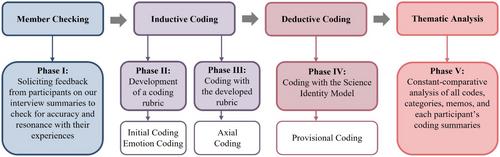
Even though marginalized women are earning more doctoral degrees in chemistry than ever before, the proportion of women who complete chemistry doctorates does not reflect national population trends. Previous research has explored the experiences of marginalized women seeking chemistry doctorate degrees. These studies highlight the issues that marginalized women face but do not explain why they face them or the systemic issues that underpin these experiences. This study captures the firsthand experiences of marginalized domestic and international women (Black, Hispanic/Latina, Asian, Pacific Islander, and Indigenous) pursuing graduate degrees in chemistry. We conducted semi-structured interviews with 29 participants to understand how their social identities might impact the development of their science identities. Intersectionality and the Science Identity Model informed both the interview guide and the interpretation of our data. Deductive and inductive coding, constant comparative analysis, and thematic analysis were used to examine the interplay between participants' identities and experiences. We found that recognition had a critical impact on women's science identities. Results show that participants received more positive recognition than negative from their academic community. The participants who received mostly positive recognition developed research, teaching, and altruistic science identities. Most of the positive recognition was associated with research accomplishments, which is not surprising since doctoral programs in chemistry focus primarily on research training. Conversely, the participants who received mostly negative forms of recognition developed disrupted science identities. These women described being tokenized, taken advantage of, and having their accomplishments dismissed because of their gender, race, and ethnicity. Additionally, sexist and racist comments surrounding appearance, speech, and demeanor contributed to a diminished sense of being taken seriously and, consequently, feeling less like a scientist.
期刊介绍:
Journal of Research in Science Teaching, the official journal of NARST: A Worldwide Organization for Improving Science Teaching and Learning Through Research, publishes reports for science education researchers and practitioners on issues of science teaching and learning and science education policy. Scholarly manuscripts within the domain of the Journal of Research in Science Teaching include, but are not limited to, investigations employing qualitative, ethnographic, historical, survey, philosophical, case study research, quantitative, experimental, quasi-experimental, data mining, and data analytics approaches; position papers; policy perspectives; critical reviews of the literature; and comments and criticism.




 京公网安备 11010802042870号
京ICP备2023020795号-1
京公网安备 11010802042870号
京ICP备2023020795号-1

 分享
分享
 求助内容:
求助内容: 应助结果提醒方式:
 扫码关注我们
