{"title":"Hormesis as a Hidden Hand in Global Environmental Change?","authors":"Matthias C. Rillig, Anika Lehmann, Mohan Bi","doi":"10.1021/acs.est.5c01101","DOIUrl":null,"url":null,"abstract":"Figure 1. (A) Hormetic responses mean a response to a negative influence is positive at very low doses. (B) If widespread, such hermetic effects could lead to ecosystem process rates being affected, leading to an overestimation or underestimation of the effect of other factors of global change. (C) When environmental drivers are exceeding the hormetic threshold, the ecosystem state can undergo a transition from a stable state to an unstable state. M.C.R. wrote the first draft of the paper, and M.B. and A.L. added additional ideas and designed the figure. Matthias C. Rillig studied biology in Germany and Scotland and obtained a Ph.D. in California, USA. After nine years of being on the faculty of the University of Montana, he joined Freie Universität Berlin, where he is now a professor of ecology. He is director of the Berlin-Brandenburg Institute of Advanced Biodiversity Research. Matthias won an Advanced Grant of the European Research Council, is a fellow of the Ecological Society of America, and is a member of the German National Academy of Sciences, Leopoldina, and Academia Europaea. His lab focuses on soil ecology, human-caused effects on soils and their biodiversity, and emerging environmental challenges. This article references 11 other publications. This article has not yet been cited by other publications.","PeriodicalId":36,"journal":{"name":"环境科学与技术","volume":"5 1","pages":""},"PeriodicalIF":11.3000,"publicationDate":"2025-02-05","publicationTypes":"Journal Article","fieldsOfStudy":null,"isOpenAccess":false,"openAccessPdf":"","citationCount":"0","resultStr":null,"platform":"Semanticscholar","paperid":null,"PeriodicalName":"环境科学与技术","FirstCategoryId":"1","ListUrlMain":"https://doi.org/10.1021/acs.est.5c01101","RegionNum":1,"RegionCategory":"环境科学与生态学","ArticlePicture":[],"TitleCN":null,"AbstractTextCN":null,"PMCID":null,"EPubDate":"","PubModel":"","JCR":"Q1","JCRName":"ENGINEERING, ENVIRONMENTAL","Score":null,"Total":0}
引用次数: 0
Abstract
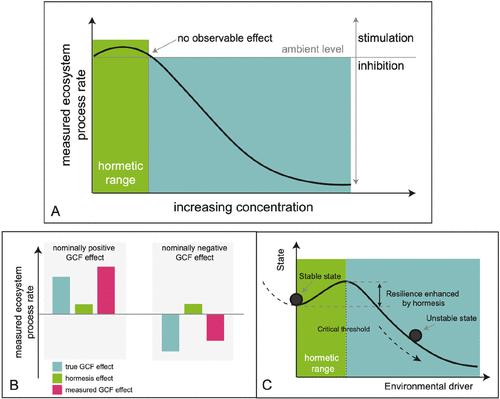
Figure 1. (A) Hormetic responses mean a response to a negative influence is positive at very low doses. (B) If widespread, such hermetic effects could lead to ecosystem process rates being affected, leading to an overestimation or underestimation of the effect of other factors of global change. (C) When environmental drivers are exceeding the hormetic threshold, the ecosystem state can undergo a transition from a stable state to an unstable state. M.C.R. wrote the first draft of the paper, and M.B. and A.L. added additional ideas and designed the figure. Matthias C. Rillig studied biology in Germany and Scotland and obtained a Ph.D. in California, USA. After nine years of being on the faculty of the University of Montana, he joined Freie Universität Berlin, where he is now a professor of ecology. He is director of the Berlin-Brandenburg Institute of Advanced Biodiversity Research. Matthias won an Advanced Grant of the European Research Council, is a fellow of the Ecological Society of America, and is a member of the German National Academy of Sciences, Leopoldina, and Academia Europaea. His lab focuses on soil ecology, human-caused effects on soils and their biodiversity, and emerging environmental challenges. This article references 11 other publications. This article has not yet been cited by other publications.
图1所示。(A)辐照反应是指在极低剂量下对消极影响的反应是积极的。(B)如果这种封闭效应广泛存在,可能导致生态系统过程速率受到影响,导致对全球变化的其他因素的影响的高估或低估。(C)当环境驱动因素超过激能阈值时,生态系统状态可以经历从稳定状态到不稳定状态的过渡。M.C.R.写了论文的初稿,M.B.和A.L.补充了一些想法,并设计了这个图形。Matthias C. Rillig曾在德国和苏格兰学习生物学,并在美国加州获得博士学位。在蒙大拿大学任教九年后,他加入了柏林自由Universität,现在是生态学教授。他是柏林-勃兰登堡高级生物多样性研究所所长。Matthias获得了欧洲研究委员会的高级资助,是美国生态学会的会员,也是德国国家科学院、利奥波迪纳和欧洲科学院的成员。他的实验室专注于土壤生态学,人类对土壤及其生物多样性的影响,以及新出现的环境挑战。本文引用了11个其他出版物。这篇文章尚未被其他出版物引用。
期刊介绍:
Environmental Science & Technology (ES&T) is a co-sponsored academic and technical magazine by the Hubei Provincial Environmental Protection Bureau and the Hubei Provincial Academy of Environmental Sciences.
Environmental Science & Technology (ES&T) holds the status of Chinese core journals, scientific papers source journals of China, Chinese Science Citation Database source journals, and Chinese Academic Journal Comprehensive Evaluation Database source journals. This publication focuses on the academic field of environmental protection, featuring articles related to environmental protection and technical advancements.



 京公网安备 11010802042870号
京ICP备2023020795号-1
京公网安备 11010802042870号
京ICP备2023020795号-1

 分享
分享
 求助内容:
求助内容: 应助结果提醒方式:
 扫码关注我们
