Kaier Shen, Weize Shi, Huimin Song, Chenxi Zheng, Yingjing Yan, Xufeng Hong, Xu Liu, Yun An, Yuanrui Li, Fei Ye, Mengxue He, Guo Ye, Chenyan Ma, Lei Zheng, Peng Gao, Quanquan Pang
{"title":"Solid Catholyte with Regulated Interphase Redox for All-Solid-State Lithium-Sulfur Batteries","authors":"Kaier Shen, Weize Shi, Huimin Song, Chenxi Zheng, Yingjing Yan, Xufeng Hong, Xu Liu, Yun An, Yuanrui Li, Fei Ye, Mengxue He, Guo Ye, Chenyan Ma, Lei Zheng, Peng Gao, Quanquan Pang","doi":"10.1002/adma.202417171","DOIUrl":null,"url":null,"abstract":"<p>All-solid-state lithium-sulfur battery (ASSLSB) is considered one of the ultimate next-generation energy storage technologies due to the expected low cost, high safety, and high specific energy. The high-conductivity and low-modulus sulfide electrolytes hold promise as electrolytes in the cathode (i.e., solid catholytes) for ASSLSBs, but their parasitic decomposition and reactions over cycling lead to degradation of the active material−catholyte interphases and hence limited cycling life. Herein a strategy is described to stabilize the ASSLSBs by regulating the interphase redox reversibility of the sulfide catholyte, which is validated on a new sulfide electrolyte formulated as Li<sub>6+x</sub>P<sub>1−x</sub>W<sub>x</sub>S<sub>5</sub>I (LPWSI). The experiments show that the presence of mixed ionic-electronic conducting WS<sub>2</sub> boosts the Li<sub>4</sub>P<sub>2</sub>S<sub>7</sub>−to−Li<sub>3</sub>PS<sub>4</sub> reaction in the interphase, which prevents irreversible accumulation of impeding P<sub>2</sub>S<sub>7</sub><sup>4−</sup> and thereby improves the catholyte's interphase stability. With the LPWSI catholyte, the ambient-temperature ASSLSB exhibits stable cycling sustaining 92.2% capacity over 400 cycles at C/5 with an initial areal capacity of 1.95 mA h cm<sup>−2</sup>. Furthermore, the cells demonstrate excellent high-rate stability over 1000 cycles at rates of 1C and 2C. The reported strategy contributes to reshaping the understanding of how solid catholyte can function in composite cathodes and provides new guidelines for designing catholyte for high-capacity conversion-based electrodes that involve complex evolution of interphases.</p>","PeriodicalId":114,"journal":{"name":"Advanced Materials","volume":"37 11","pages":""},"PeriodicalIF":26.8000,"publicationDate":"2025-02-05","publicationTypes":"Journal Article","fieldsOfStudy":null,"isOpenAccess":false,"openAccessPdf":"","citationCount":"0","resultStr":null,"platform":"Semanticscholar","paperid":null,"PeriodicalName":"Advanced Materials","FirstCategoryId":"88","ListUrlMain":"https://advanced.onlinelibrary.wiley.com/doi/10.1002/adma.202417171","RegionNum":1,"RegionCategory":"材料科学","ArticlePicture":[],"TitleCN":null,"AbstractTextCN":null,"PMCID":null,"EPubDate":"","PubModel":"","JCR":"Q1","JCRName":"CHEMISTRY, MULTIDISCIPLINARY","Score":null,"Total":0}
引用次数: 0
Abstract
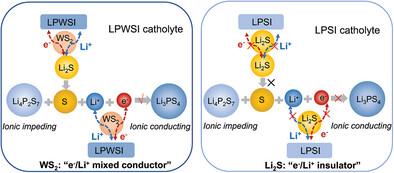
All-solid-state lithium-sulfur battery (ASSLSB) is considered one of the ultimate next-generation energy storage technologies due to the expected low cost, high safety, and high specific energy. The high-conductivity and low-modulus sulfide electrolytes hold promise as electrolytes in the cathode (i.e., solid catholytes) for ASSLSBs, but their parasitic decomposition and reactions over cycling lead to degradation of the active material−catholyte interphases and hence limited cycling life. Herein a strategy is described to stabilize the ASSLSBs by regulating the interphase redox reversibility of the sulfide catholyte, which is validated on a new sulfide electrolyte formulated as Li6+xP1−xWxS5I (LPWSI). The experiments show that the presence of mixed ionic-electronic conducting WS2 boosts the Li4P2S7−to−Li3PS4 reaction in the interphase, which prevents irreversible accumulation of impeding P2S74− and thereby improves the catholyte's interphase stability. With the LPWSI catholyte, the ambient-temperature ASSLSB exhibits stable cycling sustaining 92.2% capacity over 400 cycles at C/5 with an initial areal capacity of 1.95 mA h cm−2. Furthermore, the cells demonstrate excellent high-rate stability over 1000 cycles at rates of 1C and 2C. The reported strategy contributes to reshaping the understanding of how solid catholyte can function in composite cathodes and provides new guidelines for designing catholyte for high-capacity conversion-based electrodes that involve complex evolution of interphases.
全固态锂硫电池(ASSLSB)因其低成本、高安全性和高比能而被认为是下一代储能技术的终极选择之一。高导电性和低模量硫化物电解质有望作为ASSLSBs的阴极电解质(即固体阴极电解质),但它们的寄生分解和循环反应导致活性物质-阴极界面的降解,因此限制了循环寿命。本文描述了一种通过调节硫化物阴极电解质的相间氧化还原可逆性来稳定asslbs的策略,并在新型硫化物电解质Li6+xP1−xWxS5I (LPWSI)上进行了验证。实验表明,混合离子-电子导电WS2的存在促进了间相中Li4P2S7−to−Li3PS4的反应,阻止了阻碍P2S74−的不可逆积累,从而提高了阴极间相的稳定性。使用LPWSI阴极电解质,室温下的ASSLSB表现出稳定的循环,在C/5下循环400次,其初始面积容量为1.95 mA h cm−2,保持92.2%的容量。此外,这些电池在1C和2C的倍率下,在1000次循环中表现出优异的高倍率稳定性。该策略有助于重塑对固体阴极如何在复合阴极中发挥作用的理解,并为设计涉及复杂界面演变的高容量转换电极的阴极提供了新的指导方针。
期刊介绍:
Advanced Materials, one of the world's most prestigious journals and the foundation of the Advanced portfolio, is the home of choice for best-in-class materials science for more than 30 years. Following this fast-growing and interdisciplinary field, we are considering and publishing the most important discoveries on any and all materials from materials scientists, chemists, physicists, engineers as well as health and life scientists and bringing you the latest results and trends in modern materials-related research every week.




 京公网安备 11010802042870号
京ICP备2023020795号-1
京公网安备 11010802042870号
京ICP备2023020795号-1

 分享
分享
 求助内容:
求助内容: 应助结果提醒方式:
 扫码关注我们
