Alan Rosales, Leo O. Blondel, Joshua Hull, Qimeng Gao, Nihal Aykun, Jennifer L. Peek, Alejandra Vargas, Sophia Fergione, Mingqing Song, Matthew H. Wilson, Andrew S. Barbas, Aravind Asokan
{"title":"Evolving adeno-associated viruses for gene transfer to the kidney via cross-species cycling of capsid libraries","authors":"Alan Rosales, Leo O. Blondel, Joshua Hull, Qimeng Gao, Nihal Aykun, Jennifer L. Peek, Alejandra Vargas, Sophia Fergione, Mingqing Song, Matthew H. Wilson, Andrew S. Barbas, Aravind Asokan","doi":"10.1038/s41551-024-01341-0","DOIUrl":null,"url":null,"abstract":"The difficulty of delivering genes to the kidney has limited the translation of genetic medicines, particularly for the more than 10% of the global population with chronic kidney disease. Here we show that new variants of adeno-associated viruses (AAVs) displaying robust and widespread transduction in the kidneys of mice, pigs and non-human-primates can be obtained by evolving capsid libraries via cross-species cycling in different kidney models. Specifically, the new variants, AAV.k13 and AAV.k20, were enriched from the libraries following sequential intravenous cycling through mouse and pig kidneys, ex vivo cycling in human organoid cultures, and ex vivo machine perfusion in isolated kidneys from rhesus macaques. The two variants transduced murine kidneys following intravenous administration, with selective tropism for proximal tubules, and led to markedly higher transgene expression than parental AAV9 vectors in proximal tubule epithelial cells within human organoid cultures and in autotransplanted pig kidneys. Following ureteral delivery, AAV.k20 efficiently transduced kidneys in pigs and macaques. The AAV.k13 and AAV.k20 variants are promising vectors for therapeutic gene-transfer applications in kidney diseases and transplantation. Variants of adeno-associated viruses displaying robust and widespread transduction in murine, porcine and non-human-primate kidneys, and in human kidney organoids, can be obtained via the cross-species cycling of capsid libraries in the different kidney models.","PeriodicalId":19063,"journal":{"name":"Nature Biomedical Engineering","volume":"9 7","pages":"1086-1100"},"PeriodicalIF":26.8000,"publicationDate":"2025-02-05","publicationTypes":"Journal Article","fieldsOfStudy":null,"isOpenAccess":false,"openAccessPdf":"https://www.nature.comhttps://www.nature.com/articles/s41551-024-01341-0.pdf","citationCount":"0","resultStr":null,"platform":"Semanticscholar","paperid":null,"PeriodicalName":"Nature Biomedical Engineering","FirstCategoryId":"5","ListUrlMain":"https://www.nature.com/articles/s41551-024-01341-0","RegionNum":1,"RegionCategory":"医学","ArticlePicture":[],"TitleCN":null,"AbstractTextCN":null,"PMCID":null,"EPubDate":"","PubModel":"","JCR":"Q1","JCRName":"ENGINEERING, BIOMEDICAL","Score":null,"Total":0}
引用次数: 0
Abstract
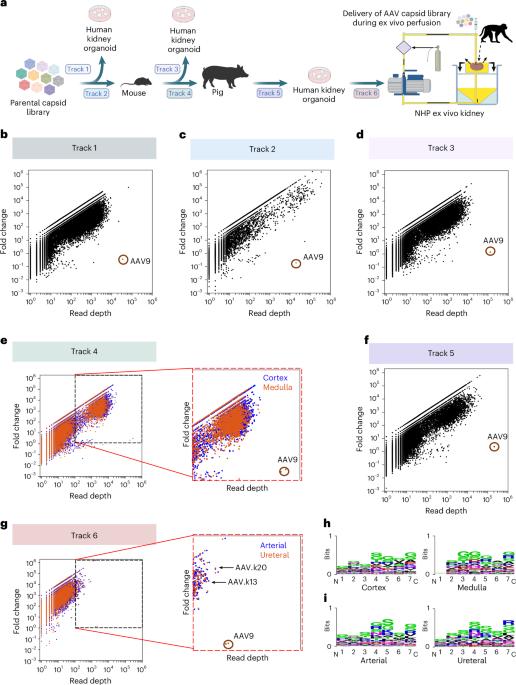
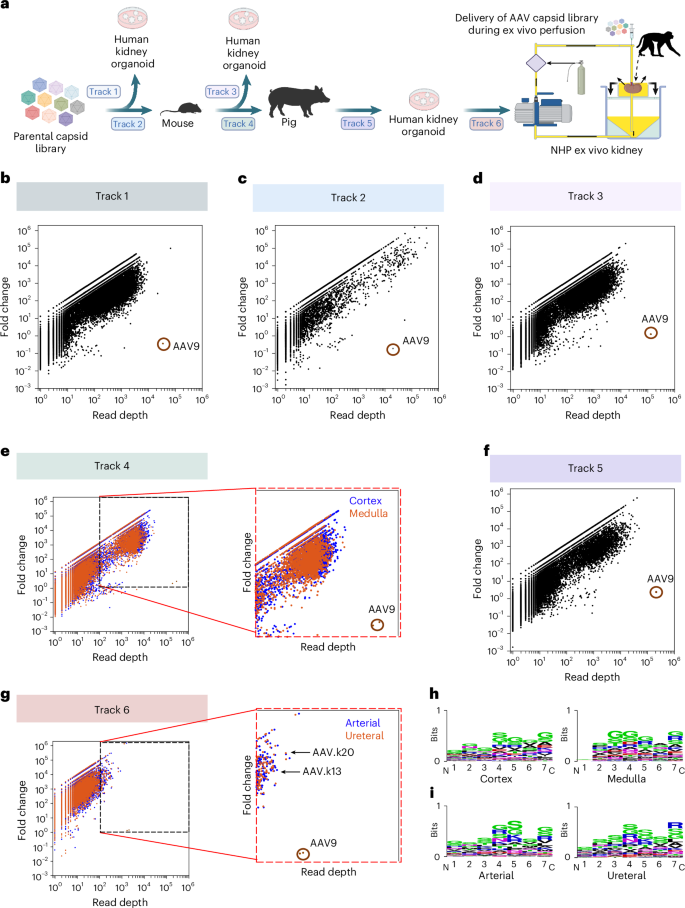
The difficulty of delivering genes to the kidney has limited the translation of genetic medicines, particularly for the more than 10% of the global population with chronic kidney disease. Here we show that new variants of adeno-associated viruses (AAVs) displaying robust and widespread transduction in the kidneys of mice, pigs and non-human-primates can be obtained by evolving capsid libraries via cross-species cycling in different kidney models. Specifically, the new variants, AAV.k13 and AAV.k20, were enriched from the libraries following sequential intravenous cycling through mouse and pig kidneys, ex vivo cycling in human organoid cultures, and ex vivo machine perfusion in isolated kidneys from rhesus macaques. The two variants transduced murine kidneys following intravenous administration, with selective tropism for proximal tubules, and led to markedly higher transgene expression than parental AAV9 vectors in proximal tubule epithelial cells within human organoid cultures and in autotransplanted pig kidneys. Following ureteral delivery, AAV.k20 efficiently transduced kidneys in pigs and macaques. The AAV.k13 and AAV.k20 variants are promising vectors for therapeutic gene-transfer applications in kidney diseases and transplantation. Variants of adeno-associated viruses displaying robust and widespread transduction in murine, porcine and non-human-primate kidneys, and in human kidney organoids, can be obtained via the cross-species cycling of capsid libraries in the different kidney models.
期刊介绍:
Nature Biomedical Engineering is an online-only monthly journal that was launched in January 2017. It aims to publish original research, reviews, and commentary focusing on applied biomedicine and health technology. The journal targets a diverse audience, including life scientists who are involved in developing experimental or computational systems and methods to enhance our understanding of human physiology. It also covers biomedical researchers and engineers who are engaged in designing or optimizing therapies, assays, devices, or procedures for diagnosing or treating diseases. Additionally, clinicians, who make use of research outputs to evaluate patient health or administer therapy in various clinical settings and healthcare contexts, are also part of the target audience.



 京公网安备 11010802042870号
京ICP备2023020795号-1
京公网安备 11010802042870号
京ICP备2023020795号-1

 分享
分享
 求助内容:
求助内容: 应助结果提醒方式:
 扫码关注我们
