Brandon J. Metge, Li'an Williams, Courtney A. Swain, Dominique C. Hinshaw, Amr R. Elhamamsy, Dongquan Chen, Rajeev S. Samant, Lalita A. Shevde
{"title":"Ribosomal RNA Biosynthesis Functionally Programs Tumor-Associated Macrophages to Support Breast Cancer Progression","authors":"Brandon J. Metge, Li'an Williams, Courtney A. Swain, Dominique C. Hinshaw, Amr R. Elhamamsy, Dongquan Chen, Rajeev S. Samant, Lalita A. Shevde","doi":"10.1158/0008-5472.can-24-0707","DOIUrl":null,"url":null,"abstract":"Macrophages are important cellular components of the innate immune system, serving as the first line of immune defense. They are also among the first immune cells to be reprogrammed by the evolving tumor milieu into tumor-supportive macrophages that facilitate tumor progression and promote therapeutic evasion. Here, we uncovered that macrophages from preneoplastic breast lesions were enriched for ribosome biosynthesis genes, indicating that this is an early event that is maintained in the tumor tissue. Furthermore, following treatment with irradiation or chemotherapy, breast tumors featured an abundance of tumor-supporting macrophages that displayed an enrichment of signatures of ribosomal RNA expression and ribosome biosynthesis. Consistently, rRNA synthesis was increased in tumor-supportive macrophages. In preclinical models of mammary cancer, a low dose of the RNA biogenesis inhibitor BMH-21 converted pro-tumor macrophages to tumor-suppressive macrophages and supported an inflammatory tumor microenvironment. Inhibition of rRNA transcription stimulated a nucleolar stress response that activated the p53 and NF-κB pathways, which orchestrated impaired ribosome biogenesis checkpoint signaling that induced an inflammatory program in macrophages. Finally, inhibiting ribosome biogenesis augmented the effectiveness of neoadjuvant therapy. Together, these findings provide evidence that ribosome biogenesis is a targetable dependency to reprogram the tumor immune microenvironment.","PeriodicalId":9441,"journal":{"name":"Cancer research","volume":"10 1","pages":""},"PeriodicalIF":16.6000,"publicationDate":"2025-02-04","publicationTypes":"Journal Article","fieldsOfStudy":null,"isOpenAccess":false,"openAccessPdf":"","citationCount":"0","resultStr":null,"platform":"Semanticscholar","paperid":null,"PeriodicalName":"Cancer research","FirstCategoryId":"3","ListUrlMain":"https://doi.org/10.1158/0008-5472.can-24-0707","RegionNum":1,"RegionCategory":"医学","ArticlePicture":[],"TitleCN":null,"AbstractTextCN":null,"PMCID":null,"EPubDate":"","PubModel":"","JCR":"Q1","JCRName":"ONCOLOGY","Score":null,"Total":0}
引用次数: 0
Abstract
Macrophages are important cellular components of the innate immune system, serving as the first line of immune defense. They are also among the first immune cells to be reprogrammed by the evolving tumor milieu into tumor-supportive macrophages that facilitate tumor progression and promote therapeutic evasion. Here, we uncovered that macrophages from preneoplastic breast lesions were enriched for ribosome biosynthesis genes, indicating that this is an early event that is maintained in the tumor tissue. Furthermore, following treatment with irradiation or chemotherapy, breast tumors featured an abundance of tumor-supporting macrophages that displayed an enrichment of signatures of ribosomal RNA expression and ribosome biosynthesis. Consistently, rRNA synthesis was increased in tumor-supportive macrophages. In preclinical models of mammary cancer, a low dose of the RNA biogenesis inhibitor BMH-21 converted pro-tumor macrophages to tumor-suppressive macrophages and supported an inflammatory tumor microenvironment. Inhibition of rRNA transcription stimulated a nucleolar stress response that activated the p53 and NF-κB pathways, which orchestrated impaired ribosome biogenesis checkpoint signaling that induced an inflammatory program in macrophages. Finally, inhibiting ribosome biogenesis augmented the effectiveness of neoadjuvant therapy. Together, these findings provide evidence that ribosome biogenesis is a targetable dependency to reprogram the tumor immune microenvironment.
期刊介绍:
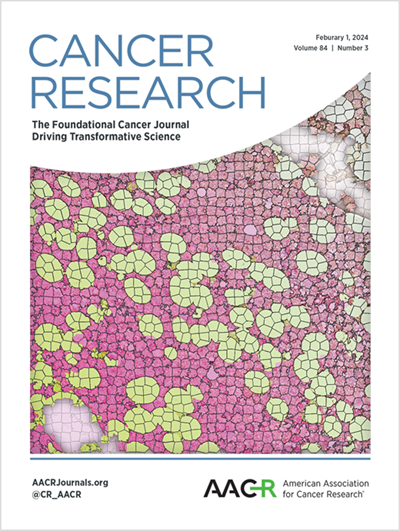
Cancer Research, published by the American Association for Cancer Research (AACR), is a journal that focuses on impactful original studies, reviews, and opinion pieces relevant to the broad cancer research community. Manuscripts that present conceptual or technological advances leading to insights into cancer biology are particularly sought after. The journal also places emphasis on convergence science, which involves bridging multiple distinct areas of cancer research.
With primary subsections including Cancer Biology, Cancer Immunology, Cancer Metabolism and Molecular Mechanisms, Translational Cancer Biology, Cancer Landscapes, and Convergence Science, Cancer Research has a comprehensive scope. It is published twice a month and has one volume per year, with a print ISSN of 0008-5472 and an online ISSN of 1538-7445.
Cancer Research is abstracted and/or indexed in various databases and platforms, including BIOSIS Previews (R) Database, MEDLINE, Current Contents/Life Sciences, Current Contents/Clinical Medicine, Science Citation Index, Scopus, and Web of Science.




 京公网安备 11010802042870号
京ICP备2023020795号-1
京公网安备 11010802042870号
京ICP备2023020795号-1

 分享
分享
 求助内容:
求助内容: 应助结果提醒方式:
 扫码关注我们
