A. Anisi , M. Sheikholeslami , Z. Khalili , Faranack M. Boora
{"title":"Optimizing solar panel performance with new algorithm incorporating duct with helical tape and hybrid nanofluid","authors":"A. Anisi , M. Sheikholeslami , Z. Khalili , Faranack M. Boora","doi":"10.1016/j.jtice.2024.105908","DOIUrl":null,"url":null,"abstract":"<div><h3>Background</h3><div>This work introduces an innovative configuration for intensifying the productivity of solar photovoltaic-thermal units (PVT) through the incorporation of a cooling system. Notably, a thermoelectric module is strategically added to further intensification of produced electricity.</div></div><div><h3>Methods</h3><div>This unit has a duct where the hybrid nanofluid passes through which a turbulator is placed. Furthermore, this system has a jet impingement component. In a departure from traditional methodologies, this investigation optimizes the PVT unit's overall effectiveness by employing an algorithm based on machine learning. Three critical goal functions are considered in this optimization process: <em>Ep</em> (pumping power), <em>CO</em><sub>2</sub> − <em>m</em> (CO<sub>2</sub> mitigation), and <em>Profit</em> of the system, each of which respectively represents the generated electrical energy for energy analysis, the reduction of produced carbon for environmental evaluation and the financial gain from employing the present system for economic assessment. This innovative approach not only contributes to advancing the field of solar photovoltaic-thermal systems but also underscores the importance of optimizing these units for increased energy efficiency, reduced environmental impact, and enhanced economic viability in the context of renewable energy technologies.</div></div><div><h3>Significant findings</h3><div>The connections between the PVT's variable mappings, comprising the input parameters of the fluid velocity (<em>V<sub>Tube</sub></em>), solar radiation (<em>G</em>), jet impingement velocity (<em>V<sub>J</sub></em>), and helical tape ratio (<em>R</em>) and the outputs of the <em>E<sub>p</sub>, Profit, CO</em><sub>2</sub> − <em>m</em>, are established through the implementation of various models. The findings suggest that the GPR (Gaussian Process Regression) model is the most appropriate, as evidenced by its <em>R</em><sup>2</sup> values of 0.9987, 1, and 1 for <em>E<sub>p</sub>, Profit</em>, and <em>CO</em><sub>2</sub> − <em>m</em>, correspondingly. The NSGA-II technique is utilized in this study. This procedure is used to ascertain the Pareto optimal solutions with respect to all three conflicting objectives. The outcome illustrates the Pareto graphs, and each of them in provides a suitable compromise between all objectives without degrading any of them.</div></div>","PeriodicalId":381,"journal":{"name":"Journal of the Taiwan Institute of Chemical Engineers","volume":"167 ","pages":"Article 105908"},"PeriodicalIF":6.3000,"publicationDate":"2025-02-01","publicationTypes":"Journal Article","fieldsOfStudy":null,"isOpenAccess":false,"openAccessPdf":"","citationCount":"0","resultStr":null,"platform":"Semanticscholar","paperid":null,"PeriodicalName":"Journal of the Taiwan Institute of Chemical Engineers","FirstCategoryId":"5","ListUrlMain":"https://www.sciencedirect.com/science/article/pii/S1876107024005662","RegionNum":3,"RegionCategory":"工程技术","ArticlePicture":[],"TitleCN":null,"AbstractTextCN":null,"PMCID":null,"EPubDate":"2024/12/14 0:00:00","PubModel":"Epub","JCR":"Q1","JCRName":"ENGINEERING, CHEMICAL","Score":null,"Total":0}
引用次数: 0
Abstract
Background
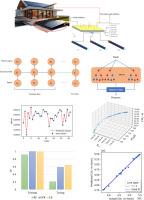
This work introduces an innovative configuration for intensifying the productivity of solar photovoltaic-thermal units (PVT) through the incorporation of a cooling system. Notably, a thermoelectric module is strategically added to further intensification of produced electricity.
Methods
This unit has a duct where the hybrid nanofluid passes through which a turbulator is placed. Furthermore, this system has a jet impingement component. In a departure from traditional methodologies, this investigation optimizes the PVT unit's overall effectiveness by employing an algorithm based on machine learning. Three critical goal functions are considered in this optimization process: Ep (pumping power), CO2 − m (CO2 mitigation), and Profit of the system, each of which respectively represents the generated electrical energy for energy analysis, the reduction of produced carbon for environmental evaluation and the financial gain from employing the present system for economic assessment. This innovative approach not only contributes to advancing the field of solar photovoltaic-thermal systems but also underscores the importance of optimizing these units for increased energy efficiency, reduced environmental impact, and enhanced economic viability in the context of renewable energy technologies.
Significant findings
The connections between the PVT's variable mappings, comprising the input parameters of the fluid velocity (VTube), solar radiation (G), jet impingement velocity (VJ), and helical tape ratio (R) and the outputs of the Ep, Profit, CO2 − m, are established through the implementation of various models. The findings suggest that the GPR (Gaussian Process Regression) model is the most appropriate, as evidenced by its R2 values of 0.9987, 1, and 1 for Ep, Profit, and CO2 − m, correspondingly. The NSGA-II technique is utilized in this study. This procedure is used to ascertain the Pareto optimal solutions with respect to all three conflicting objectives. The outcome illustrates the Pareto graphs, and each of them in provides a suitable compromise between all objectives without degrading any of them.
期刊介绍:
Journal of the Taiwan Institute of Chemical Engineers (formerly known as Journal of the Chinese Institute of Chemical Engineers) publishes original works, from fundamental principles to practical applications, in the broad field of chemical engineering with special focus on three aspects: Chemical and Biomolecular Science and Technology, Energy and Environmental Science and Technology, and Materials Science and Technology. Authors should choose for their manuscript an appropriate aspect section and a few related classifications when submitting to the journal online.




 京公网安备 11010802042870号
京ICP备2023020795号-1
京公网安备 11010802042870号
京ICP备2023020795号-1

 分享
分享
 求助内容:
求助内容: 应助结果提醒方式:
 扫码关注我们
