{"title":"Mortality attributable to ambient PM2.5 pollution in China's aging population","authors":"Lei Wan, Hilary Bambrick, Michael Tong","doi":"10.1016/j.eiar.2025.107823","DOIUrl":null,"url":null,"abstract":"<div><h3>Background</h3><div>As China's population is aging rapidly, understanding the shifts in PM<sub>2.5</sub> attributable mortality within this context is crucial for informing future clean air policies.</div></div><div><h3>Methods</h3><div>We adopted a Fusion relative risk model, combined with 100 m resolution age structure data, to better estimate China's age- and cause-specific mortality attributable to PM<sub>2.5</sub> over 2010–2019, and projected attributable mortality in 2030 and 2060 at a 0.1° spatial resolution under three scenarios: Baseline, Carbon-peak and Carbon-neutral. We also assessed the impact of population aging using a decomposition method at the grid level.</div></div><div><h3>Results</h3><div>PM<sub>2.5</sub> attributable deaths declined by 9.2 % from 2010 (1.95 million, 95 % UI: 1.80–2.09) to 2019 (1.77 million, 95 % UI: 1.64–1.90), with population aging contributing an increase of 0.48 million deaths. The elderly population constituted over 70 % of total attributable mortality during 2010–2019, and this share is expected to increase to over 90 % in 2060 under three future scenarios. Under Baseline scenario, attributable deaths are expected to increase, with population aging as the major contributor. Under Carbon-peak scenario, the projected mortality declines over 2019–2030 and 2030–2060 will be partly offset by population aging. Under Carbon-neutral scenario, population aging is projected to increase attributable deaths by 0.57 million and 1.27 million over the two periods, largely offsetting the reductions achieved by the declines in PM<sub>2.5</sub> concentrations and cause-specific baseline mortality rates.</div></div><div><h3>Conclusions</h3><div>Population aging is the main factor that increases PM<sub>2.5</sub> attributable mortality. Specific measures considering the vulnerability of the elderly are needed to further alleviate future health burden from air pollution.</div></div>","PeriodicalId":309,"journal":{"name":"Environmental Impact Assessment Review","volume":"112 ","pages":"Article 107823"},"PeriodicalIF":11.2000,"publicationDate":"2025-03-01","publicationTypes":"Journal Article","fieldsOfStudy":null,"isOpenAccess":false,"openAccessPdf":"","citationCount":"0","resultStr":null,"platform":"Semanticscholar","paperid":null,"PeriodicalName":"Environmental Impact Assessment Review","FirstCategoryId":"90","ListUrlMain":"https://www.sciencedirect.com/science/article/pii/S0195925525000204","RegionNum":1,"RegionCategory":"社会学","ArticlePicture":[],"TitleCN":null,"AbstractTextCN":null,"PMCID":null,"EPubDate":"2025/1/14 0:00:00","PubModel":"Epub","JCR":"Q1","JCRName":"ENVIRONMENTAL STUDIES","Score":null,"Total":0}
引用次数: 0
Abstract
Background
As China's population is aging rapidly, understanding the shifts in PM2.5 attributable mortality within this context is crucial for informing future clean air policies.
Methods
We adopted a Fusion relative risk model, combined with 100 m resolution age structure data, to better estimate China's age- and cause-specific mortality attributable to PM2.5 over 2010–2019, and projected attributable mortality in 2030 and 2060 at a 0.1° spatial resolution under three scenarios: Baseline, Carbon-peak and Carbon-neutral. We also assessed the impact of population aging using a decomposition method at the grid level.
Results
PM2.5 attributable deaths declined by 9.2 % from 2010 (1.95 million, 95 % UI: 1.80–2.09) to 2019 (1.77 million, 95 % UI: 1.64–1.90), with population aging contributing an increase of 0.48 million deaths. The elderly population constituted over 70 % of total attributable mortality during 2010–2019, and this share is expected to increase to over 90 % in 2060 under three future scenarios. Under Baseline scenario, attributable deaths are expected to increase, with population aging as the major contributor. Under Carbon-peak scenario, the projected mortality declines over 2019–2030 and 2030–2060 will be partly offset by population aging. Under Carbon-neutral scenario, population aging is projected to increase attributable deaths by 0.57 million and 1.27 million over the two periods, largely offsetting the reductions achieved by the declines in PM2.5 concentrations and cause-specific baseline mortality rates.
Conclusions
Population aging is the main factor that increases PM2.5 attributable mortality. Specific measures considering the vulnerability of the elderly are needed to further alleviate future health burden from air pollution.
期刊介绍:
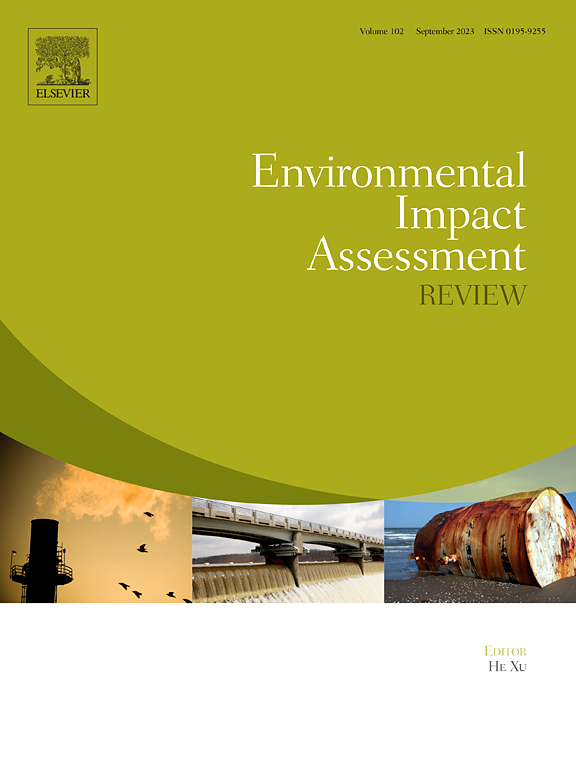
Environmental Impact Assessment Review is an interdisciplinary journal that serves a global audience of practitioners, policymakers, and academics involved in assessing the environmental impact of policies, projects, processes, and products. The journal focuses on innovative theory and practice in environmental impact assessment (EIA). Papers are expected to present innovative ideas, be topical, and coherent. The journal emphasizes concepts, methods, techniques, approaches, and systems related to EIA theory and practice.



 京公网安备 11010802042870号
京ICP备2023020795号-1
京公网安备 11010802042870号
京ICP备2023020795号-1

 分享
分享
 求助内容:
求助内容: 应助结果提醒方式:
 扫码关注我们
