Tiago G. Morais , Manuel P. dos Santos , Lúcia Barão , Tiago Domingos , Ricardo F.M. Teixeira
{"title":"Grazing or confining — Decoding Beef's environmental footprint","authors":"Tiago G. Morais , Manuel P. dos Santos , Lúcia Barão , Tiago Domingos , Ricardo F.M. Teixeira","doi":"10.1016/j.eiar.2025.107846","DOIUrl":null,"url":null,"abstract":"<div><div>Greenhouse gas (GHG) emissions of beef production are extremely variable depending on the livestock production system (LPS) used, with lack of clarity on the influencing factors. Here, we assess those factors using a mass balance model with regional case study data for Portugal. We show that the whole-system GHG emissions range for beef production from steers in beef herds is 15–124 kg CO<sub>2</sub>e per 100 g protein depending on LPS (confined, pasture-based or mixed), breed, age at slaughter, and adequacy and upstream impact of supplemental feed. If steers are adequately supplemented, then LPS that involve at least a stage of grazing for steers have the lowest emissions, regardless of supplemental feed impact. In case of suboptimal supplementation during grazing, confinement is optimal at intermediate to low feed impact. For high feed impact, slaughtering at weaning is optimal. Choosing the best LPS and slaughtering age reduces the range of emissions to 15–35 kg CO<sub>2</sub>e per 100 g protein.</div></div>","PeriodicalId":309,"journal":{"name":"Environmental Impact Assessment Review","volume":"112 ","pages":"Article 107846"},"PeriodicalIF":11.2000,"publicationDate":"2025-03-01","publicationTypes":"Journal Article","fieldsOfStudy":null,"isOpenAccess":false,"openAccessPdf":"","citationCount":"0","resultStr":null,"platform":"Semanticscholar","paperid":null,"PeriodicalName":"Environmental Impact Assessment Review","FirstCategoryId":"90","ListUrlMain":"https://www.sciencedirect.com/science/article/pii/S0195925525000435","RegionNum":1,"RegionCategory":"社会学","ArticlePicture":[],"TitleCN":null,"AbstractTextCN":null,"PMCID":null,"EPubDate":"2025/2/3 0:00:00","PubModel":"Epub","JCR":"Q1","JCRName":"ENVIRONMENTAL STUDIES","Score":null,"Total":0}
引用次数: 0
Abstract
Greenhouse gas (GHG) emissions of beef production are extremely variable depending on the livestock production system (LPS) used, with lack of clarity on the influencing factors. Here, we assess those factors using a mass balance model with regional case study data for Portugal. We show that the whole-system GHG emissions range for beef production from steers in beef herds is 15–124 kg CO2e per 100 g protein depending on LPS (confined, pasture-based or mixed), breed, age at slaughter, and adequacy and upstream impact of supplemental feed. If steers are adequately supplemented, then LPS that involve at least a stage of grazing for steers have the lowest emissions, regardless of supplemental feed impact. In case of suboptimal supplementation during grazing, confinement is optimal at intermediate to low feed impact. For high feed impact, slaughtering at weaning is optimal. Choosing the best LPS and slaughtering age reduces the range of emissions to 15–35 kg CO2e per 100 g protein.
期刊介绍:
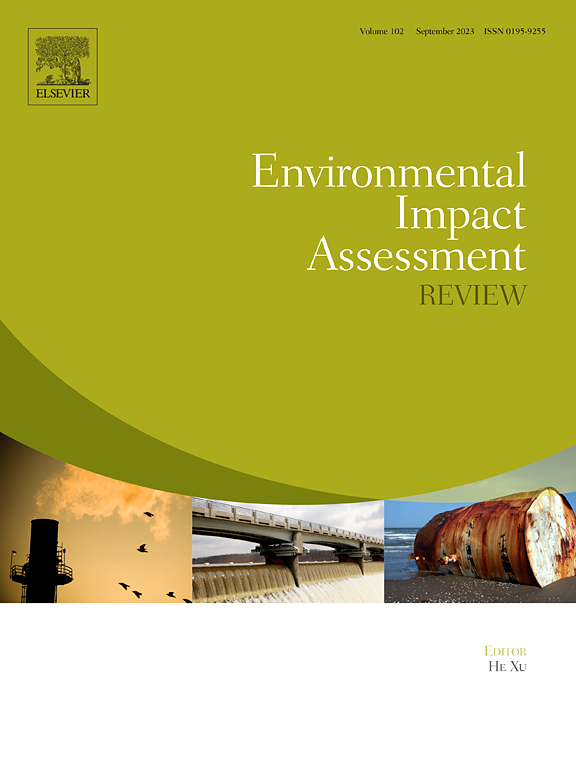
Environmental Impact Assessment Review is an interdisciplinary journal that serves a global audience of practitioners, policymakers, and academics involved in assessing the environmental impact of policies, projects, processes, and products. The journal focuses on innovative theory and practice in environmental impact assessment (EIA). Papers are expected to present innovative ideas, be topical, and coherent. The journal emphasizes concepts, methods, techniques, approaches, and systems related to EIA theory and practice.





 京公网安备 11010802042870号
京ICP备2023020795号-1
京公网安备 11010802042870号
京ICP备2023020795号-1

 分享
分享
 求助内容:
求助内容: 应助结果提醒方式:
 扫码关注我们
