Daniel Jiménez-Desmond , José Santiago Pozo-Antonio , Anna Arizzi
{"title":"Outdoor durability of nano-sized silica-based chromatic reintegrations. Influence of exposure conditions and pigment composition","authors":"Daniel Jiménez-Desmond , José Santiago Pozo-Antonio , Anna Arizzi","doi":"10.1016/j.dyepig.2025.112651","DOIUrl":null,"url":null,"abstract":"<div><div>Outdoor exposed wall paintings are highly vulnerable to decay from environmental factors such as solar radiation, humidity, and soluble salts. These factors can also affect the chromatic reintegrations in wall paintings. However, little research has been conducted on their durability. Therefore, a novel approach has been carried out by exploring the use of an aqueous colloidal dispersion of nano-sized silica as a binder in chromatic reintegrations under different environments. Thus, the binder was mixed with pigments (silicate-, oxide- and sulphide-based ones) to evaluate the influence of their chemical nature on the durability. Also, the paint mock-ups were exposed for one year to outdoor <em>Csb</em>- and <em>Dsa</em>-type environments (Köppen-Geiger climate classification system), in which moisture, temperature, rainfall and proximity to the sea differ considerably. Colour and gloss were measured before and after exposure. The paint samples were characterized using X-ray diffraction, Fourier transform infrared spectroscopy, Raman spectroscopy, and optical and scanning electron microscopies. After exposure, colour stability was highly influenced by the chemical nature of the pigments. A calcium-rich layer developed on all the mock-ups, together with other deposits, whose extent was highly influenced by the exposure conditions. Oxide-based pigments provided the best results, followed by the blue silicate-based ones. In contrast, sulphide-based and green earth-based pigments suffered substantial paint loss and colour changes. The different performance of the paintings was due to the affinity of the pigments with the binder and their predisposition to form bonds with hydroxyl (–OH), silanol (Si–OH) and siloxane (Si–O–Si) groups.</div></div>","PeriodicalId":302,"journal":{"name":"Dyes and Pigments","volume":"235 ","pages":"Article 112651"},"PeriodicalIF":4.2000,"publicationDate":"2025-04-01","publicationTypes":"Journal Article","fieldsOfStudy":null,"isOpenAccess":false,"openAccessPdf":"","citationCount":"0","resultStr":null,"platform":"Semanticscholar","paperid":null,"PeriodicalName":"Dyes and Pigments","FirstCategoryId":"88","ListUrlMain":"https://www.sciencedirect.com/science/article/pii/S014372082500021X","RegionNum":3,"RegionCategory":"工程技术","ArticlePicture":[],"TitleCN":null,"AbstractTextCN":null,"PMCID":null,"EPubDate":"2025/1/15 0:00:00","PubModel":"Epub","JCR":"Q2","JCRName":"CHEMISTRY, APPLIED","Score":null,"Total":0}
引用次数: 0
Abstract
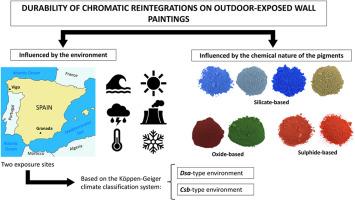
Outdoor exposed wall paintings are highly vulnerable to decay from environmental factors such as solar radiation, humidity, and soluble salts. These factors can also affect the chromatic reintegrations in wall paintings. However, little research has been conducted on their durability. Therefore, a novel approach has been carried out by exploring the use of an aqueous colloidal dispersion of nano-sized silica as a binder in chromatic reintegrations under different environments. Thus, the binder was mixed with pigments (silicate-, oxide- and sulphide-based ones) to evaluate the influence of their chemical nature on the durability. Also, the paint mock-ups were exposed for one year to outdoor Csb- and Dsa-type environments (Köppen-Geiger climate classification system), in which moisture, temperature, rainfall and proximity to the sea differ considerably. Colour and gloss were measured before and after exposure. The paint samples were characterized using X-ray diffraction, Fourier transform infrared spectroscopy, Raman spectroscopy, and optical and scanning electron microscopies. After exposure, colour stability was highly influenced by the chemical nature of the pigments. A calcium-rich layer developed on all the mock-ups, together with other deposits, whose extent was highly influenced by the exposure conditions. Oxide-based pigments provided the best results, followed by the blue silicate-based ones. In contrast, sulphide-based and green earth-based pigments suffered substantial paint loss and colour changes. The different performance of the paintings was due to the affinity of the pigments with the binder and their predisposition to form bonds with hydroxyl (–OH), silanol (Si–OH) and siloxane (Si–O–Si) groups.
期刊介绍:
Dyes and Pigments covers the scientific and technical aspects of the chemistry and physics of dyes, pigments and their intermediates. Emphasis is placed on the properties of the colouring matters themselves rather than on their applications or the system in which they may be applied.
Thus the journal accepts research and review papers on the synthesis of dyes, pigments and intermediates, their physical or chemical properties, e.g. spectroscopic, surface, solution or solid state characteristics, the physical aspects of their preparation, e.g. precipitation, nucleation and growth, crystal formation, liquid crystalline characteristics, their photochemical, ecological or biological properties and the relationship between colour and chemical constitution. However, papers are considered which deal with the more fundamental aspects of colourant application and of the interactions of colourants with substrates or media.
The journal will interest a wide variety of workers in a range of disciplines whose work involves dyes, pigments and their intermediates, and provides a platform for investigators with common interests but diverse fields of activity such as cosmetics, reprographics, dye and pigment synthesis, medical research, polymers, etc.



 京公网安备 11010802042870号
京ICP备2023020795号-1
京公网安备 11010802042870号
京ICP备2023020795号-1

 分享
分享
 求助内容:
求助内容: 应助结果提醒方式:
 扫码关注我们
