{"title":"The origin and role of CH4–N2 in the formation of Yantongqiaozi gold deposit, Jilin Province, NE China","authors":"He Yang , Shunda Li , Bingyang Ye , Keyong Wang","doi":"10.1016/j.oregeorev.2024.106434","DOIUrl":null,"url":null,"abstract":"<div><div>The Yantongqiaozi gold deposit, located in the southern Jilin Province of Northeast China, is hosted within a breccia pipe and surrounded by Archean metamorphic rocks. This deposit has four paragenetic stages: stage I pyrrhotite–pyrite–quartz, stage II gold–pyrite–quartz, stage III sphalerite–pyrite–quartz, and stage IV pyrite–quartz–calcite. Additionally, it contains CH<sub>4</sub>–N<sub>2</sub>-rich fluid, which is associated with gold mineralization; however, the origin and evolution of this fluid remains unclear. Fluid inclusion petrography and microthermometry revealed that stage I is characterized by medium–high temperature CH<sub>4</sub>–H<sub>2</sub>O fluids (296–359 °C), which evolves into medium-temperature N<sub>2</sub>–CO<sub>2</sub>–H<sub>2</sub>O fluids (251–323 °C) in stage II, further shifting into low-temperature NaCl–H<sub>2</sub>O fluids (165–254 °C) in stages III and IV. The H–O–C–N isotopes record that the initial magma fluids were contaminated by organic matter from the surrounding strata, followed by water–rock interaction and gradual dilution by meteoric water. CH<sub>4</sub> in the stage I fluid is generated by the thermal decomposition of organic matter, possibly from Jurassic coal-bearing strata. CH<sub>4</sub>-rich fluids facilitate the activation and migration of gold from the surrounding strata. The simultaneous trapping of single-phase CH<sub>4</sub> and H<sub>2</sub>O inclusions indicate that fluid effervescence is the primary mechanism of metal precipitation in stage I. The conversion of CH<sub>4</sub> to CO<sub>2</sub> in stage II fluid is indicative of increased oxygen fugacity. N<sub>2</sub>, likely owing to the breakdown of NH<sub>4</sub><sup>+</sup>-containing minerals formed during metamorphism. Isotopic fractionation patterns suggest that extensive water–rock interactions lead to gold precipitation in stage II. Substantial temperature decreases and volatile losses in the stage III and IV fluids indicate continuous dilution by meteoric water, resulting in mineral precipitation. Unlike that in reduced porphyry and orogenic gold deposits, the gold mineralization at Yantongqiaozi derives from the combined effects of magmatic and metamorphic processes. Together, our findings highlight the pivotal role of CH<sub>4</sub>–N<sub>2</sub>-rich fluids in the migration and precipitation of gold and support a porphyry–orogenic transitional mineralization model for the Yantongqiaozi deposit. This model is expected to provide insights regarding the genesis and exploration of similar deposits.</div></div>","PeriodicalId":19644,"journal":{"name":"Ore Geology Reviews","volume":"176 ","pages":"Article 106434"},"PeriodicalIF":3.6000,"publicationDate":"2025-01-01","publicationTypes":"Journal Article","fieldsOfStudy":null,"isOpenAccess":false,"openAccessPdf":"","citationCount":"0","resultStr":null,"platform":"Semanticscholar","paperid":null,"PeriodicalName":"Ore Geology Reviews","FirstCategoryId":"89","ListUrlMain":"https://www.sciencedirect.com/science/article/pii/S0169136824005675","RegionNum":2,"RegionCategory":"地球科学","ArticlePicture":[],"TitleCN":null,"AbstractTextCN":null,"PMCID":null,"EPubDate":"2024/12/30 0:00:00","PubModel":"Epub","JCR":"Q1","JCRName":"GEOLOGY","Score":null,"Total":0}
引用次数: 0
Abstract
The Yantongqiaozi gold deposit, located in the southern Jilin Province of Northeast China, is hosted within a breccia pipe and surrounded by Archean metamorphic rocks. This deposit has four paragenetic stages: stage I pyrrhotite–pyrite–quartz, stage II gold–pyrite–quartz, stage III sphalerite–pyrite–quartz, and stage IV pyrite–quartz–calcite. Additionally, it contains CH4–N2-rich fluid, which is associated with gold mineralization; however, the origin and evolution of this fluid remains unclear. Fluid inclusion petrography and microthermometry revealed that stage I is characterized by medium–high temperature CH4–H2O fluids (296–359 °C), which evolves into medium-temperature N2–CO2–H2O fluids (251–323 °C) in stage II, further shifting into low-temperature NaCl–H2O fluids (165–254 °C) in stages III and IV. The H–O–C–N isotopes record that the initial magma fluids were contaminated by organic matter from the surrounding strata, followed by water–rock interaction and gradual dilution by meteoric water. CH4 in the stage I fluid is generated by the thermal decomposition of organic matter, possibly from Jurassic coal-bearing strata. CH4-rich fluids facilitate the activation and migration of gold from the surrounding strata. The simultaneous trapping of single-phase CH4 and H2O inclusions indicate that fluid effervescence is the primary mechanism of metal precipitation in stage I. The conversion of CH4 to CO2 in stage II fluid is indicative of increased oxygen fugacity. N2, likely owing to the breakdown of NH4+-containing minerals formed during metamorphism. Isotopic fractionation patterns suggest that extensive water–rock interactions lead to gold precipitation in stage II. Substantial temperature decreases and volatile losses in the stage III and IV fluids indicate continuous dilution by meteoric water, resulting in mineral precipitation. Unlike that in reduced porphyry and orogenic gold deposits, the gold mineralization at Yantongqiaozi derives from the combined effects of magmatic and metamorphic processes. Together, our findings highlight the pivotal role of CH4–N2-rich fluids in the migration and precipitation of gold and support a porphyry–orogenic transitional mineralization model for the Yantongqiaozi deposit. This model is expected to provide insights regarding the genesis and exploration of similar deposits.
期刊介绍:
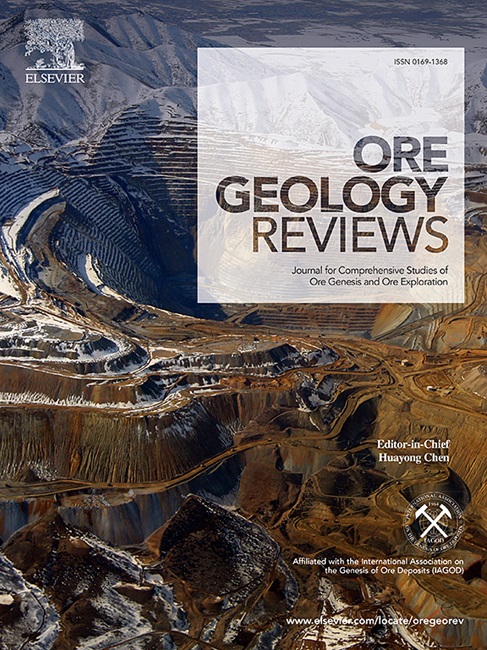
Ore Geology Reviews aims to familiarize all earth scientists with recent advances in a number of interconnected disciplines related to the study of, and search for, ore deposits. The reviews range from brief to longer contributions, but the journal preferentially publishes manuscripts that fill the niche between the commonly shorter journal articles and the comprehensive book coverages, and thus has a special appeal to many authors and readers.





 京公网安备 11010802042870号
京ICP备2023020795号-1
京公网安备 11010802042870号
京ICP备2023020795号-1

 分享
分享
 求助内容:
求助内容: 应助结果提醒方式:
 扫码关注我们
