Xiaolei Cai , Yinghong Guo , Shun Guan , Duo Wang , Huihui Han , Yipeng Ji
{"title":"The separation characteristics of O/W emulsions in compact flotation unit enhanced by electrical flotation technology","authors":"Xiaolei Cai , Yinghong Guo , Shun Guan , Duo Wang , Huihui Han , Yipeng Ji","doi":"10.1016/j.cep.2025.110195","DOIUrl":null,"url":null,"abstract":"<div><div>The widespread application of Enhanced Oil Recovery technology has led to a higher degree of oil phase emulsification and more robust stability in produced water, posing a severe challenge to the production water treatment process of offshore oil fields. Due to the limited space on offshore platforms, it is difficult to improve the oil removal rate by increasing the residence time of the processing device. Compact Flotation Unit, as an efficient oily wastewater treatment technology that is gradually being widely used on offshore platforms, exhibits limited effectiveness in removing emulsified oil droplets. Electric floatation technology is an effective method for the demulsification treatment of oil-water emulsions. To assess the feasibility of the electric floatation technology to strengthen the separation performance of CFU, the separation performance of CFU under different operating conditions and their impact on the lower limit of oil droplet Sauter mean diameter removal are researched, and the separation characteristics of electric flotation technology for O/W emulsions are analyzed. In particular, the effects of current density, electrode spacing, and number of electrode plates on the growth rate of oil droplet Sauter mean diameter, oil removal efficiency, and turbidity removal rate are analyzed. The experimental results shows that, for the O/W emulsion with an initial oil content of 500mg/L, the growth rate of oil droplet Sauter mean diameter can reach about 1.6, the oil droplet Sauter mean diameter can increase to 28.8μm, and the turbidity removal rate can go over 67.1 % under the electric field parameters of a current density of 180mA/cm² and a plate spacing of 15 mm by using the metal oxide-coated electrodes applying for 1 min. It indicates that applying current can effectively facilitate the coalescence of oil droplets, resulting in an increase in the Sauter mean diameter, thereby significantly improving the removal efficiency of CFU from tiny oil droplets.</div></div>","PeriodicalId":9929,"journal":{"name":"Chemical Engineering and Processing - Process Intensification","volume":"209 ","pages":"Article 110195"},"PeriodicalIF":3.9000,"publicationDate":"2025-03-01","publicationTypes":"Journal Article","fieldsOfStudy":null,"isOpenAccess":false,"openAccessPdf":"","citationCount":"0","resultStr":null,"platform":"Semanticscholar","paperid":null,"PeriodicalName":"Chemical Engineering and Processing - Process Intensification","FirstCategoryId":"5","ListUrlMain":"https://www.sciencedirect.com/science/article/pii/S0255270125000455","RegionNum":3,"RegionCategory":"工程技术","ArticlePicture":[],"TitleCN":null,"AbstractTextCN":null,"PMCID":null,"EPubDate":"2025/1/31 0:00:00","PubModel":"Epub","JCR":"Q3","JCRName":"ENERGY & FUELS","Score":null,"Total":0}
引用次数: 0
Abstract
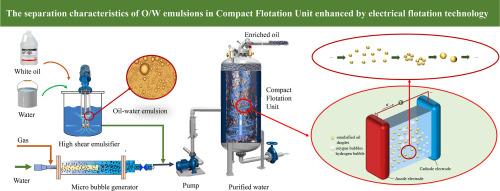
The widespread application of Enhanced Oil Recovery technology has led to a higher degree of oil phase emulsification and more robust stability in produced water, posing a severe challenge to the production water treatment process of offshore oil fields. Due to the limited space on offshore platforms, it is difficult to improve the oil removal rate by increasing the residence time of the processing device. Compact Flotation Unit, as an efficient oily wastewater treatment technology that is gradually being widely used on offshore platforms, exhibits limited effectiveness in removing emulsified oil droplets. Electric floatation technology is an effective method for the demulsification treatment of oil-water emulsions. To assess the feasibility of the electric floatation technology to strengthen the separation performance of CFU, the separation performance of CFU under different operating conditions and their impact on the lower limit of oil droplet Sauter mean diameter removal are researched, and the separation characteristics of electric flotation technology for O/W emulsions are analyzed. In particular, the effects of current density, electrode spacing, and number of electrode plates on the growth rate of oil droplet Sauter mean diameter, oil removal efficiency, and turbidity removal rate are analyzed. The experimental results shows that, for the O/W emulsion with an initial oil content of 500mg/L, the growth rate of oil droplet Sauter mean diameter can reach about 1.6, the oil droplet Sauter mean diameter can increase to 28.8μm, and the turbidity removal rate can go over 67.1 % under the electric field parameters of a current density of 180mA/cm² and a plate spacing of 15 mm by using the metal oxide-coated electrodes applying for 1 min. It indicates that applying current can effectively facilitate the coalescence of oil droplets, resulting in an increase in the Sauter mean diameter, thereby significantly improving the removal efficiency of CFU from tiny oil droplets.
期刊介绍:
Chemical Engineering and Processing: Process Intensification is intended for practicing researchers in industry and academia, working in the field of Process Engineering and related to the subject of Process Intensification.Articles published in the Journal demonstrate how novel discoveries, developments and theories in the field of Process Engineering and in particular Process Intensification may be used for analysis and design of innovative equipment and processing methods with substantially improved sustainability, efficiency and environmental performance.




 京公网安备 11010802042870号
京ICP备2023020795号-1
京公网安备 11010802042870号
京ICP备2023020795号-1

 分享
分享
 求助内容:
求助内容: 应助结果提醒方式:
 扫码关注我们
