Milad Yaghoubi , Kazem Alirezalu , Farzaneh Hadi , Monika Marcinkowska-Lesiak , Mohammad Rashedi Ismail-Fitry , A.M. Abd El-Aty , Emel Oz , Fatih Oz
{"title":"Probiotic-incorporated active packaging solutions for meat and meat products: A review of benefits and recent applications","authors":"Milad Yaghoubi , Kazem Alirezalu , Farzaneh Hadi , Monika Marcinkowska-Lesiak , Mohammad Rashedi Ismail-Fitry , A.M. Abd El-Aty , Emel Oz , Fatih Oz","doi":"10.1016/j.tifs.2024.104848","DOIUrl":null,"url":null,"abstract":"<div><h3>Background</h3><div>Increased consumer awareness regarding the environmental effects of plastic food packaging and synthetic preservatives has driven the food industry to explore alternative options. Edible and biodegradable films and coatings are progressively being adopted as a natural substitute for conventional food packaging. Probiotics incorporated in films and coatings not only have diverse techno-functional and nutritional properties in foods but also when consumed in sufficient amounts, support gut health and enhance the immune system.</div></div><div><h3>Scope and approach</h3><div>This review explores the method of probiotics incorporation in packaging material, effective factors on probiotics viability in films and coatings, their effects on meat and meat products quality (i.e., physicochemical, microbial, functional, and sensory attributes), as well as synergistic effects of probiotic-containing packaging with other strategies. Moreover, the present review outlines the regulations associated to the promotion of food packaging containing probiotics.</div></div><div><h3>Key findings and conclusions</h3><div>Edible films and coatings are composed of thin layers designed to maintain meat products against microbial and chemical deteriorations to improve the safety and techno-functionality without the negative effects on sensory and nutritional properties. However, the efficacy of probiotic-incorporated packaging is influenced by viability and type of probiotic strains, packaging materials, and the storage conditions of meat products, which could be developed using suitable prebiotics. Bacteriocins, organic acids and hydrogen peroxide produced by probiotics as well as chitosan as coating material revealed strong antimicrobial effects against foodborne and spoilage bacteria, positioning them as promising alternatives to synthetic preservatives. However, further studies are needed on films and coatings incorporated with probiotics in combination with other natural antimicrobials including enzymes, bioactive peptides and essential oils which possess remarkable preservative properties to improve stability and shelf life of meat and meat products.</div></div>","PeriodicalId":441,"journal":{"name":"Trends in Food Science & Technology","volume":"156 ","pages":"Article 104848"},"PeriodicalIF":15.4000,"publicationDate":"2025-02-01","publicationTypes":"Journal Article","fieldsOfStudy":null,"isOpenAccess":false,"openAccessPdf":"","citationCount":"0","resultStr":null,"platform":"Semanticscholar","paperid":null,"PeriodicalName":"Trends in Food Science & Technology","FirstCategoryId":"97","ListUrlMain":"https://www.sciencedirect.com/science/article/pii/S0924224424005247","RegionNum":1,"RegionCategory":"农林科学","ArticlePicture":[],"TitleCN":null,"AbstractTextCN":null,"PMCID":null,"EPubDate":"2024/12/18 0:00:00","PubModel":"Epub","JCR":"Q1","JCRName":"FOOD SCIENCE & TECHNOLOGY","Score":null,"Total":0}
引用次数: 0
Abstract
Background
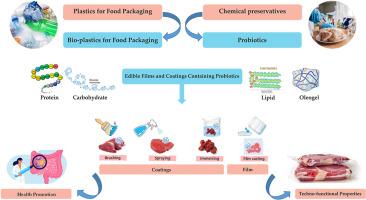
Increased consumer awareness regarding the environmental effects of plastic food packaging and synthetic preservatives has driven the food industry to explore alternative options. Edible and biodegradable films and coatings are progressively being adopted as a natural substitute for conventional food packaging. Probiotics incorporated in films and coatings not only have diverse techno-functional and nutritional properties in foods but also when consumed in sufficient amounts, support gut health and enhance the immune system.
Scope and approach
This review explores the method of probiotics incorporation in packaging material, effective factors on probiotics viability in films and coatings, their effects on meat and meat products quality (i.e., physicochemical, microbial, functional, and sensory attributes), as well as synergistic effects of probiotic-containing packaging with other strategies. Moreover, the present review outlines the regulations associated to the promotion of food packaging containing probiotics.
Key findings and conclusions
Edible films and coatings are composed of thin layers designed to maintain meat products against microbial and chemical deteriorations to improve the safety and techno-functionality without the negative effects on sensory and nutritional properties. However, the efficacy of probiotic-incorporated packaging is influenced by viability and type of probiotic strains, packaging materials, and the storage conditions of meat products, which could be developed using suitable prebiotics. Bacteriocins, organic acids and hydrogen peroxide produced by probiotics as well as chitosan as coating material revealed strong antimicrobial effects against foodborne and spoilage bacteria, positioning them as promising alternatives to synthetic preservatives. However, further studies are needed on films and coatings incorporated with probiotics in combination with other natural antimicrobials including enzymes, bioactive peptides and essential oils which possess remarkable preservative properties to improve stability and shelf life of meat and meat products.
期刊介绍:
Trends in Food Science & Technology is a prestigious international journal that specializes in peer-reviewed articles covering the latest advancements in technology, food science, and human nutrition. It serves as a bridge between specialized primary journals and general trade magazines, providing readable and scientifically rigorous reviews and commentaries on current research developments and their potential applications in the food industry.
Unlike traditional journals, Trends in Food Science & Technology does not publish original research papers. Instead, it focuses on critical and comprehensive reviews to offer valuable insights for professionals in the field. By bringing together cutting-edge research and industry applications, this journal plays a vital role in disseminating knowledge and facilitating advancements in the food science and technology sector.



 京公网安备 11010802042870号
京ICP备2023020795号-1
京公网安备 11010802042870号
京ICP备2023020795号-1

 分享
分享
 求助内容:
求助内容: 应助结果提醒方式:
 扫码关注我们
