T-2 mycotoxin: From occurrence and toxicokinetics to recent advances in aptasensor-based detection strategies and future perspectives for enhanced food safety
Ali Raza , Sobia Niazi , Muhammad Shoaib , Imran Mahmood Khan , Faizan Ul Haq , Khubaib Ali , Ibrahim Khan , Yin Zhang , Zhouping Wang
{"title":"T-2 mycotoxin: From occurrence and toxicokinetics to recent advances in aptasensor-based detection strategies and future perspectives for enhanced food safety","authors":"Ali Raza , Sobia Niazi , Muhammad Shoaib , Imran Mahmood Khan , Faizan Ul Haq , Khubaib Ali , Ibrahim Khan , Yin Zhang , Zhouping Wang","doi":"10.1016/j.tifs.2024.104784","DOIUrl":null,"url":null,"abstract":"<div><h3>Background</h3><div>Mycotoxins, particularly T-2, pose significant food safety risks, leading to agricultural losses and economic challenges. The growing prevalence of T-2, coupled with the lack of legal maximum limits in many countries, has weakened food safety surveillance and monitoring systems. This necessitates updated assessments of T-2 prevalence, regulatory frameworks, and advancements in detection methods. Aptasensors have emerged as a promising solution, offering cost-effective, rapid, and sensitive detection while addressing the limitations of traditional methods, thereby enhancing food safety monitoring.</div></div><div><h3>Scope and approach</h3><div>This review presents a comprehensive analysis of T-2 toxin prevalence, toxicokinetics, limitations of conventional detection methods, and recent advancements in aptasensors tailored for T-2 detection over the past five years. Detection principles and signal amplification strategies of various aptasensing methodologies—such as colorimetric, fluorescence, surface-enhanced Raman spectroscopy (SERS), chemiluminescence, and electrochemical aptasensors—are systematically analyzed. Additionally, technical challenges, including aptamer stability, signal transduction, and matrix interference, are discussed. Future directions in aptamer modification, hybrid nanomaterial synthesis, and novel signal amplification and multiplexing techniques are highlighted.</div></div><div><h3>Key findings and conclusions</h3><div>Aptasensing strategies such as colorimetric, fluorescence, chemiluminescence, and electrochemical methods leverage distinct mechanisms like visual detection, light emission, enzyme catalysis, and electrical signal changes, offering superior sensitivity for trace-level T-2 detection compared to traditional methods. Innovations in sensor design, nanomaterial integration, and aptamer refinement enable aptasensors to provide portable, real-time T-2 monitoring, with potential to strengthen regulatory standards, promote interdisciplinary research, and advance biosensor technology.</div></div>","PeriodicalId":441,"journal":{"name":"Trends in Food Science & Technology","volume":"156 ","pages":"Article 104784"},"PeriodicalIF":15.4000,"publicationDate":"2025-02-01","publicationTypes":"Journal Article","fieldsOfStudy":null,"isOpenAccess":false,"openAccessPdf":"","citationCount":"0","resultStr":null,"platform":"Semanticscholar","paperid":null,"PeriodicalName":"Trends in Food Science & Technology","FirstCategoryId":"97","ListUrlMain":"https://www.sciencedirect.com/science/article/pii/S0924224424004606","RegionNum":1,"RegionCategory":"农林科学","ArticlePicture":[],"TitleCN":null,"AbstractTextCN":null,"PMCID":null,"EPubDate":"2024/11/29 0:00:00","PubModel":"Epub","JCR":"Q1","JCRName":"FOOD SCIENCE & TECHNOLOGY","Score":null,"Total":0}
引用次数: 0
Abstract
Background
Mycotoxins, particularly T-2, pose significant food safety risks, leading to agricultural losses and economic challenges. The growing prevalence of T-2, coupled with the lack of legal maximum limits in many countries, has weakened food safety surveillance and monitoring systems. This necessitates updated assessments of T-2 prevalence, regulatory frameworks, and advancements in detection methods. Aptasensors have emerged as a promising solution, offering cost-effective, rapid, and sensitive detection while addressing the limitations of traditional methods, thereby enhancing food safety monitoring.
Scope and approach
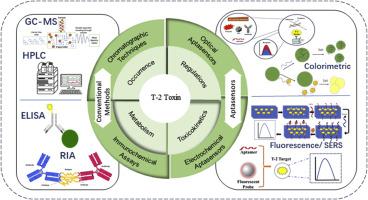
This review presents a comprehensive analysis of T-2 toxin prevalence, toxicokinetics, limitations of conventional detection methods, and recent advancements in aptasensors tailored for T-2 detection over the past five years. Detection principles and signal amplification strategies of various aptasensing methodologies—such as colorimetric, fluorescence, surface-enhanced Raman spectroscopy (SERS), chemiluminescence, and electrochemical aptasensors—are systematically analyzed. Additionally, technical challenges, including aptamer stability, signal transduction, and matrix interference, are discussed. Future directions in aptamer modification, hybrid nanomaterial synthesis, and novel signal amplification and multiplexing techniques are highlighted.
Key findings and conclusions
Aptasensing strategies such as colorimetric, fluorescence, chemiluminescence, and electrochemical methods leverage distinct mechanisms like visual detection, light emission, enzyme catalysis, and electrical signal changes, offering superior sensitivity for trace-level T-2 detection compared to traditional methods. Innovations in sensor design, nanomaterial integration, and aptamer refinement enable aptasensors to provide portable, real-time T-2 monitoring, with potential to strengthen regulatory standards, promote interdisciplinary research, and advance biosensor technology.
期刊介绍:
Trends in Food Science & Technology is a prestigious international journal that specializes in peer-reviewed articles covering the latest advancements in technology, food science, and human nutrition. It serves as a bridge between specialized primary journals and general trade magazines, providing readable and scientifically rigorous reviews and commentaries on current research developments and their potential applications in the food industry.
Unlike traditional journals, Trends in Food Science & Technology does not publish original research papers. Instead, it focuses on critical and comprehensive reviews to offer valuable insights for professionals in the field. By bringing together cutting-edge research and industry applications, this journal plays a vital role in disseminating knowledge and facilitating advancements in the food science and technology sector.



 京公网安备 11010802042870号
京ICP备2023020795号-1
京公网安备 11010802042870号
京ICP备2023020795号-1

 分享
分享
 求助内容:
求助内容: 应助结果提醒方式:
 扫码关注我们
