Paolo S. Garofalo , Daniele Redi , Nikita Malafeevskiy , Gunnar Schwarz , Christoph Neff , Peter Keresztes Schmidt , Detlef Günther
{"title":"Failed genesis of a Fe-skarn deposit caused by redox states of intrusion and wall rocks (Torre di Rio, Island of Elba, Italy)","authors":"Paolo S. Garofalo , Daniele Redi , Nikita Malafeevskiy , Gunnar Schwarz , Christoph Neff , Peter Keresztes Schmidt , Detlef Günther","doi":"10.1016/j.oregeorev.2025.106446","DOIUrl":null,"url":null,"abstract":"<div><div>The Torre di Rio skarn (Island of Elba, Italy) is a pyroxene-ilvaite-epidote skarn that hosts a Fe-oxide mineralization and is the type locality of the mineral <em>ilvaite</em>. In contrast with other Fe deposits of the island, it belongs to a group of subeconomic skarns. We combine surface mapping, petrographic data, scanning electron microscope and electron probe microanalyses, fluid inclusion microthermometry, elemental imaging by Laser Ablation-Inductively Coupled Plasma - Time of Flight Mass Spectrometry (LA-ICP-TOFMS), and fluid-mineral equilibria to compare the genesis of this skarn with that of typical economic skarns.</div><div>Fieldwork shows that Torre di Rio consist of ilvaite-, ilvaite-pyroxene, and pyroxene-epidote zones. The epidote-rich zone is in contact with the wall rocks, i.e., a sequence of pelites, marls, marbles, and other sedimentary lithologies. The 6.53–5.9 Ma Porto Azzurro monzogranite is the reduced (ilmenite-bearing) causative intrusion of the skarn, which induced contact metamorphism in the wall rocks at 6.7–6.2 Ma. Torre di Rio formed within the biotite-white mica-chlorite metamorphic zone, a few hundred meters from the contact with Porto Azzurro.</div><div>Within the skarn, ilvaite and pyroxenes are both euhedral and arranged in rosettes and spheroids. Ilvaite has a consistent chemical composition with a significant Mn enrichment close to the wall rocks, and pyroxene is hedenbergitic. The epidote is euhedral and occurs as epidote s.s. and allanite-(Ce). Late phases are albite, annite, phengite, chlorite, quartz, calcite, and chalcedony. Magnetite and hematite form spheroid textures or are finely mixed. Euhedral pyrrhotite and pyrite host native Bi and Pb.</div><div>Seventeen calcite- and quartz-hosted fluid inclusion assemblages from the ilvaite skarn zones are associated with the magnetite and hematite aggregates. At room temperature, all assemblages are two-phase (L-V). Fourteen of them show constant phase proportions and three show variable proportions. The assemblages with constant phase proportions have salinities between 0.8 and 17.0 mass% NaCleq and homogenize by bubble disappearance between c. 150 and 300 °C. The assemblages with variable phase proportions homogenize by bubble and liquid disappearance between 280 and 330 °C.</div><div>Element imaging by LA-ICP-TOFMS of ilvaite and quartz from skarn spheroids shows that several lithophile (e.g., Al, Mg) and siderophile (e.g., As, Ge, Ga, In, Sb) trace elements occur at concentrations between c. 20 μg/g and 1 wt%.</div><div>We interpret our dataset as a product of a shallow skarn that formed under extremely reducing conditions, which were controlled by the redox nature of both Porto Azzurro and wall rocks. At these conditions, supersaturation of pyroxenes and ilvaite within the skarn was achieved as a result of phase separation, cooling, and mixing of batches of heterogeneous and homogeneous ore fluids at about 350–150 °C. A Fe-skarn deposit failed to form at Torre di Rio because the supersaturation of Fe-oxides from the ore fluid was inhibited, but the presence of the typical siderophile elements of geothermal-epithermal deposits indicate that the ore environment was transitional between skarn and epithermal. Similar conditions are found in other deposits of the Island of Elba and of the Northern Apennine belt.</div></div>","PeriodicalId":19644,"journal":{"name":"Ore Geology Reviews","volume":"177 ","pages":"Article 106446"},"PeriodicalIF":3.6000,"publicationDate":"2025-02-01","publicationTypes":"Journal Article","fieldsOfStudy":null,"isOpenAccess":false,"openAccessPdf":"","citationCount":"0","resultStr":null,"platform":"Semanticscholar","paperid":null,"PeriodicalName":"Ore Geology Reviews","FirstCategoryId":"89","ListUrlMain":"https://www.sciencedirect.com/science/article/pii/S016913682500006X","RegionNum":2,"RegionCategory":"地球科学","ArticlePicture":[],"TitleCN":null,"AbstractTextCN":null,"PMCID":null,"EPubDate":"2025/1/6 0:00:00","PubModel":"Epub","JCR":"Q1","JCRName":"GEOLOGY","Score":null,"Total":0}
引用次数: 0
Abstract
The Torre di Rio skarn (Island of Elba, Italy) is a pyroxene-ilvaite-epidote skarn that hosts a Fe-oxide mineralization and is the type locality of the mineral ilvaite. In contrast with other Fe deposits of the island, it belongs to a group of subeconomic skarns. We combine surface mapping, petrographic data, scanning electron microscope and electron probe microanalyses, fluid inclusion microthermometry, elemental imaging by Laser Ablation-Inductively Coupled Plasma - Time of Flight Mass Spectrometry (LA-ICP-TOFMS), and fluid-mineral equilibria to compare the genesis of this skarn with that of typical economic skarns.
Fieldwork shows that Torre di Rio consist of ilvaite-, ilvaite-pyroxene, and pyroxene-epidote zones. The epidote-rich zone is in contact with the wall rocks, i.e., a sequence of pelites, marls, marbles, and other sedimentary lithologies. The 6.53–5.9 Ma Porto Azzurro monzogranite is the reduced (ilmenite-bearing) causative intrusion of the skarn, which induced contact metamorphism in the wall rocks at 6.7–6.2 Ma. Torre di Rio formed within the biotite-white mica-chlorite metamorphic zone, a few hundred meters from the contact with Porto Azzurro.
Within the skarn, ilvaite and pyroxenes are both euhedral and arranged in rosettes and spheroids. Ilvaite has a consistent chemical composition with a significant Mn enrichment close to the wall rocks, and pyroxene is hedenbergitic. The epidote is euhedral and occurs as epidote s.s. and allanite-(Ce). Late phases are albite, annite, phengite, chlorite, quartz, calcite, and chalcedony. Magnetite and hematite form spheroid textures or are finely mixed. Euhedral pyrrhotite and pyrite host native Bi and Pb.
Seventeen calcite- and quartz-hosted fluid inclusion assemblages from the ilvaite skarn zones are associated with the magnetite and hematite aggregates. At room temperature, all assemblages are two-phase (L-V). Fourteen of them show constant phase proportions and three show variable proportions. The assemblages with constant phase proportions have salinities between 0.8 and 17.0 mass% NaCleq and homogenize by bubble disappearance between c. 150 and 300 °C. The assemblages with variable phase proportions homogenize by bubble and liquid disappearance between 280 and 330 °C.
Element imaging by LA-ICP-TOFMS of ilvaite and quartz from skarn spheroids shows that several lithophile (e.g., Al, Mg) and siderophile (e.g., As, Ge, Ga, In, Sb) trace elements occur at concentrations between c. 20 μg/g and 1 wt%.
We interpret our dataset as a product of a shallow skarn that formed under extremely reducing conditions, which were controlled by the redox nature of both Porto Azzurro and wall rocks. At these conditions, supersaturation of pyroxenes and ilvaite within the skarn was achieved as a result of phase separation, cooling, and mixing of batches of heterogeneous and homogeneous ore fluids at about 350–150 °C. A Fe-skarn deposit failed to form at Torre di Rio because the supersaturation of Fe-oxides from the ore fluid was inhibited, but the presence of the typical siderophile elements of geothermal-epithermal deposits indicate that the ore environment was transitional between skarn and epithermal. Similar conditions are found in other deposits of the Island of Elba and of the Northern Apennine belt.
期刊介绍:
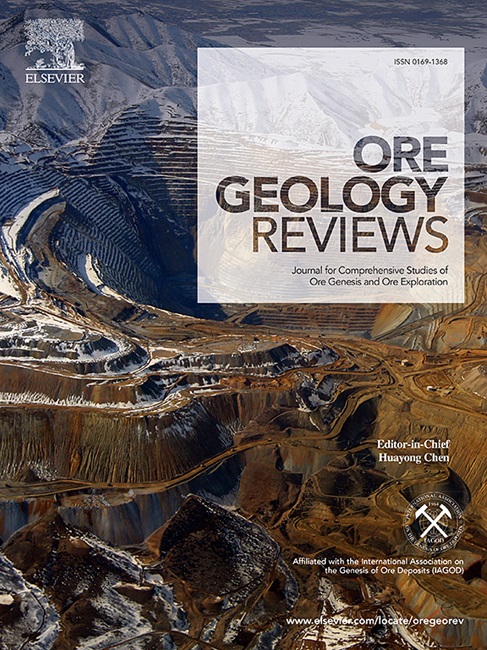
Ore Geology Reviews aims to familiarize all earth scientists with recent advances in a number of interconnected disciplines related to the study of, and search for, ore deposits. The reviews range from brief to longer contributions, but the journal preferentially publishes manuscripts that fill the niche between the commonly shorter journal articles and the comprehensive book coverages, and thus has a special appeal to many authors and readers.




 京公网安备 11010802042870号
京ICP备2023020795号-1
京公网安备 11010802042870号
京ICP备2023020795号-1

 分享
分享
 求助内容:
求助内容: 应助结果提醒方式:
 扫码关注我们
