{"title":"The co-effects of technology innovation and digital infrastructure on central bank digital currency: A DSGE analysis","authors":"Wei Peng , Baogui Xin , Hui Tan , Jiwon Kwon","doi":"10.1016/j.ribaf.2025.102783","DOIUrl":null,"url":null,"abstract":"<div><div>The Central Bank Digital Currency (CBDC) stands at the forefront of financial innovation, intertwining with the coevolution of technology innovation and digital infrastructure. Despite their significance, the co-effects of technology innovation and digital infrastructure on the evolution and efficacy of CBDCs remain underexplored. This study introduces a dynamic stochastic general equilibrium (DSGE) model that encapsulates various economic agents, including households, firms in different stages, financial institutions, and policy authorities, to simulate real-world interactions and policy implications. We uncover a non-linear relationship between CBDCs and traditional banking deposits, challenging and reconciling disparate views in the existing literature. The study reveals that while CBDCs can potentially enhance macroeconomic stability and efficiency in the short term, their long-term impact is contingent upon sustained technology innovation and robust digital infrastructure. These findings offer nuanced insights into the co-evolutionary process of financial mechanisms and technological progress, providing a theoretical foundation for policymakers to navigate the complex dynamics of introducing CBDCs within the digital economy. This research not only bridges a critical gap in financial innovation literature but also charts a course for future empirical investigations into the broader economic ramifications of CBDC implementation.</div></div>","PeriodicalId":51430,"journal":{"name":"Research in International Business and Finance","volume":"75 ","pages":"Article 102783"},"PeriodicalIF":6.9000,"publicationDate":"2025-01-28","publicationTypes":"Journal Article","fieldsOfStudy":null,"isOpenAccess":false,"openAccessPdf":"","citationCount":"0","resultStr":null,"platform":"Semanticscholar","paperid":null,"PeriodicalName":"Research in International Business and Finance","FirstCategoryId":"96","ListUrlMain":"https://www.sciencedirect.com/science/article/pii/S027553192500039X","RegionNum":2,"RegionCategory":"经济学","ArticlePicture":[],"TitleCN":null,"AbstractTextCN":null,"PMCID":null,"EPubDate":"","PubModel":"","JCR":"Q1","JCRName":"BUSINESS, FINANCE","Score":null,"Total":0}
引用次数: 0
Abstract
The Central Bank Digital Currency (CBDC) stands at the forefront of financial innovation, intertwining with the coevolution of technology innovation and digital infrastructure. Despite their significance, the co-effects of technology innovation and digital infrastructure on the evolution and efficacy of CBDCs remain underexplored. This study introduces a dynamic stochastic general equilibrium (DSGE) model that encapsulates various economic agents, including households, firms in different stages, financial institutions, and policy authorities, to simulate real-world interactions and policy implications. We uncover a non-linear relationship between CBDCs and traditional banking deposits, challenging and reconciling disparate views in the existing literature. The study reveals that while CBDCs can potentially enhance macroeconomic stability and efficiency in the short term, their long-term impact is contingent upon sustained technology innovation and robust digital infrastructure. These findings offer nuanced insights into the co-evolutionary process of financial mechanisms and technological progress, providing a theoretical foundation for policymakers to navigate the complex dynamics of introducing CBDCs within the digital economy. This research not only bridges a critical gap in financial innovation literature but also charts a course for future empirical investigations into the broader economic ramifications of CBDC implementation.
期刊介绍:
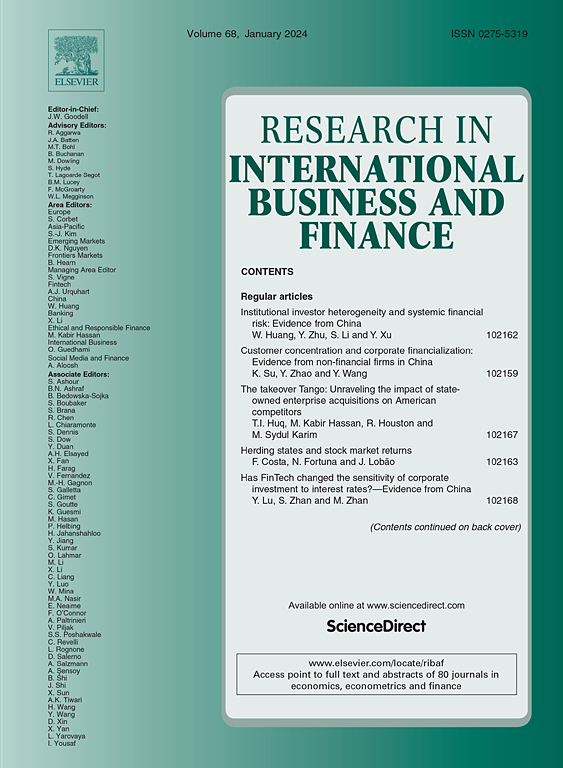
Research in International Business and Finance (RIBAF) seeks to consolidate its position as a premier scholarly vehicle of academic finance. The Journal publishes high quality, insightful, well-written papers that explore current and new issues in international finance. Papers that foster dialogue, innovation, and intellectual risk-taking in financial studies; as well as shed light on the interaction between finance and broader societal concerns are particularly appreciated. The Journal welcomes submissions that seek to expand the boundaries of academic finance and otherwise challenge the discipline. Papers studying finance using a variety of methodologies; as well as interdisciplinary studies will be considered for publication. Papers that examine topical issues using extensive international data sets are welcome. Single-country studies can also be considered for publication provided that they develop novel methodological and theoretical approaches or fall within the Journal''s priority themes. It is especially important that single-country studies communicate to the reader why the particular chosen country is especially relevant to the issue being investigated. [...] The scope of topics that are most interesting to RIBAF readers include the following: -Financial markets and institutions -Financial practices and sustainability -The impact of national culture on finance -The impact of formal and informal institutions on finance -Privatizations, public financing, and nonprofit issues in finance -Interdisciplinary financial studies -Finance and international development -International financial crises and regulation -Financialization studies -International financial integration and architecture -Behavioral aspects in finance -Consumer finance -Methodologies and conceptualization issues related to finance



 京公网安备 11010802042870号
京ICP备2023020795号-1
京公网安备 11010802042870号
京ICP备2023020795号-1

 分享
分享
 求助内容:
求助内容: 应助结果提醒方式:
 扫码关注我们
