Rational design of fast-responding and highly selective fluorescent probes for detecting and imaging acetylcholinesterase homeostatic changes in Alzheimer's disease
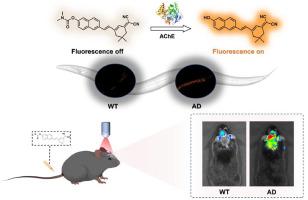
{"title":"Rational design of fast-responding and highly selective fluorescent probes for detecting and imaging acetylcholinesterase homeostatic changes in Alzheimer's disease","authors":"Inam Ullah , Chenrun Zhang , Yiwen Shao, Jiawen Shen, Hai-Liang Zhu","doi":"10.1016/j.dyepig.2025.112636","DOIUrl":null,"url":null,"abstract":"<div><div>Alzheimer's disease (AD) is a progressive amnestic cognitive deteriorating neurodegenerative disease. Acetylcholinesterase (AChE) has a very high catalytic hydrolysis efficiency, which can rapidly hydrolyze acetylcholine into choline, playing a critical role in regulating the nervous system. Therefore, we designed and synthesized a fluorescent probe capable of quantitatively detecting AChE called <strong>ACP</strong>. Most strikingly, an extremely low detection limit of 0.341U/mL is far superior to those of many probes. The approach of utilizing <strong>ACP</strong> enabled us to swiftly identify and track real-time alterations in intracellular AChE levels. Additionally, our study marks the pioneering use of <strong>ACP</strong> in effectively detecting an increase in AChE expression in <em>C. elegans</em> and mice models of Alzheimer's disease (AD). In conclusion, this study provides a new tool for quantitatively detecting AChE levels and shows great potential for application in AChE-related studies.</div></div>","PeriodicalId":302,"journal":{"name":"Dyes and Pigments","volume":"236 ","pages":"Article 112636"},"PeriodicalIF":4.2000,"publicationDate":"2025-01-15","publicationTypes":"Journal Article","fieldsOfStudy":null,"isOpenAccess":false,"openAccessPdf":"","citationCount":"0","resultStr":null,"platform":"Semanticscholar","paperid":null,"PeriodicalName":"Dyes and Pigments","FirstCategoryId":"88","ListUrlMain":"https://www.sciencedirect.com/science/article/pii/S0143720825000063","RegionNum":3,"RegionCategory":"工程技术","ArticlePicture":[],"TitleCN":null,"AbstractTextCN":null,"PMCID":null,"EPubDate":"","PubModel":"","JCR":"Q2","JCRName":"CHEMISTRY, APPLIED","Score":null,"Total":0}
引用次数: 0
Abstract
Alzheimer's disease (AD) is a progressive amnestic cognitive deteriorating neurodegenerative disease. Acetylcholinesterase (AChE) has a very high catalytic hydrolysis efficiency, which can rapidly hydrolyze acetylcholine into choline, playing a critical role in regulating the nervous system. Therefore, we designed and synthesized a fluorescent probe capable of quantitatively detecting AChE called ACP. Most strikingly, an extremely low detection limit of 0.341U/mL is far superior to those of many probes. The approach of utilizing ACP enabled us to swiftly identify and track real-time alterations in intracellular AChE levels. Additionally, our study marks the pioneering use of ACP in effectively detecting an increase in AChE expression in C. elegans and mice models of Alzheimer's disease (AD). In conclusion, this study provides a new tool for quantitatively detecting AChE levels and shows great potential for application in AChE-related studies.
期刊介绍:
Dyes and Pigments covers the scientific and technical aspects of the chemistry and physics of dyes, pigments and their intermediates. Emphasis is placed on the properties of the colouring matters themselves rather than on their applications or the system in which they may be applied.
Thus the journal accepts research and review papers on the synthesis of dyes, pigments and intermediates, their physical or chemical properties, e.g. spectroscopic, surface, solution or solid state characteristics, the physical aspects of their preparation, e.g. precipitation, nucleation and growth, crystal formation, liquid crystalline characteristics, their photochemical, ecological or biological properties and the relationship between colour and chemical constitution. However, papers are considered which deal with the more fundamental aspects of colourant application and of the interactions of colourants with substrates or media.
The journal will interest a wide variety of workers in a range of disciplines whose work involves dyes, pigments and their intermediates, and provides a platform for investigators with common interests but diverse fields of activity such as cosmetics, reprographics, dye and pigment synthesis, medical research, polymers, etc.



 京公网安备 11010802042870号
京ICP备2023020795号-1
京公网安备 11010802042870号
京ICP备2023020795号-1

 分享
分享
 求助内容:
求助内容: 应助结果提醒方式:
 扫码关注我们
