Formation behavior of subcrystals and its strengthening and toughening mechanism by coupling with α phase in titanium alloys during forging at various temperatures
{"title":"Formation behavior of subcrystals and its strengthening and toughening mechanism by coupling with α phase in titanium alloys during forging at various temperatures","authors":"Shichen Sun , Hongze Fang , Jiaqi Hao , Baohui Zhu , Xianfei Ding , Ruirun Chen","doi":"10.1016/j.jmatprotec.2024.118705","DOIUrl":null,"url":null,"abstract":"<div><div>Subgrain formation and its coupling with the α phase significantly improve the strength and toughness of titanium alloys. To elucidate the effect of temperature changes on the formation mechanism of nano-subgrains in Ti-6V-5Al-5Mo-5Cr-3Nb-2Zr-0.2Si alloy, multi-directional forging was conducted at various temperatures, and finally quantified the contribution of subgrains and phase evolution to mechanical properties. The results revealed that the equiaxed α phase precipitates at the β grain boundary. As the temperature rises, the aspect ratio of the α phase increases, while its content decreases. The formation mechanism of nano-subgrains during multi-directional forging at 690 ℃ involves dislocation accumulation and the separation of torsional bands within the β grains. When the temperature increases, the deformation resistance decreases, eliminating the need for crystal torsion to reduce this resistance. Subsequently, high-density dislocations form dislocation walls, which delineate the boundaries of fine nano-subgrains. This random orientation of subgrains significantly enhances both the strength and toughness of the titanium alloy forged at 770 ℃. Therefore, the tensile strength and fracture toughness of the alloy reach peak values of 1084.8 MPa and 54.18 MPa·m<sup>1/2</sup>, respectively. Microstructural analysis of the cracks reveals that the nano-subgrains effectively hinder their rapid propagation. Due to the coupled strengthening effect of subgrains and α phases, the tensile strength and fracture toughness of the titanium alloy forged at 770 ℃ are increased by 26 % and 40 % respectively compared with the as-cast alloy.</div></div>","PeriodicalId":367,"journal":{"name":"Journal of Materials Processing Technology","volume":"336 ","pages":"Article 118705"},"PeriodicalIF":7.5000,"publicationDate":"2025-02-01","publicationTypes":"Journal Article","fieldsOfStudy":null,"isOpenAccess":false,"openAccessPdf":"","citationCount":"0","resultStr":null,"platform":"Semanticscholar","paperid":null,"PeriodicalName":"Journal of Materials Processing Technology","FirstCategoryId":"88","ListUrlMain":"https://www.sciencedirect.com/science/article/pii/S0924013624004230","RegionNum":2,"RegionCategory":"材料科学","ArticlePicture":[],"TitleCN":null,"AbstractTextCN":null,"PMCID":null,"EPubDate":"2024/12/25 0:00:00","PubModel":"Epub","JCR":"Q1","JCRName":"ENGINEERING, INDUSTRIAL","Score":null,"Total":0}
引用次数: 0
Abstract
Subgrain formation and its coupling with the α phase significantly improve the strength and toughness of titanium alloys. To elucidate the effect of temperature changes on the formation mechanism of nano-subgrains in Ti-6V-5Al-5Mo-5Cr-3Nb-2Zr-0.2Si alloy, multi-directional forging was conducted at various temperatures, and finally quantified the contribution of subgrains and phase evolution to mechanical properties. The results revealed that the equiaxed α phase precipitates at the β grain boundary. As the temperature rises, the aspect ratio of the α phase increases, while its content decreases. The formation mechanism of nano-subgrains during multi-directional forging at 690 ℃ involves dislocation accumulation and the separation of torsional bands within the β grains. When the temperature increases, the deformation resistance decreases, eliminating the need for crystal torsion to reduce this resistance. Subsequently, high-density dislocations form dislocation walls, which delineate the boundaries of fine nano-subgrains. This random orientation of subgrains significantly enhances both the strength and toughness of the titanium alloy forged at 770 ℃. Therefore, the tensile strength and fracture toughness of the alloy reach peak values of 1084.8 MPa and 54.18 MPa·m1/2, respectively. Microstructural analysis of the cracks reveals that the nano-subgrains effectively hinder their rapid propagation. Due to the coupled strengthening effect of subgrains and α phases, the tensile strength and fracture toughness of the titanium alloy forged at 770 ℃ are increased by 26 % and 40 % respectively compared with the as-cast alloy.
期刊介绍:
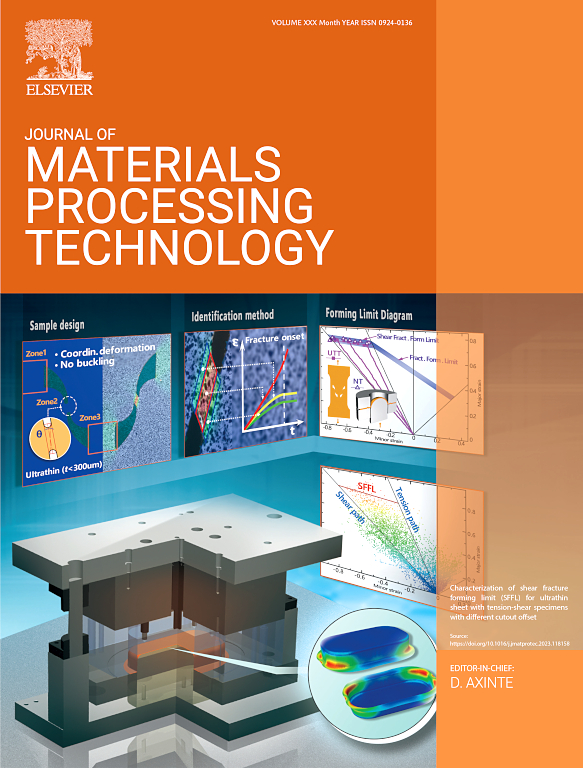
The Journal of Materials Processing Technology covers the processing techniques used in manufacturing components from metals and other materials. The journal aims to publish full research papers of original, significant and rigorous work and so to contribute to increased production efficiency and improved component performance.
Areas of interest to the journal include:
• Casting, forming and machining
• Additive processing and joining technologies
• The evolution of material properties under the specific conditions met in manufacturing processes
• Surface engineering when it relates specifically to a manufacturing process
• Design and behavior of equipment and tools.



 京公网安备 11010802042870号
京ICP备2023020795号-1
京公网安备 11010802042870号
京ICP备2023020795号-1

 分享
分享
 求助内容:
求助内容: 应助结果提醒方式:
 扫码关注我们
