Unveiling the biodeterioration activity of microbial communities to the historical manuscript: Biocontrol using biosynthesized gold and zinc oxide nanoparticles
Sultan M. Alsharif , Ahmed M. Eid , Saad El-Din Hassan , Mohammed Ali Abdel-Rahman , Gomaa Abdel-Maksoud , Duaa A. Bukhari , Fatmah O. sefrji , Abdulmajeed A. Alqurashi , Moayad S. Waznah , Amr Fouda
{"title":"Unveiling the biodeterioration activity of microbial communities to the historical manuscript: Biocontrol using biosynthesized gold and zinc oxide nanoparticles","authors":"Sultan M. Alsharif , Ahmed M. Eid , Saad El-Din Hassan , Mohammed Ali Abdel-Rahman , Gomaa Abdel-Maksoud , Duaa A. Bukhari , Fatmah O. sefrji , Abdulmajeed A. Alqurashi , Moayad S. Waznah , Amr Fouda","doi":"10.1016/j.culher.2025.01.001","DOIUrl":null,"url":null,"abstract":"<div><div>Determining characteristics of deteriorated historical manuscripts and identifying the microbial strains associated with their deterioration opens the way for discovering new strategies for preservation. Evidence of deterioration in an archaeological manuscript from the 17th century was detected by optical and SEM-EDX analysis. Ten bacterial and seven fungal strains were obtained from deteriorated parts of the manuscript. These microbial strains were identified based on 16S rRNA and ITS sequence analysis as follows: <em>Bacillus subtilis</em> (two strains), one strain of <em>B. cereus, B. amyloliquefaciens</em> and <em>Acinetobacter haemolyticus. A. indicus</em> (two strains), one strain of <em>Sphingomonas paucimobilis, Serratia plymuthica, Staphylococcus epidermidis, Aspergillus flavus</em> and <em>A. ustus, A. chinensis</em> (two strains), one strain of <em>Penicillium chrysogenum, P. citrinum</em> and <em>Paecilomyces variotii.</em> The superior efficacy of these strains in biodeterioration <em>via</em> various hydrolytic enzymes was explored. For an appropriate, eco-friendly, safe, and cost-effective method for microbial biodeterioration treatment, gold nanoparticles (Au-NPs) and zinc oxide nanoparticles (ZnO<img>NPs) were fabricated from aqueous leaf extracts of <em>Portulaca oleracea</em> L. The synthesized NPs were spherical, crystallographic, and well arranged, with average sizes of 38 nm (Au-NPs) and 23 nm (ZnO<img>NPs). NPs at two concentrations (100 and 200 µg mL<sup>–1</sup>) were used to inhibit bacterial and fungal growth. The data obtained revealed that the antimicrobial activity was concentration dependent. Compared with the Au-NPs, the plant-generated ZnO<img>NPs showed superior antimicrobial activity. Overall, the plant-mediated production of NPs offers a promising eco-friendly approach for treating microbial biodeterioration in historical artifacts.</div></div>","PeriodicalId":15480,"journal":{"name":"Journal of Cultural Heritage","volume":"71 ","pages":"Pages 440-452"},"PeriodicalIF":3.3000,"publicationDate":"2025-01-01","publicationTypes":"Journal Article","fieldsOfStudy":null,"isOpenAccess":false,"openAccessPdf":"","citationCount":"0","resultStr":null,"platform":"Semanticscholar","paperid":null,"PeriodicalName":"Journal of Cultural Heritage","FirstCategoryId":"103","ListUrlMain":"https://www.sciencedirect.com/science/article/pii/S1296207425000019","RegionNum":2,"RegionCategory":"综合性期刊","ArticlePicture":[],"TitleCN":null,"AbstractTextCN":null,"PMCID":null,"EPubDate":"2025/1/14 0:00:00","PubModel":"Epub","JCR":"0","JCRName":"ARCHAEOLOGY","Score":null,"Total":0}
引用次数: 0
Abstract
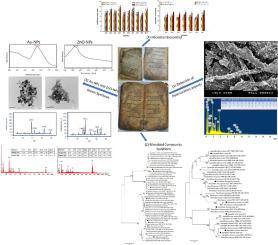
Determining characteristics of deteriorated historical manuscripts and identifying the microbial strains associated with their deterioration opens the way for discovering new strategies for preservation. Evidence of deterioration in an archaeological manuscript from the 17th century was detected by optical and SEM-EDX analysis. Ten bacterial and seven fungal strains were obtained from deteriorated parts of the manuscript. These microbial strains were identified based on 16S rRNA and ITS sequence analysis as follows: Bacillus subtilis (two strains), one strain of B. cereus, B. amyloliquefaciens and Acinetobacter haemolyticus. A. indicus (two strains), one strain of Sphingomonas paucimobilis, Serratia plymuthica, Staphylococcus epidermidis, Aspergillus flavus and A. ustus, A. chinensis (two strains), one strain of Penicillium chrysogenum, P. citrinum and Paecilomyces variotii. The superior efficacy of these strains in biodeterioration via various hydrolytic enzymes was explored. For an appropriate, eco-friendly, safe, and cost-effective method for microbial biodeterioration treatment, gold nanoparticles (Au-NPs) and zinc oxide nanoparticles (ZnONPs) were fabricated from aqueous leaf extracts of Portulaca oleracea L. The synthesized NPs were spherical, crystallographic, and well arranged, with average sizes of 38 nm (Au-NPs) and 23 nm (ZnONPs). NPs at two concentrations (100 and 200 µg mL–1) were used to inhibit bacterial and fungal growth. The data obtained revealed that the antimicrobial activity was concentration dependent. Compared with the Au-NPs, the plant-generated ZnONPs showed superior antimicrobial activity. Overall, the plant-mediated production of NPs offers a promising eco-friendly approach for treating microbial biodeterioration in historical artifacts.
期刊介绍:
The Journal of Cultural Heritage publishes original papers which comprise previously unpublished data and present innovative methods concerning all aspects of science and technology of cultural heritage as well as interpretation and theoretical issues related to preservation.



 京公网安备 11010802042870号
京ICP备2023020795号-1
京公网安备 11010802042870号
京ICP备2023020795号-1

 分享
分享
 求助内容:
求助内容: 应助结果提醒方式:
 扫码关注我们
