{"title":"Seasonal eutrophication in lentic small waterbodies: Understanding nutrients-chlorophyll-a relationships and implications","authors":"Pooja Singh, Basant Yadav","doi":"10.1016/j.hazadv.2024.100563","DOIUrl":null,"url":null,"abstract":"<div><div>Assessing seasonal variations in pollution within lentic small waterbodies (LSWBs) is crucial, particularly in regions with significant temperature and rainfall fluctuations, as these variations are driven by natural and anthropogenic inputs from both point and non-point sources. This study assesses the seasonal dynamics of physicochemical parameters and their impact on the trophic status of lentic small waterbodies (LSWBs). Using statistical modeling, including regression analysis, it explores chlorophyll-a (Chl-a) as a proxy for eutrophication and establishes empirical relationships between nutrients (TN, TP) and Chl-a based on data collected from December 2022 to November 2023. The ratios of total nitrogen (TN) to total phosphorus (TP) were analysed to understand the conditions that limit phytoplankton biomass production. Nutrient (TN, TP)-Chl-a correlations were established to explain seasonal eutrophication in these waterbodies. Furthermore, the trophic level index (TLI) was employed to assess the eutrophication status across seasons. The results suggest that LSWBs are the most polluted during the monsoon season, characterised by low Secchi disk depth (SDD) and dissolved oxygen (DO), along with high TN/TP concentrations from domestic sewage and agricultural runoff. Nutrient (TN:TP) ratios and their correlations with Chl-a suggest that TN (<10) primarily affects algal growth, especially during monsoons. TN:TP ratio displayed a notable rise in the post-monsoon season for all three LSWBs. TLI assessment indicated a general deterioration in water quality from oligotrophic (0 to 30) to hypertrophic (70 to 100) conditions in the monsoon and post-monsoon seasons. Our findings highlight the importance of accounting for limitation-specific, season-specific, and type-specific correlations between algal biomass and environmental factors. By subdividing water bodies for type-specific management, the research offers a framework to address the limitations in interpreting empirical nutrient-Chl-a relationships. These findings contribute to more accurate, site-specific management strategies for mitigating eutrophication, advancing both regional and global efforts to protect freshwater ecosystems.</div></div>","PeriodicalId":73763,"journal":{"name":"Journal of hazardous materials advances","volume":"17 ","pages":"Article 100563"},"PeriodicalIF":7.7000,"publicationDate":"2025-02-01","publicationTypes":"Journal Article","fieldsOfStudy":null,"isOpenAccess":false,"openAccessPdf":"","citationCount":"0","resultStr":null,"platform":"Semanticscholar","paperid":null,"PeriodicalName":"Journal of hazardous materials advances","FirstCategoryId":"1085","ListUrlMain":"https://www.sciencedirect.com/science/article/pii/S2772416624001633","RegionNum":0,"RegionCategory":null,"ArticlePicture":[],"TitleCN":null,"AbstractTextCN":null,"PMCID":null,"EPubDate":"2024/12/10 0:00:00","PubModel":"Epub","JCR":"Q2","JCRName":"ENGINEERING, ENVIRONMENTAL","Score":null,"Total":0}
引用次数: 0
Abstract
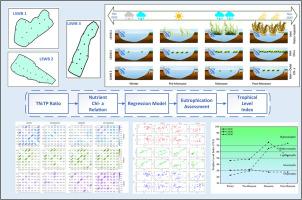
Assessing seasonal variations in pollution within lentic small waterbodies (LSWBs) is crucial, particularly in regions with significant temperature and rainfall fluctuations, as these variations are driven by natural and anthropogenic inputs from both point and non-point sources. This study assesses the seasonal dynamics of physicochemical parameters and their impact on the trophic status of lentic small waterbodies (LSWBs). Using statistical modeling, including regression analysis, it explores chlorophyll-a (Chl-a) as a proxy for eutrophication and establishes empirical relationships between nutrients (TN, TP) and Chl-a based on data collected from December 2022 to November 2023. The ratios of total nitrogen (TN) to total phosphorus (TP) were analysed to understand the conditions that limit phytoplankton biomass production. Nutrient (TN, TP)-Chl-a correlations were established to explain seasonal eutrophication in these waterbodies. Furthermore, the trophic level index (TLI) was employed to assess the eutrophication status across seasons. The results suggest that LSWBs are the most polluted during the monsoon season, characterised by low Secchi disk depth (SDD) and dissolved oxygen (DO), along with high TN/TP concentrations from domestic sewage and agricultural runoff. Nutrient (TN:TP) ratios and their correlations with Chl-a suggest that TN (<10) primarily affects algal growth, especially during monsoons. TN:TP ratio displayed a notable rise in the post-monsoon season for all three LSWBs. TLI assessment indicated a general deterioration in water quality from oligotrophic (0 to 30) to hypertrophic (70 to 100) conditions in the monsoon and post-monsoon seasons. Our findings highlight the importance of accounting for limitation-specific, season-specific, and type-specific correlations between algal biomass and environmental factors. By subdividing water bodies for type-specific management, the research offers a framework to address the limitations in interpreting empirical nutrient-Chl-a relationships. These findings contribute to more accurate, site-specific management strategies for mitigating eutrophication, advancing both regional and global efforts to protect freshwater ecosystems.




 京公网安备 11010802042870号
京ICP备2023020795号-1
京公网安备 11010802042870号
京ICP备2023020795号-1

 分享
分享
 求助内容:
求助内容: 应助结果提醒方式:
 扫码关注我们
