{"title":"Enhanced electrochemical removal of sulfamethazine on Sm-doped Ti4O7 anode: Mechanisms and toxicity evaluation","authors":"Nan Tao , Yina Tian , Jianing Wang , Jie Teng","doi":"10.1016/j.hazadv.2025.100607","DOIUrl":null,"url":null,"abstract":"<div><div>As one typical broad-spectrum antibiotics, the abuse of sulfonamide induce potential ecology risk to aquatic environment. Here, the novel Sm-doped Ti<sub>4</sub>O<sub>7</sub> electrode (Sm-Ti<sub>4</sub>O<sub>7</sub>) were fabricated using a facile spark plasma sintering (SPS) method for anodic decomposition of recalcitrant pollutants of sulfamethazine (SMZ). Electrochemical degradation experiments demonstrated that the 0.25% Sm-Ti<sub>4</sub>O<sub>7</sub> anode achieved a remarkable 91.2% removal SMZ (<em>k</em><sub>obs</sub> = 0.0158 min<sup>−1</sup>), which the degradation kinetics was 3.16 times higher than that of the pristine Ti<sub>4</sub>O<sub>7</sub> anode. Electron paramagnetic resonance (EPR) and quenching experiments confirmed that hydroxyl radicals (•OH) were the primary active species responsible for the SMZ degradation. Linear sweep voltammetry (LSV) revealed that the oxygen evolution potential (OEP) of 0.25% Sm-Ti<sub>4</sub>O<sub>7</sub> anode was 2.23 V (vs. standard hydrogen electrode, SHE), which is higher than that of pristine Ti<sub>4</sub>O<sub>7</sub> anode. Thus, the one-electron water oxidation reaction was boosted on 0.25% Sm-Ti<sub>4</sub>O<sub>7</sub> anode for producing highly reactive of •OH. The degradation pathway and intermediate products were validated using high-performance liquid chromatography-tandem mass spectrometry (HPLC-MS/MS), and the toxicity analysis was also estimated. In summary, the doping of rare metal Sm in Ti<sub>4</sub>O<sub>7</sub> could boosts the electro-generation of hydroxyl radical via H<sub>2</sub>O oxidation, which make the electrochemical oxidation more effective and efficient.</div></div>","PeriodicalId":73763,"journal":{"name":"Journal of hazardous materials advances","volume":"17 ","pages":"Article 100607"},"PeriodicalIF":7.7000,"publicationDate":"2025-02-01","publicationTypes":"Journal Article","fieldsOfStudy":null,"isOpenAccess":false,"openAccessPdf":"","citationCount":"0","resultStr":null,"platform":"Semanticscholar","paperid":null,"PeriodicalName":"Journal of hazardous materials advances","FirstCategoryId":"1085","ListUrlMain":"https://www.sciencedirect.com/science/article/pii/S2772416625000191","RegionNum":0,"RegionCategory":null,"ArticlePicture":[],"TitleCN":null,"AbstractTextCN":null,"PMCID":null,"EPubDate":"","PubModel":"","JCR":"Q2","JCRName":"ENGINEERING, ENVIRONMENTAL","Score":null,"Total":0}
引用次数: 0
Abstract
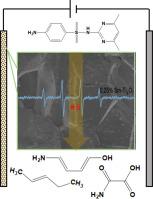
As one typical broad-spectrum antibiotics, the abuse of sulfonamide induce potential ecology risk to aquatic environment. Here, the novel Sm-doped Ti4O7 electrode (Sm-Ti4O7) were fabricated using a facile spark plasma sintering (SPS) method for anodic decomposition of recalcitrant pollutants of sulfamethazine (SMZ). Electrochemical degradation experiments demonstrated that the 0.25% Sm-Ti4O7 anode achieved a remarkable 91.2% removal SMZ (kobs = 0.0158 min−1), which the degradation kinetics was 3.16 times higher than that of the pristine Ti4O7 anode. Electron paramagnetic resonance (EPR) and quenching experiments confirmed that hydroxyl radicals (•OH) were the primary active species responsible for the SMZ degradation. Linear sweep voltammetry (LSV) revealed that the oxygen evolution potential (OEP) of 0.25% Sm-Ti4O7 anode was 2.23 V (vs. standard hydrogen electrode, SHE), which is higher than that of pristine Ti4O7 anode. Thus, the one-electron water oxidation reaction was boosted on 0.25% Sm-Ti4O7 anode for producing highly reactive of •OH. The degradation pathway and intermediate products were validated using high-performance liquid chromatography-tandem mass spectrometry (HPLC-MS/MS), and the toxicity analysis was also estimated. In summary, the doping of rare metal Sm in Ti4O7 could boosts the electro-generation of hydroxyl radical via H2O oxidation, which make the electrochemical oxidation more effective and efficient.




 京公网安备 11010802042870号
京ICP备2023020795号-1
京公网安备 11010802042870号
京ICP备2023020795号-1

 分享
分享
 求助内容:
求助内容: 应助结果提醒方式:
 扫码关注我们
