Yuan Meng , Yuping Sun , Ning Wang , Shuyan Li , Lijun Guan , Yapeng Fan , Xuke Lu , Nan Xu , Shuai Wang , Hui Huang , Xiugui Chen , Junjuan Wang , Lanjie Zhao , Lixue Guo , Hongyu Nan , Xiaoping Zhu , Keyun Feng , Kunpeng Zhang , Wuwei Ye
{"title":"GhSERAT1 enhanced the resistance of cotton to cadmium by maintaining the microscopic integrity of chloroplasts in cotton","authors":"Yuan Meng , Yuping Sun , Ning Wang , Shuyan Li , Lijun Guan , Yapeng Fan , Xuke Lu , Nan Xu , Shuai Wang , Hui Huang , Xiugui Chen , Junjuan Wang , Lanjie Zhao , Lixue Guo , Hongyu Nan , Xiaoping Zhu , Keyun Feng , Kunpeng Zhang , Wuwei Ye","doi":"10.1016/j.hazadv.2025.100606","DOIUrl":null,"url":null,"abstract":"<div><div>Cysteine metabolism is essential for plants to alleviate cadmium (Cd<sup>2+</sup>) stress. Investigating the function of serine acetyltransferase (SAT), the pivotal enzyme in cysteine synthesis, in combating Cd<sup>2+</sup> stress is highly significant. This study conducted a bioinformatics analysis of the SAT gene family and identified key candidate genes, <em>GhSERAT1;1</em> and <em>GhSERAT1;2</em>, that respond to Cd<sup>2+</sup> stress. Plants subjected to gene silencing of <em>GhSERAT1;1</em> and <em>GhSERAT1;2</em> through virus-induced gene silencing exhibited a notable reduction in cysteine and glutathione levels, an increase in intracellular malondialdehyde content, and heightened sensitivity to Cd<sup>2+</sup> stress. Compared with non-silenced plants, those with silenced genes displayed poorer growth conditions, decreased biomass, and more pronounced damage to chloroplast and leaf structures when exposed to Cd<sup>2+</sup> stress. This study integrated the primary enzyme involved in cysteine synthesis with Cd<sup>2+</sup> stress, elucidating the relationship between Cd<sup>2+</sup> and cysteine. These findings significantly enhance our understanding of cysteine synthesis genes and contribute to developing Cd<sup>2+</sup>-resistant plant breeding strategies.</div></div>","PeriodicalId":73763,"journal":{"name":"Journal of hazardous materials advances","volume":"17 ","pages":"Article 100606"},"PeriodicalIF":7.7000,"publicationDate":"2025-02-01","publicationTypes":"Journal Article","fieldsOfStudy":null,"isOpenAccess":false,"openAccessPdf":"","citationCount":"0","resultStr":null,"platform":"Semanticscholar","paperid":null,"PeriodicalName":"Journal of hazardous materials advances","FirstCategoryId":"1085","ListUrlMain":"https://www.sciencedirect.com/science/article/pii/S277241662500018X","RegionNum":0,"RegionCategory":null,"ArticlePicture":[],"TitleCN":null,"AbstractTextCN":null,"PMCID":null,"EPubDate":"","PubModel":"","JCR":"Q2","JCRName":"ENGINEERING, ENVIRONMENTAL","Score":null,"Total":0}
引用次数: 0
Abstract
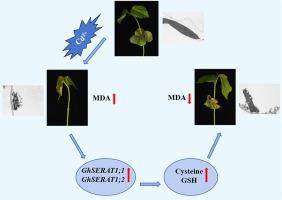
Cysteine metabolism is essential for plants to alleviate cadmium (Cd2+) stress. Investigating the function of serine acetyltransferase (SAT), the pivotal enzyme in cysteine synthesis, in combating Cd2+ stress is highly significant. This study conducted a bioinformatics analysis of the SAT gene family and identified key candidate genes, GhSERAT1;1 and GhSERAT1;2, that respond to Cd2+ stress. Plants subjected to gene silencing of GhSERAT1;1 and GhSERAT1;2 through virus-induced gene silencing exhibited a notable reduction in cysteine and glutathione levels, an increase in intracellular malondialdehyde content, and heightened sensitivity to Cd2+ stress. Compared with non-silenced plants, those with silenced genes displayed poorer growth conditions, decreased biomass, and more pronounced damage to chloroplast and leaf structures when exposed to Cd2+ stress. This study integrated the primary enzyme involved in cysteine synthesis with Cd2+ stress, elucidating the relationship between Cd2+ and cysteine. These findings significantly enhance our understanding of cysteine synthesis genes and contribute to developing Cd2+-resistant plant breeding strategies.




 京公网安备 11010802042870号
京ICP备2023020795号-1
京公网安备 11010802042870号
京ICP备2023020795号-1

 分享
分享
 求助内容:
求助内容: 应助结果提醒方式:
 扫码关注我们
