Amir Hossein Behroozi , Louise Meunier , Arghavan Mirahsani , Pascale Champagne , Ehssan H. Koupaie
{"title":"Graphene-based materials and technologies for the treatment of PFAS in water: A review of recent developments","authors":"Amir Hossein Behroozi , Louise Meunier , Arghavan Mirahsani , Pascale Champagne , Ehssan H. Koupaie","doi":"10.1016/j.hazadv.2025.100626","DOIUrl":null,"url":null,"abstract":"<div><div>Per and polyfluoroalkyl substances (PFAS) are anthropogenic chemicals used in various commercial and industrial applications. As an emerging global concern due to their ubiquity and toxicity, PFAS are the focus of ongoing environmental research. Although production is partially limited by regulations, PFAS are released in water, soil, and air worldwide. Considering their deleterious impacts on wildlife and humans, developing strategies to capture and remove PFAS is crucial. Graphene materials may be advantageously applied to PFAS remediation. A survey of graphene-based materials and technologies used to treat PFAS-contaminated water is presented in this review. First, the general concept of PFAS and their related environmental and health problems are outlined. Then, the features and structures of graphene-containing materials, including graphene quantum dots, graphene oxide (GO), reduced-GO, carbon nanotubes, and graphene nanoplatelets, are described. Finally, prevailing PFAS treatment techniques, i.e., adsorption, advanced oxidation processes, membrane separation, electrochemical separation, and hybrid applications, are described along with the mechanisms involved. Currently, PFAS cannot be effectively treated to the very low regulatory guidelines (less than one part per billion for certain compounds) using any current methods because of incomplete removal, impractical applications, or operating costs. Barriers remain, including adsorbent regeneration, membrane fouling, system scale up, and toxic by-product generation. Integrating graphene-based materials, especially graphene nanoplatelets, into treatment may address these problems if PFAS can be removed completely without secondary contamination. Further research is required to achieve effective PFAS removal. However, health and environmental risks remain associated with PFAS and graphene-based materials, which must be addressed.</div></div>","PeriodicalId":73763,"journal":{"name":"Journal of hazardous materials advances","volume":"17 ","pages":"Article 100626"},"PeriodicalIF":7.7000,"publicationDate":"2025-02-01","publicationTypes":"Journal Article","fieldsOfStudy":null,"isOpenAccess":false,"openAccessPdf":"","citationCount":"0","resultStr":null,"platform":"Semanticscholar","paperid":null,"PeriodicalName":"Journal of hazardous materials advances","FirstCategoryId":"1085","ListUrlMain":"https://www.sciencedirect.com/science/article/pii/S2772416625000385","RegionNum":0,"RegionCategory":null,"ArticlePicture":[],"TitleCN":null,"AbstractTextCN":null,"PMCID":null,"EPubDate":"","PubModel":"","JCR":"Q2","JCRName":"ENGINEERING, ENVIRONMENTAL","Score":null,"Total":0}
引用次数: 0
Abstract
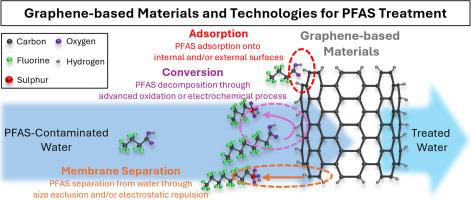
Per and polyfluoroalkyl substances (PFAS) are anthropogenic chemicals used in various commercial and industrial applications. As an emerging global concern due to their ubiquity and toxicity, PFAS are the focus of ongoing environmental research. Although production is partially limited by regulations, PFAS are released in water, soil, and air worldwide. Considering their deleterious impacts on wildlife and humans, developing strategies to capture and remove PFAS is crucial. Graphene materials may be advantageously applied to PFAS remediation. A survey of graphene-based materials and technologies used to treat PFAS-contaminated water is presented in this review. First, the general concept of PFAS and their related environmental and health problems are outlined. Then, the features and structures of graphene-containing materials, including graphene quantum dots, graphene oxide (GO), reduced-GO, carbon nanotubes, and graphene nanoplatelets, are described. Finally, prevailing PFAS treatment techniques, i.e., adsorption, advanced oxidation processes, membrane separation, electrochemical separation, and hybrid applications, are described along with the mechanisms involved. Currently, PFAS cannot be effectively treated to the very low regulatory guidelines (less than one part per billion for certain compounds) using any current methods because of incomplete removal, impractical applications, or operating costs. Barriers remain, including adsorbent regeneration, membrane fouling, system scale up, and toxic by-product generation. Integrating graphene-based materials, especially graphene nanoplatelets, into treatment may address these problems if PFAS can be removed completely without secondary contamination. Further research is required to achieve effective PFAS removal. However, health and environmental risks remain associated with PFAS and graphene-based materials, which must be addressed.




 京公网安备 11010802042870号
京ICP备2023020795号-1
京公网安备 11010802042870号
京ICP备2023020795号-1

 分享
分享
 求助内容:
求助内容: 应助结果提醒方式:
 扫码关注我们
