Yihao Li , Jie Guan , Xiaojiao Zhang , Jie Yang , Shuai Chen , Yaoguang Guo , Donghai Lin , Qin Xu , Yanlin Wu , Hao Yuan , Jue Dai
{"title":"Conversion of waste photovoltaic silicon into silicon-carbon nanocages for lithium batteries anodes preparation","authors":"Yihao Li , Jie Guan , Xiaojiao Zhang , Jie Yang , Shuai Chen , Yaoguang Guo , Donghai Lin , Qin Xu , Yanlin Wu , Hao Yuan , Jue Dai","doi":"10.1016/j.mtsust.2024.101050","DOIUrl":null,"url":null,"abstract":"<div><div>As the global demand for renewable energy surges, the mass decommissioning and disposal of photovoltaic (PV) modules pose significant environmental and economic challenges. In particular, the accumulation of waste silicon from these modules calls for efficient recycling solutions. Silicon possesses a large volume expansion problem during repeated de-embedding of lithium, we instead utilize electrospinning technology to encapsulate the waste silicon in nanocages and introduce titanium dioxide and silver into the structure. A one-step calcination process produces nanoparticle-loaded nanofiber cages, with in situ TiO<sub>2</sub> and Ag particles enhancing structural integrity. The silicon-carbon nanofiber (SATCNF) composite exhibits outstanding electrochemical performance, retaining a reversible capacity of 466.3 mAh/g after 50 cycles at a current density of 0.1 A/g. Furthermore, it demonstrates robust stability during high-rate charge and discharge cycles, maintaining substantial capacity even under elevated current densities. This work not only provides a pathway for mitigating the environmental burden of waste silicon but also contributes to advancements in LIB technology for sustainable energy storage.</div></div>","PeriodicalId":18322,"journal":{"name":"Materials Today Sustainability","volume":"28 ","pages":"Article 101050"},"PeriodicalIF":7.9000,"publicationDate":"2024-12-01","publicationTypes":"Journal Article","fieldsOfStudy":null,"isOpenAccess":false,"openAccessPdf":"","citationCount":"0","resultStr":null,"platform":"Semanticscholar","paperid":null,"PeriodicalName":"Materials Today Sustainability","FirstCategoryId":"88","ListUrlMain":"https://www.sciencedirect.com/science/article/pii/S2589234724003865","RegionNum":3,"RegionCategory":"材料科学","ArticlePicture":[],"TitleCN":null,"AbstractTextCN":null,"PMCID":null,"EPubDate":"","PubModel":"","JCR":"Q1","JCRName":"GREEN & SUSTAINABLE SCIENCE & TECHNOLOGY","Score":null,"Total":0}
引用次数: 0
Abstract
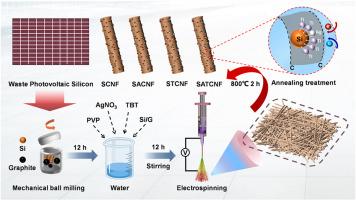
As the global demand for renewable energy surges, the mass decommissioning and disposal of photovoltaic (PV) modules pose significant environmental and economic challenges. In particular, the accumulation of waste silicon from these modules calls for efficient recycling solutions. Silicon possesses a large volume expansion problem during repeated de-embedding of lithium, we instead utilize electrospinning technology to encapsulate the waste silicon in nanocages and introduce titanium dioxide and silver into the structure. A one-step calcination process produces nanoparticle-loaded nanofiber cages, with in situ TiO2 and Ag particles enhancing structural integrity. The silicon-carbon nanofiber (SATCNF) composite exhibits outstanding electrochemical performance, retaining a reversible capacity of 466.3 mAh/g after 50 cycles at a current density of 0.1 A/g. Furthermore, it demonstrates robust stability during high-rate charge and discharge cycles, maintaining substantial capacity even under elevated current densities. This work not only provides a pathway for mitigating the environmental burden of waste silicon but also contributes to advancements in LIB technology for sustainable energy storage.
期刊介绍:
Materials Today Sustainability is a multi-disciplinary journal covering all aspects of sustainability through materials science.
With a rapidly increasing population with growing demands, materials science has emerged as a critical discipline toward protecting of the environment and ensuring the long term survival of future generations.



 京公网安备 11010802042870号
京ICP备2023020795号-1
京公网安备 11010802042870号
京ICP备2023020795号-1

 分享
分享
 求助内容:
求助内容: 应助结果提醒方式:
 扫码关注我们
