Akira Kuwahara, Kenta Murakami, Yuki Mizushima and Hideki Tomita
{"title":"Spectroscopic characterization of uranium atoms in uranium-dioxide laser-produced plasma in a high-vacuum environment†","authors":"Akira Kuwahara, Kenta Murakami, Yuki Mizushima and Hideki Tomita","doi":"10.1039/D4JA00189C","DOIUrl":null,"url":null,"abstract":"<p >The expansion dynamics of target particles are crucial for rapid isotope analysis using resonance ionization mass spectrometry (RIMS) combined with laser ablation as an atomization source. The spatial and temporal spectral signatures in laser-produced plasma (LPP) provide insights for applying RIMS to understand the expansion behavior of target particles. In this study, diode laser absorption spectroscopy was employed to observe U atoms in UO<small><sub>2</sub></small> LPP in a high-vacuum environment (3.0 × 10<small><sup>−4</sup></small> Pa). Results showed the remarkable differences in the expansion dynamics of U atoms compared to Al atoms. Specifically, the UO<small><sub>2</sub></small> ablation plume had a double layer due to charged particles, and the spectra of the U atoms do not exhibit clear spectral splitting. Moreover, the U atoms in the <small><sup>5</sup></small>L<small><sub>6</sub></small> ground state and low-lying <small><sup>5</sup></small>K<small><sub>5</sub></small> meta-stable state (notably, >99% of U atoms generally exist in both energy states) are probed to examine their distributions between the two energy states. The results reveal that approximately 28–38% of the U atoms are distributed in the <small><sup>5</sup></small>K<small><sub>5</sub></small> meta-stable state because of thermal excitation. These quantitative insights provide a clear pathway toward advancing the applications of laser ablation.</p>","PeriodicalId":81,"journal":{"name":"Journal of Analytical Atomic Spectrometry","volume":" 2","pages":" 421-428"},"PeriodicalIF":3.1000,"publicationDate":"2024-12-04","publicationTypes":"Journal Article","fieldsOfStudy":null,"isOpenAccess":false,"openAccessPdf":"https://pubs.rsc.org/en/content/articlepdf/2025/ja/d4ja00189c?page=search","citationCount":"0","resultStr":null,"platform":"Semanticscholar","paperid":null,"PeriodicalName":"Journal of Analytical Atomic Spectrometry","FirstCategoryId":"92","ListUrlMain":"https://pubs.rsc.org/en/content/articlelanding/2025/ja/d4ja00189c","RegionNum":2,"RegionCategory":"化学","ArticlePicture":[],"TitleCN":null,"AbstractTextCN":null,"PMCID":null,"EPubDate":"","PubModel":"","JCR":"Q2","JCRName":"CHEMISTRY, ANALYTICAL","Score":null,"Total":0}
引用次数: 0
Abstract
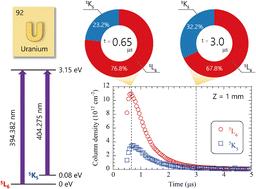
The expansion dynamics of target particles are crucial for rapid isotope analysis using resonance ionization mass spectrometry (RIMS) combined with laser ablation as an atomization source. The spatial and temporal spectral signatures in laser-produced plasma (LPP) provide insights for applying RIMS to understand the expansion behavior of target particles. In this study, diode laser absorption spectroscopy was employed to observe U atoms in UO2 LPP in a high-vacuum environment (3.0 × 10⁻⁴ Pa). Results showed the remarkable differences in the expansion dynamics of U atoms compared to Al atoms. Specifically, the UO2 ablation plume had a double layer due to charged particles, and the spectra of the U atoms do not exhibit clear spectral splitting. Moreover, the U atoms in the 5L6 ground state and low-lying 5K5 meta-stable state (notably, >99% of U atoms generally exist in both energy states) are probed to examine their distributions between the two energy states. The results reveal that approximately 28–38% of the U atoms are distributed in the 5K5 meta-stable state because of thermal excitation. These quantitative insights provide a clear pathway toward advancing the applications of laser ablation.



 京公网安备 11010802042870号
京ICP备2023020795号-1
京公网安备 11010802042870号
京ICP备2023020795号-1

 分享
分享
 求助内容:
求助内容: 应助结果提醒方式:
 扫码关注我们
