Jiongli Pan, Yi Lin, Xinyuan Liu, Xiaozhen Zhang, Tingbo Liang, Xueli Bai
{"title":"Harnessing amino acid pathways to influence myeloid cell function in tumor immunity.","authors":"Jiongli Pan, Yi Lin, Xinyuan Liu, Xiaozhen Zhang, Tingbo Liang, Xueli Bai","doi":"10.1186/s10020-025-01099-4","DOIUrl":null,"url":null,"abstract":"<p><p>Amino acids are pivotal regulators of immune cell metabolism, signaling pathways, and gene expression. In myeloid cells, these processes underlie their functional plasticity, enabling shifts between pro-inflammatory, anti-inflammatory, pro-tumor, and anti-tumor activities. Within the tumor microenvironment, amino acid metabolism plays a crucial role in mediating the immunosuppressive functions of myeloid cells, contributing to tumor progression. This review delves into the mechanisms by which specific amino acids-glutamine, serine, arginine, and tryptophan-regulate myeloid cell function and polarization. Furthermore, we explore the therapeutic potential of targeting amino acid metabolism to enhance anti-tumor immunity, offering insights into novel strategies for cancer treatment.</p>","PeriodicalId":18813,"journal":{"name":"Molecular Medicine","volume":"31 1","pages":"44"},"PeriodicalIF":6.4000,"publicationDate":"2025-02-04","publicationTypes":"Journal Article","fieldsOfStudy":null,"isOpenAccess":false,"openAccessPdf":"https://www.ncbi.nlm.nih.gov/pmc/articles/PMC11796060/pdf/","citationCount":"0","resultStr":null,"platform":"Semanticscholar","paperid":null,"PeriodicalName":"Molecular Medicine","FirstCategoryId":"3","ListUrlMain":"https://doi.org/10.1186/s10020-025-01099-4","RegionNum":2,"RegionCategory":"医学","ArticlePicture":[],"TitleCN":null,"AbstractTextCN":null,"PMCID":null,"EPubDate":"","PubModel":"","JCR":"Q1","JCRName":"BIOCHEMISTRY & MOLECULAR BIOLOGY","Score":null,"Total":0}
引用次数: 0
Abstract
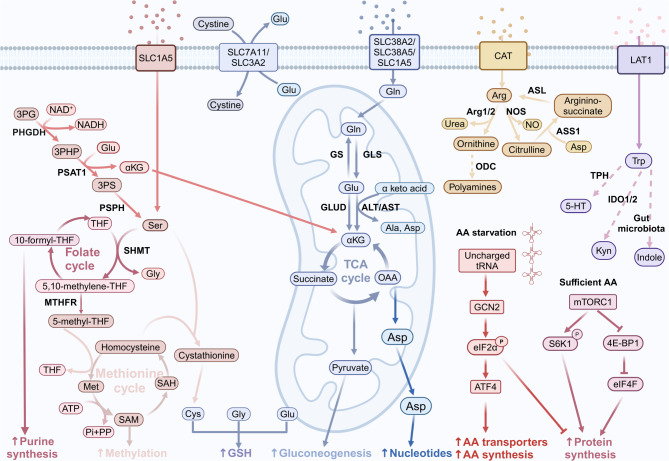
Amino acids are pivotal regulators of immune cell metabolism, signaling pathways, and gene expression. In myeloid cells, these processes underlie their functional plasticity, enabling shifts between pro-inflammatory, anti-inflammatory, pro-tumor, and anti-tumor activities. Within the tumor microenvironment, amino acid metabolism plays a crucial role in mediating the immunosuppressive functions of myeloid cells, contributing to tumor progression. This review delves into the mechanisms by which specific amino acids-glutamine, serine, arginine, and tryptophan-regulate myeloid cell function and polarization. Furthermore, we explore the therapeutic potential of targeting amino acid metabolism to enhance anti-tumor immunity, offering insights into novel strategies for cancer treatment.
期刊介绍:
Molecular Medicine is an open access journal that focuses on publishing recent findings related to disease pathogenesis at the molecular or physiological level. These insights can potentially contribute to the development of specific tools for disease diagnosis, treatment, or prevention. The journal considers manuscripts that present material pertinent to the genetic, molecular, or cellular underpinnings of critical physiological or disease processes. Submissions to Molecular Medicine are expected to elucidate the broader implications of the research findings for human disease and medicine in a manner that is accessible to a wide audience.






 京公网安备 11010802042870号
京ICP备2023020795号-1
京公网安备 11010802042870号
京ICP备2023020795号-1

 分享
分享
 求助内容:
求助内容: 应助结果提醒方式:
 扫码关注我们
