Xinyu Wang, Alphonse de Koster, Belinda B Koenders, Martijs Jonker, Stanley Brul, Benno H Ter Kuile
{"title":"<i>De novo</i> acquisition of antibiotic resistance in six species of bacteria.","authors":"Xinyu Wang, Alphonse de Koster, Belinda B Koenders, Martijs Jonker, Stanley Brul, Benno H Ter Kuile","doi":"10.1128/spectrum.01785-24","DOIUrl":null,"url":null,"abstract":"<p><p>Bacteria can become resistant to antibiotics in two ways: by acquiring resistance genes through horizontal gene transfer and by <i>de novo</i> development of resistance upon exposure to non-lethal concentrations. The importance of the second process, <i>de novo</i> build-up, has not been investigated systematically over a range of species and may be underestimated as a result. To investigate the DNA mutation patterns accompanying the <i>de novo</i> antibiotic resistance acquisition process, six bacterial species encountered in the food chain were exposed to step-wise increasing sublethal concentrations of six antibiotics to develop high levels of resistance. Phenotypic and mutational landscapes were constructed based on whole-genome sequencing at two time points of the evolutionary trajectory. In this study, we found that (1) all of the six strains can develop high levels of resistance against most antibiotics; (2) increased resistance is accompanied by different mutations for each bacterium-antibiotic combination; (3) the number of mutations varies widely, with <i>Y. enterocolitica</i> having by far the most; (4) in the case of fluoroquinolone resistance, a mutational pattern of <i>gyrA</i> combined with <i>parC</i> is conserved in five of six species; and (5) mutations in genes coding for efflux pumps are widely encountered in gram-negative species. The overall conclusion is that very similar phenotypic outcomes are instigated by very different genetic changes. The outcome of this study may assist policymakers when formulating practical strategies to prevent development of antimicrobial resistance in human and veterinary health care.IMPORTANCEMost studies on <i>de novo</i> development of antimicrobial resistance have been performed on <i>Escherichia coli</i>. To examine whether the conclusions of this research can be applied to more bacterial species, six species of veterinary importance were made resistant to six antibiotics, each of a different class. The rapid build-up of resistance observed in all six species upon exposure to non-lethal concentrations of antimicrobials indicates a similar ability to adjust to the presence of antibiotics. The large differences in the number of DNA mutations accompanying <i>de novo</i> resistance suggest that the mechanisms and pathways involved may differ. Hence, very similar phenotypes can be the result of various genotypes. The implications of the outcome are to be considered by policymakers in the area of veterinary and human healthcare.</p>","PeriodicalId":18670,"journal":{"name":"Microbiology spectrum","volume":" ","pages":"e0178524"},"PeriodicalIF":3.8000,"publicationDate":"2025-03-04","publicationTypes":"Journal Article","fieldsOfStudy":null,"isOpenAccess":false,"openAccessPdf":"https://www.ncbi.nlm.nih.gov/pmc/articles/PMC11878088/pdf/","citationCount":"0","resultStr":null,"platform":"Semanticscholar","paperid":null,"PeriodicalName":"Microbiology spectrum","FirstCategoryId":"99","ListUrlMain":"https://doi.org/10.1128/spectrum.01785-24","RegionNum":2,"RegionCategory":"生物学","ArticlePicture":[],"TitleCN":null,"AbstractTextCN":null,"PMCID":null,"EPubDate":"2025/2/5 0:00:00","PubModel":"Epub","JCR":"Q2","JCRName":"MICROBIOLOGY","Score":null,"Total":0}
引用次数: 0
Abstract
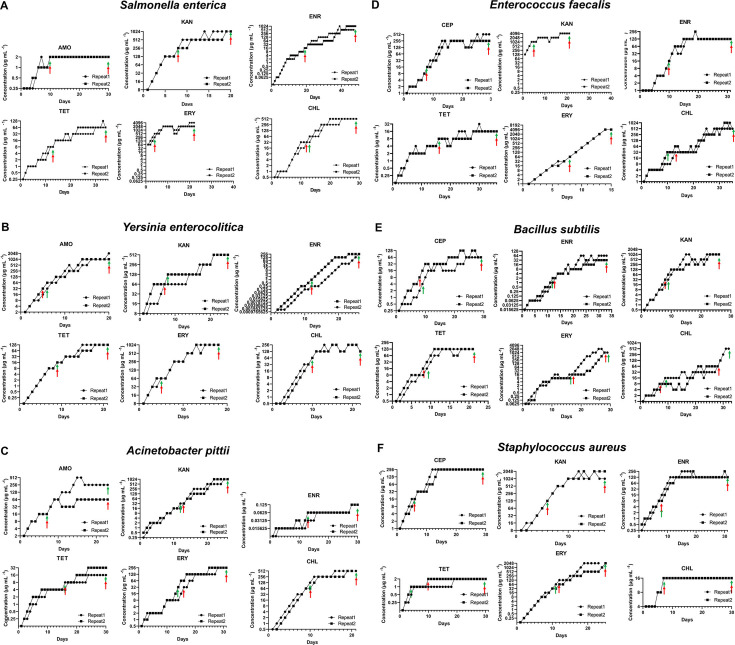
Bacteria can become resistant to antibiotics in two ways: by acquiring resistance genes through horizontal gene transfer and by de novo development of resistance upon exposure to non-lethal concentrations. The importance of the second process, de novo build-up, has not been investigated systematically over a range of species and may be underestimated as a result. To investigate the DNA mutation patterns accompanying the de novo antibiotic resistance acquisition process, six bacterial species encountered in the food chain were exposed to step-wise increasing sublethal concentrations of six antibiotics to develop high levels of resistance. Phenotypic and mutational landscapes were constructed based on whole-genome sequencing at two time points of the evolutionary trajectory. In this study, we found that (1) all of the six strains can develop high levels of resistance against most antibiotics; (2) increased resistance is accompanied by different mutations for each bacterium-antibiotic combination; (3) the number of mutations varies widely, with Y. enterocolitica having by far the most; (4) in the case of fluoroquinolone resistance, a mutational pattern of gyrA combined with parC is conserved in five of six species; and (5) mutations in genes coding for efflux pumps are widely encountered in gram-negative species. The overall conclusion is that very similar phenotypic outcomes are instigated by very different genetic changes. The outcome of this study may assist policymakers when formulating practical strategies to prevent development of antimicrobial resistance in human and veterinary health care.IMPORTANCEMost studies on de novo development of antimicrobial resistance have been performed on Escherichia coli. To examine whether the conclusions of this research can be applied to more bacterial species, six species of veterinary importance were made resistant to six antibiotics, each of a different class. The rapid build-up of resistance observed in all six species upon exposure to non-lethal concentrations of antimicrobials indicates a similar ability to adjust to the presence of antibiotics. The large differences in the number of DNA mutations accompanying de novo resistance suggest that the mechanisms and pathways involved may differ. Hence, very similar phenotypes can be the result of various genotypes. The implications of the outcome are to be considered by policymakers in the area of veterinary and human healthcare.
期刊介绍:
Microbiology Spectrum publishes commissioned review articles on topics in microbiology representing ten content areas: Archaea; Food Microbiology; Bacterial Genetics, Cell Biology, and Physiology; Clinical Microbiology; Environmental Microbiology and Ecology; Eukaryotic Microbes; Genomics, Computational, and Synthetic Microbiology; Immunology; Pathogenesis; and Virology. Reviews are interrelated, with each review linking to other related content. A large board of Microbiology Spectrum editors aids in the development of topics for potential reviews and in the identification of an editor, or editors, who shepherd each collection.





 京公网安备 11010802042870号
京ICP备2023020795号-1
京公网安备 11010802042870号
京ICP备2023020795号-1

 分享
分享
 求助内容:
求助内容: 应助结果提醒方式:
 扫码关注我们
