Kay van Heeswijk, Daniëlle Spek, Jesse Muijsenberg, Loes Janssen, Michiel Winkes, Adwin R Hoogeveen, Marc Scheltinga
{"title":"Reliability of Ultrasound Based Compressibility of the Lower Leg Anterior Tibial Muscle Compartment in Healthy Volunteers.","authors":"Kay van Heeswijk, Daniëlle Spek, Jesse Muijsenberg, Loes Janssen, Michiel Winkes, Adwin R Hoogeveen, Marc Scheltinga","doi":"10.26603/001c.128284","DOIUrl":null,"url":null,"abstract":"<p><strong>Background: </strong>Some individuals have exercise-induced lower leg pain (ELP) caused by a chronic exertional compartment syndrome (CECS). As intracompartmental muscle pressure measurements are invasive with suboptimal test characteristics, other diagnostic tools are needed. Recently, ultrasound-based muscle compartment thickness analysis at 10mmHg (d10) and 80mmHg (d80) external pressure was introduced for this purpose. The difference in compartment thickness at these two external pressures induced by the study device is used to calculate muscle compressibility, a possible marker for CECS.</p><p><strong>Purpose: </strong>The purpose of this study was to investigate the reliability of a novel ultrasound compressibility technique using two distinct internal landmarks at the lower leg in a diverse group of asymptomatic adults.</p><p><strong>Study design: </strong>Cross-sectional study.</p><p><strong>Methods: </strong>Healthy volunteers (n=35; 21 female; median age 40 years, range 19-72; BMI 24.1 kg/m2, range 18.3-31.6) not having ELP underwent serial compressibility measurements (n=1678) of both legs by three observers at the tibialis anterior (TA) using the interosseous membrane (IM) and transition zone IM to tibial bone (TZIT) as internal landmarks. Inter- and intra-observer reliability was calculated for values of d10, d80 and compressibility using intraclass correlations (ICC).</p><p><strong>Results: </strong>TA compartments are less compressible using the IM landmark compared to the TZIT landmark (10.5% vs 12.5%; p<0.001). Inter-observer ICC for IM was always higher (d10 0.85; d80 0.82; compressibility 0.51) than for TZIT (d10 0.65; d80 0.53; compressibility 0.20). The intra-observer reliability for d10 and d80 was excellent (ICC>0.90) for all three observers. ICC of compressibility varied among observers and ranged from 0.76 to 0.48, with higher ICCs demonstrated for IM compared to TZIT.</p><p><strong>Conclusion: </strong>Ultrasound based anterior tibial muscle compressibility measurements have moderate inter-observer reliability and excellent intra-observer reliability if the interosseous membrane is used as internal landmark. Future studies are aimed to test muscle compressibility after exercise and in CECS.</p><p><strong>Level of evidence: </strong>Level 3.</p>","PeriodicalId":47892,"journal":{"name":"International Journal of Sports Physical Therapy","volume":"20 2","pages":"265-274"},"PeriodicalIF":2.1000,"publicationDate":"2025-02-02","publicationTypes":"Journal Article","fieldsOfStudy":null,"isOpenAccess":false,"openAccessPdf":"https://www.ncbi.nlm.nih.gov/pmc/articles/PMC11788095/pdf/","citationCount":"0","resultStr":null,"platform":"Semanticscholar","paperid":null,"PeriodicalName":"International Journal of Sports Physical Therapy","FirstCategoryId":"1085","ListUrlMain":"https://doi.org/10.26603/001c.128284","RegionNum":0,"RegionCategory":null,"ArticlePicture":[],"TitleCN":null,"AbstractTextCN":null,"PMCID":null,"EPubDate":"2025/1/1 0:00:00","PubModel":"eCollection","JCR":"Q3","JCRName":"SPORT SCIENCES","Score":null,"Total":0}
引用次数: 0
Abstract
Background: Some individuals have exercise-induced lower leg pain (ELP) caused by a chronic exertional compartment syndrome (CECS). As intracompartmental muscle pressure measurements are invasive with suboptimal test characteristics, other diagnostic tools are needed. Recently, ultrasound-based muscle compartment thickness analysis at 10mmHg (d10) and 80mmHg (d80) external pressure was introduced for this purpose. The difference in compartment thickness at these two external pressures induced by the study device is used to calculate muscle compressibility, a possible marker for CECS.
Purpose: The purpose of this study was to investigate the reliability of a novel ultrasound compressibility technique using two distinct internal landmarks at the lower leg in a diverse group of asymptomatic adults.
Study design: Cross-sectional study.
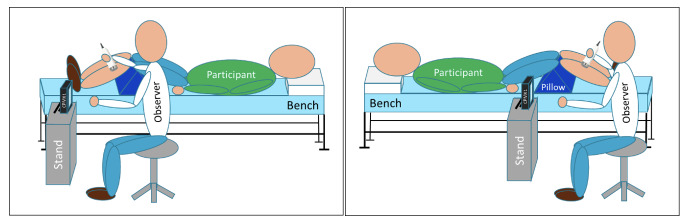
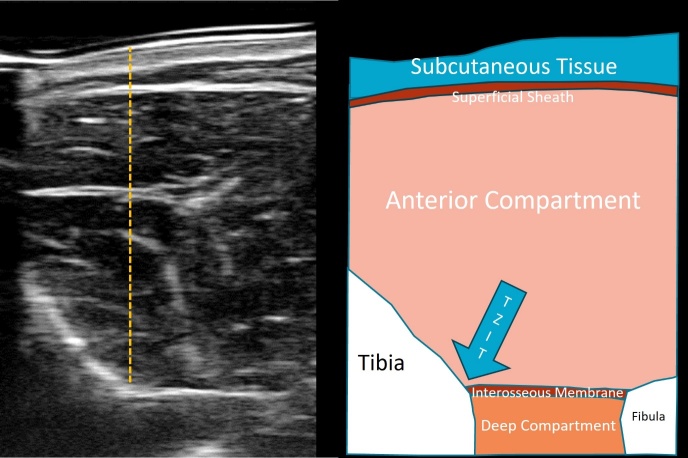
Methods: Healthy volunteers (n=35; 21 female; median age 40 years, range 19-72; BMI 24.1 kg/m2, range 18.3-31.6) not having ELP underwent serial compressibility measurements (n=1678) of both legs by three observers at the tibialis anterior (TA) using the interosseous membrane (IM) and transition zone IM to tibial bone (TZIT) as internal landmarks. Inter- and intra-observer reliability was calculated for values of d10, d80 and compressibility using intraclass correlations (ICC).
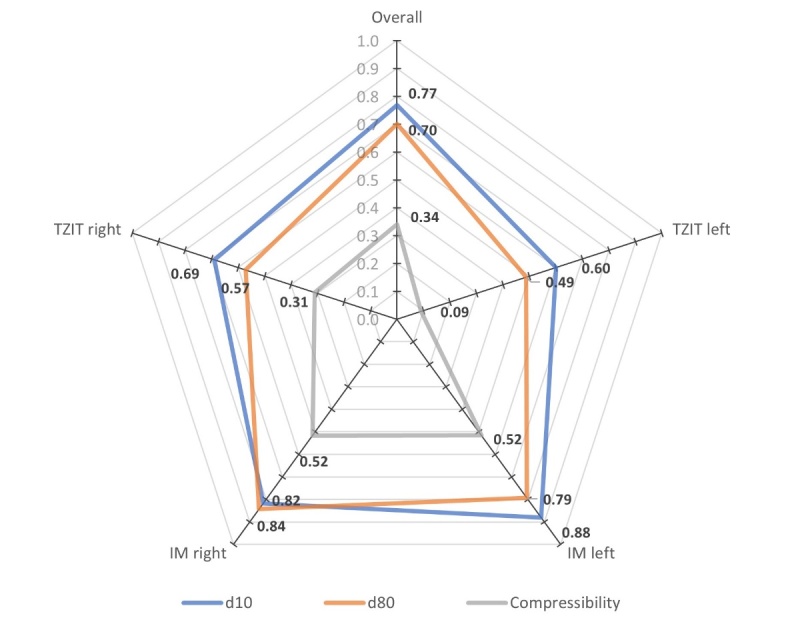
Results: TA compartments are less compressible using the IM landmark compared to the TZIT landmark (10.5% vs 12.5%; p<0.001). Inter-observer ICC for IM was always higher (d10 0.85; d80 0.82; compressibility 0.51) than for TZIT (d10 0.65; d80 0.53; compressibility 0.20). The intra-observer reliability for d10 and d80 was excellent (ICC>0.90) for all three observers. ICC of compressibility varied among observers and ranged from 0.76 to 0.48, with higher ICCs demonstrated for IM compared to TZIT.
Conclusion: Ultrasound based anterior tibial muscle compressibility measurements have moderate inter-observer reliability and excellent intra-observer reliability if the interosseous membrane is used as internal landmark. Future studies are aimed to test muscle compressibility after exercise and in CECS.




 京公网安备 11010802042870号
京ICP备2023020795号-1
京公网安备 11010802042870号
京ICP备2023020795号-1

 分享
分享
 求助内容:
求助内容: 应助结果提醒方式:
 扫码关注我们
