Kinga Kwiecien, Lourdes Santos-Merx, Tarsem Sahota, Helen Coulthard, Mariasole Da Boit
{"title":"Portion Estimation, Satiety Perception and Energy Intake Following Different Breakfast Portion Sizes in Healthy Adults.","authors":"Kinga Kwiecien, Lourdes Santos-Merx, Tarsem Sahota, Helen Coulthard, Mariasole Da Boit","doi":"10.1111/nbu.12733","DOIUrl":null,"url":null,"abstract":"<p><p>Expected satiety is a key element in predicting meal portion size and food consumption; however, how this can be affected by different breakfast portion sizes is unknown. The study examined the impact of different breakfast portions on satiety, portion size, and energy intake and comprised an online survey and an experimental intervention. Sixteen adults (9 women, BMI: 24.9 ± 4.3 kg/m<sup>2</sup>) rated images of three portion sizes (small, standard, large) of the same breakfast using an ordinal scale. Subsequently, they were asked to self-prepare and consume ad libitum the three breakfast portions in a randomised order on different days and to complete a food diary. Satiety and portion size perception were re-measured upon consumption of each breakfast. For both the visual image and breakfast consumption, the small breakfast portion was rated as the smallest and least filling, while the large portion was rated as the largest and most filling (p < 0.05). When consuming the small breakfast, participants reported being hungrier and less full between breakfast and lunch (p < 0.05) and had a higher energy intake from lunch onward, due to more snacking (p < 0.05). However, the total daily energy intake was not different among the three breakfast portion sizes. Individuals seemed accustomed to predicting satiety and portion size from images. The consumption of the small breakfast was judged as not filling enough and was accompanied by a higher energy intake via energy-dense snacks. Based on these preliminary findings, breakfast size reduction may lead to unhealthy compensatory energy intake by snacking on energy-dense foods.</p>","PeriodicalId":48536,"journal":{"name":"Nutrition Bulletin","volume":" ","pages":"229-238"},"PeriodicalIF":3.6000,"publicationDate":"2025-06-01","publicationTypes":"Journal Article","fieldsOfStudy":null,"isOpenAccess":false,"openAccessPdf":"https://www.ncbi.nlm.nih.gov/pmc/articles/PMC12147059/pdf/","citationCount":"0","resultStr":null,"platform":"Semanticscholar","paperid":null,"PeriodicalName":"Nutrition Bulletin","FirstCategoryId":"3","ListUrlMain":"https://doi.org/10.1111/nbu.12733","RegionNum":4,"RegionCategory":"医学","ArticlePicture":[],"TitleCN":null,"AbstractTextCN":null,"PMCID":null,"EPubDate":"2025/2/5 0:00:00","PubModel":"Epub","JCR":"Q3","JCRName":"NUTRITION & DIETETICS","Score":null,"Total":0}
引用次数: 0
Abstract
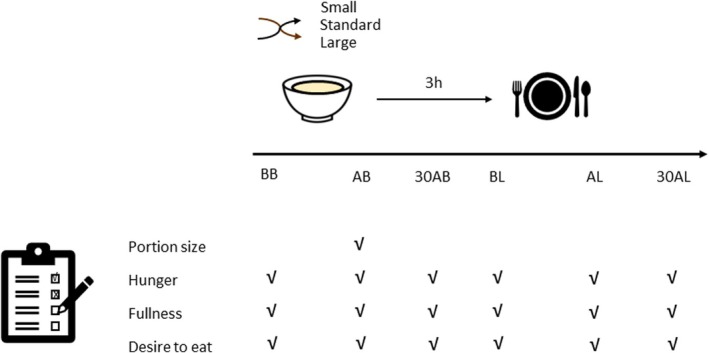
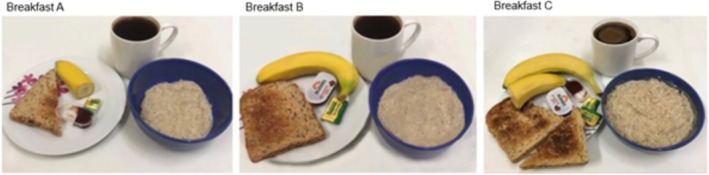
Expected satiety is a key element in predicting meal portion size and food consumption; however, how this can be affected by different breakfast portion sizes is unknown. The study examined the impact of different breakfast portions on satiety, portion size, and energy intake and comprised an online survey and an experimental intervention. Sixteen adults (9 women, BMI: 24.9 ± 4.3 kg/m2) rated images of three portion sizes (small, standard, large) of the same breakfast using an ordinal scale. Subsequently, they were asked to self-prepare and consume ad libitum the three breakfast portions in a randomised order on different days and to complete a food diary. Satiety and portion size perception were re-measured upon consumption of each breakfast. For both the visual image and breakfast consumption, the small breakfast portion was rated as the smallest and least filling, while the large portion was rated as the largest and most filling (p < 0.05). When consuming the small breakfast, participants reported being hungrier and less full between breakfast and lunch (p < 0.05) and had a higher energy intake from lunch onward, due to more snacking (p < 0.05). However, the total daily energy intake was not different among the three breakfast portion sizes. Individuals seemed accustomed to predicting satiety and portion size from images. The consumption of the small breakfast was judged as not filling enough and was accompanied by a higher energy intake via energy-dense snacks. Based on these preliminary findings, breakfast size reduction may lead to unhealthy compensatory energy intake by snacking on energy-dense foods.
期刊介绍:
The Nutrition Bulletin provides accessible reviews at the cutting edge of research. Read by researchers and nutritionists working in universities and research institutes; public health nutritionists, dieticians and other health professionals; nutritionists, technologists and others in the food industry; those engaged in higher education including students; and journalists with an interest in nutrition.



 京公网安备 11010802042870号
京ICP备2023020795号-1
京公网安备 11010802042870号
京ICP备2023020795号-1

 分享
分享
 求助内容:
求助内容: 应助结果提醒方式:
 扫码关注我们
