Highly efficient removal of perfluorooctanoic acid using synergy of cold Plasma, Sulfate Radicals, and Boron-Doped Graphene-Like Carbon: Insights into synergistic effects and degradation mechanism
Chhakchhuak Vanlalhmingmawia, Hiresh Moradi, Ye Jin Kim, Dong-Su Kim, Jae-Kyu Yang
{"title":"Highly efficient removal of perfluorooctanoic acid using synergy of cold Plasma, Sulfate Radicals, and Boron-Doped Graphene-Like Carbon: Insights into synergistic effects and degradation mechanism","authors":"Chhakchhuak Vanlalhmingmawia, Hiresh Moradi, Ye Jin Kim, Dong-Su Kim, Jae-Kyu Yang","doi":"10.1016/j.cej.2025.160334","DOIUrl":null,"url":null,"abstract":"<div><div>Advanced oxidation process warrants sustainable processes that can efficiently eliminate organic contaminants from water reservoirs. This study is the first to explore the synergistic effects of cold plasma, persulfate (PS), and boron-doped graphene-like carbon (BDGLC). Plasma activates PS to SO<sub>4</sub><sup>•-</sup> along with the production of O<sub>3</sub> and other reactive oxygen species (ROS). For the first time, BDGLC was introduced to plasma + PS system to effectively degrade O<sub>3</sub> from the plasma and convert it into more reactive <sup>•</sup>OH and also to activate PS to SO<sub>4</sub><sup>•-</sup>. A novel customized plasma reactor was set up to generate high concentrations of reactive oxygen species (ROS). This novel approach is utilized for the efficient degradation of highly stable and persistent organic pollutants viz. perfluorooctanoic acid (PFOA). The synergy of plasma + PS + BDGLC facilitated 100 % degradation of PFOA within 15 min. The synergy factor of the plasma + PS + BDGLC system was determined to be 1.136, and the value of energy yield (<span><math><mrow><msub><mi>η</mi><mrow><mi>deg</mi></mrow></msub></mrow></math></span>) was 1440.3 mgkW<sup>−1</sup>h<sup>−1</sup>. Density function theory calculations, scavenger analyses, and LC-MS analyses revealed the degradation mechanism and ROS involved in the degradation of PFOA. The applicability of the proposed method for the efficient degradation of PFOA in wastewater treatment was validated via actual wastewater studies. This study shows an improved degradation efficiency of PFOA within a shorter period of time and in a higher volume of pollutant solution, with an improved energy utilization efficiency. This research reveals a promising approach for the efficient degradation of highly stable and persistent micropollutants in wastewater in an economic and sustainable manner.</div></div>","PeriodicalId":270,"journal":{"name":"Chemical Engineering Journal","volume":"507 ","pages":"Article 160334"},"PeriodicalIF":13.2000,"publicationDate":"2025-03-01","publicationTypes":"Journal Article","fieldsOfStudy":null,"isOpenAccess":false,"openAccessPdf":"","citationCount":"0","resultStr":null,"platform":"Semanticscholar","paperid":null,"PeriodicalName":"Chemical Engineering Journal","FirstCategoryId":"5","ListUrlMain":"https://www.sciencedirect.com/science/article/pii/S1385894725011398","RegionNum":1,"RegionCategory":"工程技术","ArticlePicture":[],"TitleCN":null,"AbstractTextCN":null,"PMCID":null,"EPubDate":"2025/2/6 0:00:00","PubModel":"Epub","JCR":"Q1","JCRName":"ENGINEERING, CHEMICAL","Score":null,"Total":0}
引用次数: 0
Abstract
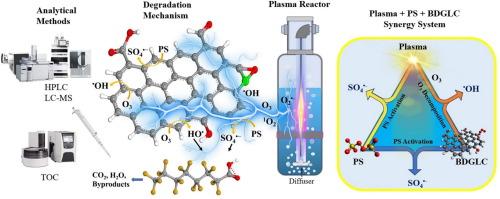
Advanced oxidation process warrants sustainable processes that can efficiently eliminate organic contaminants from water reservoirs. This study is the first to explore the synergistic effects of cold plasma, persulfate (PS), and boron-doped graphene-like carbon (BDGLC). Plasma activates PS to SO4•- along with the production of O3 and other reactive oxygen species (ROS). For the first time, BDGLC was introduced to plasma + PS system to effectively degrade O3 from the plasma and convert it into more reactive •OH and also to activate PS to SO4•-. A novel customized plasma reactor was set up to generate high concentrations of reactive oxygen species (ROS). This novel approach is utilized for the efficient degradation of highly stable and persistent organic pollutants viz. perfluorooctanoic acid (PFOA). The synergy of plasma + PS + BDGLC facilitated 100 % degradation of PFOA within 15 min. The synergy factor of the plasma + PS + BDGLC system was determined to be 1.136, and the value of energy yield () was 1440.3 mgkW−1h−1. Density function theory calculations, scavenger analyses, and LC-MS analyses revealed the degradation mechanism and ROS involved in the degradation of PFOA. The applicability of the proposed method for the efficient degradation of PFOA in wastewater treatment was validated via actual wastewater studies. This study shows an improved degradation efficiency of PFOA within a shorter period of time and in a higher volume of pollutant solution, with an improved energy utilization efficiency. This research reveals a promising approach for the efficient degradation of highly stable and persistent micropollutants in wastewater in an economic and sustainable manner.
期刊介绍:
The Chemical Engineering Journal is an international research journal that invites contributions of original and novel fundamental research. It aims to provide an international platform for presenting original fundamental research, interpretative reviews, and discussions on new developments in chemical engineering. The journal welcomes papers that describe novel theory and its practical application, as well as those that demonstrate the transfer of techniques from other disciplines. It also welcomes reports on carefully conducted experimental work that is soundly interpreted. The main focus of the journal is on original and rigorous research results that have broad significance. The Catalysis section within the Chemical Engineering Journal focuses specifically on Experimental and Theoretical studies in the fields of heterogeneous catalysis, molecular catalysis, and biocatalysis. These studies have industrial impact on various sectors such as chemicals, energy, materials, foods, healthcare, and environmental protection.




 京公网安备 11010802042870号
京ICP备2023020795号-1
京公网安备 11010802042870号
京ICP备2023020795号-1

 分享
分享
 求助内容:
求助内容: 应助结果提醒方式:
 扫码关注我们
