Rose-inspired salt-responsive hierarchical microbead via in-situ growth of layered double hydroxide plates onto rosin-derived resin for efficient tetracycline removal: Ingenious design, advanced molecular simulations, and rethinking adsorption mass transfer
Yan-Hong Wei , Ming-Xing Li , Yan-Shu Xiong , Jia-Xin Wang , Mei Li , Wei Wei , Fu-Hou Lei , Wen Li
{"title":"Rose-inspired salt-responsive hierarchical microbead via in-situ growth of layered double hydroxide plates onto rosin-derived resin for efficient tetracycline removal: Ingenious design, advanced molecular simulations, and rethinking adsorption mass transfer","authors":"Yan-Hong Wei , Ming-Xing Li , Yan-Shu Xiong , Jia-Xin Wang , Mei Li , Wei Wei , Fu-Hou Lei , Wen Li","doi":"10.1016/j.seppur.2025.131952","DOIUrl":null,"url":null,"abstract":"<div><div>Flower-like Ni/Al layered double hydroxides (Ni/Al-LDHs) were <em>in-situ</em> grown on rosin-derived resin to design a rose-inspired hierarchical microbead (RIHMB), which is efficient in removing tetracycline hydrochloride (TCH) from water system. The ingeniously designed dual-layer structure of RIHMB features an inner layer rich in quaternary ammonium (–R<sub>4</sub>N<sup>+</sup>) that strongly attracts negatively charged TCH, and a rose-like outer layer with numerous pores to accommodate the adsorbates. RIHMB exhibits exceptional reusability, achieving over 92% TCH removal efficiency after five cycles. Molecular dynamics simulations demonstrate that RIHMB not only adsorbs TCH with high efficiency but also facilitates its remarkably rapid release (NaCl as desorbent). This outcome is attributed to the porous structure of Ni/Al-LDHs, which traps TCH and acts as a physical barrier, preventing direct interaction with –R<sub>4</sub>N<sup>+</sup>. Then, chloride ions in the desorbent neutralize the positive charge of RIHMB, reduces its adsorption affinity for TCH, and promotes rapid desorption. A novel Wen Li-Wei Wei adsorption mass transfer model is presented, which reveals the collective influence of liquid-film diffusion, pore mass transfer, and sorption onto active sites on adsorption mass transfer, providing valuable insights into the underlying mechanisms. Multiple quantum chemical theoretical calculations were integrated to quantify the contributions of charge interaction, hydrogen bonding, π-π interaction, and van der Waals force to adsorption. A scale-up experiment conducted on a real water system offers a promising strategy for the remediation of environments contaminated with antibiotics.</div></div>","PeriodicalId":427,"journal":{"name":"Separation and Purification Technology","volume":"363 ","pages":"Article 131952"},"PeriodicalIF":9.0000,"publicationDate":"2025-02-06","publicationTypes":"Journal Article","fieldsOfStudy":null,"isOpenAccess":false,"openAccessPdf":"","citationCount":"0","resultStr":null,"platform":"Semanticscholar","paperid":null,"PeriodicalName":"Separation and Purification Technology","FirstCategoryId":"5","ListUrlMain":"https://www.sciencedirect.com/science/article/pii/S1383586625005490","RegionNum":1,"RegionCategory":"工程技术","ArticlePicture":[],"TitleCN":null,"AbstractTextCN":null,"PMCID":null,"EPubDate":"","PubModel":"","JCR":"Q1","JCRName":"ENGINEERING, CHEMICAL","Score":null,"Total":0}
引用次数: 0
Abstract
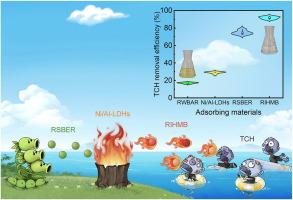
Flower-like Ni/Al layered double hydroxides (Ni/Al-LDHs) were in-situ grown on rosin-derived resin to design a rose-inspired hierarchical microbead (RIHMB), which is efficient in removing tetracycline hydrochloride (TCH) from water system. The ingeniously designed dual-layer structure of RIHMB features an inner layer rich in quaternary ammonium (–R4N+) that strongly attracts negatively charged TCH, and a rose-like outer layer with numerous pores to accommodate the adsorbates. RIHMB exhibits exceptional reusability, achieving over 92% TCH removal efficiency after five cycles. Molecular dynamics simulations demonstrate that RIHMB not only adsorbs TCH with high efficiency but also facilitates its remarkably rapid release (NaCl as desorbent). This outcome is attributed to the porous structure of Ni/Al-LDHs, which traps TCH and acts as a physical barrier, preventing direct interaction with –R4N+. Then, chloride ions in the desorbent neutralize the positive charge of RIHMB, reduces its adsorption affinity for TCH, and promotes rapid desorption. A novel Wen Li-Wei Wei adsorption mass transfer model is presented, which reveals the collective influence of liquid-film diffusion, pore mass transfer, and sorption onto active sites on adsorption mass transfer, providing valuable insights into the underlying mechanisms. Multiple quantum chemical theoretical calculations were integrated to quantify the contributions of charge interaction, hydrogen bonding, π-π interaction, and van der Waals force to adsorption. A scale-up experiment conducted on a real water system offers a promising strategy for the remediation of environments contaminated with antibiotics.
期刊介绍:
Separation and Purification Technology is a premier journal committed to sharing innovative methods for separation and purification in chemical and environmental engineering, encompassing both homogeneous solutions and heterogeneous mixtures. Our scope includes the separation and/or purification of liquids, vapors, and gases, as well as carbon capture and separation techniques. However, it's important to note that methods solely intended for analytical purposes are not within the scope of the journal. Additionally, disciplines such as soil science, polymer science, and metallurgy fall outside the purview of Separation and Purification Technology. Join us in advancing the field of separation and purification methods for sustainable solutions in chemical and environmental engineering.




 京公网安备 11010802042870号
京ICP备2023020795号-1
京公网安备 11010802042870号
京ICP备2023020795号-1

 分享
分享
 求助内容:
求助内容: 应助结果提醒方式:
 扫码关注我们
