D. Main, P. Drmota, D. P. Nadlinger, E. M. Ainley, A. Agrawal, B. C. Nichol, R. Srinivas, G. Araneda, D. M. Lucas
{"title":"Distributed quantum computing across an optical network link","authors":"D. Main, P. Drmota, D. P. Nadlinger, E. M. Ainley, A. Agrawal, B. C. Nichol, R. Srinivas, G. Araneda, D. M. Lucas","doi":"10.1038/s41586-024-08404-x","DOIUrl":null,"url":null,"abstract":"Distributed quantum computing (DQC) combines the computing power of multiple networked quantum processing modules, ideally enabling the execution of large quantum circuits without compromising performance or qubit connectivity1,2. Photonic networks are well suited as a versatile and reconfigurable interconnect layer for DQC; remote entanglement shared between matter qubits across the network enables all-to-all logical connectivity through quantum gate teleportation (QGT)3,4. For a scalable DQC architecture, the QGT implementation must be deterministic and repeatable; until now, no demonstration has satisfied these requirements. Here we experimentally demonstrate the distribution of quantum computations between two photonically interconnected trapped-ion modules. The modules, separated by about two metres, each contain dedicated network and circuit qubits. By using heralded remote entanglement between the network qubits, we deterministically teleport a controlled-Z (CZ) gate between two circuit qubits in separate modules, achieving 86% fidelity. We then execute Grover’s search algorithm5—to our knowledge, the first implementation of a distributed quantum algorithm comprising several non-local two-qubit gates—and measure a 71% success rate. Furthermore, we implement distributed iSWAP and SWAP circuits, compiled with two and three instances of QGT, respectively, demonstrating the ability to distribute arbitrary two-qubit operations6. As photons can be interfaced with a variety of systems, the versatile DQC architecture demonstrated here provides a viable pathway towards large-scale quantum computing for a range of physical platforms. The distribution of quantum computations is demonstrated between two photonically interconnected trapped-ion modules, using repeatable, deterministic teleported controlled-Z gates to perform Grover’s search algorithm.","PeriodicalId":18787,"journal":{"name":"Nature","volume":"638 8050","pages":"383-388"},"PeriodicalIF":48.5000,"publicationDate":"2025-02-05","publicationTypes":"Journal Article","fieldsOfStudy":null,"isOpenAccess":false,"openAccessPdf":"https://www.nature.com/articles/s41586-024-08404-x.pdf","citationCount":"0","resultStr":null,"platform":"Semanticscholar","paperid":null,"PeriodicalName":"Nature","FirstCategoryId":"103","ListUrlMain":"https://www.nature.com/articles/s41586-024-08404-x","RegionNum":1,"RegionCategory":"综合性期刊","ArticlePicture":[],"TitleCN":null,"AbstractTextCN":null,"PMCID":null,"EPubDate":"","PubModel":"","JCR":"Q1","JCRName":"MULTIDISCIPLINARY SCIENCES","Score":null,"Total":0}
引用次数: 0
Abstract
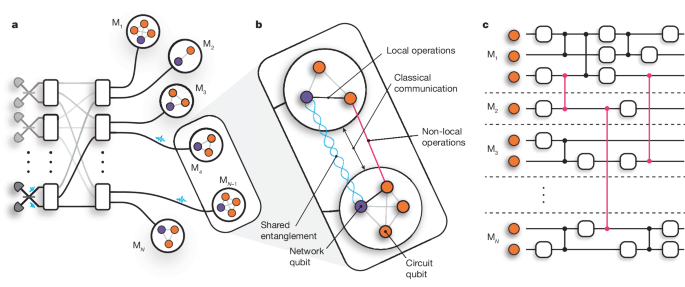
Distributed quantum computing (DQC) combines the computing power of multiple networked quantum processing modules, ideally enabling the execution of large quantum circuits without compromising performance or qubit connectivity1,2. Photonic networks are well suited as a versatile and reconfigurable interconnect layer for DQC; remote entanglement shared between matter qubits across the network enables all-to-all logical connectivity through quantum gate teleportation (QGT)3,4. For a scalable DQC architecture, the QGT implementation must be deterministic and repeatable; until now, no demonstration has satisfied these requirements. Here we experimentally demonstrate the distribution of quantum computations between two photonically interconnected trapped-ion modules. The modules, separated by about two metres, each contain dedicated network and circuit qubits. By using heralded remote entanglement between the network qubits, we deterministically teleport a controlled-Z (CZ) gate between two circuit qubits in separate modules, achieving 86% fidelity. We then execute Grover’s search algorithm5—to our knowledge, the first implementation of a distributed quantum algorithm comprising several non-local two-qubit gates—and measure a 71% success rate. Furthermore, we implement distributed iSWAP and SWAP circuits, compiled with two and three instances of QGT, respectively, demonstrating the ability to distribute arbitrary two-qubit operations6. As photons can be interfaced with a variety of systems, the versatile DQC architecture demonstrated here provides a viable pathway towards large-scale quantum computing for a range of physical platforms. The distribution of quantum computations is demonstrated between two photonically interconnected trapped-ion modules, using repeatable, deterministic teleported controlled-Z gates to perform Grover’s search algorithm.
期刊介绍:
Nature is a prestigious international journal that publishes peer-reviewed research in various scientific and technological fields. The selection of articles is based on criteria such as originality, importance, interdisciplinary relevance, timeliness, accessibility, elegance, and surprising conclusions. In addition to showcasing significant scientific advances, Nature delivers rapid, authoritative, insightful news, and interpretation of current and upcoming trends impacting science, scientists, and the broader public. The journal serves a dual purpose: firstly, to promptly share noteworthy scientific advances and foster discussions among scientists, and secondly, to ensure the swift dissemination of scientific results globally, emphasizing their significance for knowledge, culture, and daily life.





 京公网安备 11010802042870号
京ICP备2023020795号-1
京公网安备 11010802042870号
京ICP备2023020795号-1

 分享
分享
 求助内容:
求助内容: 应助结果提醒方式:
 扫码关注我们
