{"title":"Hopping-Phase Ion Bridge Enables Fast Li+ Transport in Functional Garnet-Type Solid-State Battery at Room Temperature","authors":"Binbin Yang, Nan Chen, Jianing Tian, Lipu Sun, Chenglong Deng, Yanxin Shang, Zixin Liu, Ningning Wu, Liyuan Zhao, Feng Wu, Dingguo Xia, Renjie Chen","doi":"10.1002/adma.202415966","DOIUrl":null,"url":null,"abstract":"<p>Composite polymer electrolytes (CPEs) containing Li<sub>6.4</sub>La<sub>3</sub>Zr<sub>1.4</sub>Ta<sub>0.6</sub>O<sub>12</sub> (LLZTO) is widely regarded as leading candidate for high energy density solid-state lithium-metal batteries due to its exceptional ionic conductivity and environmental stability. However, Li<sub>2</sub>CO<sub>3</sub> and LiOH layers at LLZTO surface greatly hinder Li<sup>+</sup> transport between LLZTO-polymer and the electrode–electrolyte interface. Herein, the surface of LLZTO is boronized to obtain functionalized LLZTO, and its conversion mechanism is clarified. By dissolving the crystal structure of cellulose to obtain hopping-phase ion bridge (HPIB), which release the Li<sup>+</sup> transport activity of its oxygen-containing polar functional group (─OH, ─O─). Therefore, a high-throughput ion transporter (HTIT-37) with high ion transfer number (0.86) is prepared by introducing the HPIB into functionalized LLZTO and polyvinylidene fluoride interface by intermolecular hydrogen bond interaction, and it is demonstrated that the HPIB acts as a “highway” for the Li<sup>+</sup> across this heterogeneous interface. Moreover, the HPIB is found to self-adsorb on the SEI surface, leading to fast Li<sup>+</sup> transport kinetics at anode–CPE interface. Thus, the lifespan of Li|HTIT-37|Li is over 8000 h, and the critical current density exceeds 2.3 mA cm<sup>−2</sup>. The LiNi<sub>0.5</sub>Co<sub>0.2</sub>Mn<sub>0.3</sub>O<sub>2</sub>|Li and Li<sub>1.2</sub>Ni<sub>0.13</sub>Co<sub>0.13</sub>Mn<sub>0.54</sub>O<sub>2</sub>|Li battery remains stable with the HPIB-enhanced electrode process, proving the application potential of LLZTO-based CPE in high energy density SSLMB.</p>","PeriodicalId":114,"journal":{"name":"Advanced Materials","volume":"37 11","pages":""},"PeriodicalIF":26.8000,"publicationDate":"2025-02-05","publicationTypes":"Journal Article","fieldsOfStudy":null,"isOpenAccess":false,"openAccessPdf":"","citationCount":"0","resultStr":null,"platform":"Semanticscholar","paperid":null,"PeriodicalName":"Advanced Materials","FirstCategoryId":"88","ListUrlMain":"https://advanced.onlinelibrary.wiley.com/doi/10.1002/adma.202415966","RegionNum":1,"RegionCategory":"材料科学","ArticlePicture":[],"TitleCN":null,"AbstractTextCN":null,"PMCID":null,"EPubDate":"","PubModel":"","JCR":"Q1","JCRName":"CHEMISTRY, MULTIDISCIPLINARY","Score":null,"Total":0}
引用次数: 0
Abstract
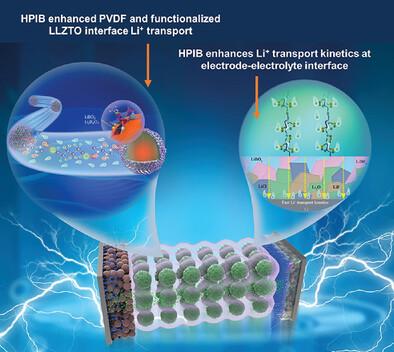
Composite polymer electrolytes (CPEs) containing Li6.4La3Zr1.4Ta0.6O12 (LLZTO) is widely regarded as leading candidate for high energy density solid-state lithium-metal batteries due to its exceptional ionic conductivity and environmental stability. However, Li2CO3 and LiOH layers at LLZTO surface greatly hinder Li+ transport between LLZTO-polymer and the electrode–electrolyte interface. Herein, the surface of LLZTO is boronized to obtain functionalized LLZTO, and its conversion mechanism is clarified. By dissolving the crystal structure of cellulose to obtain hopping-phase ion bridge (HPIB), which release the Li+ transport activity of its oxygen-containing polar functional group (─OH, ─O─). Therefore, a high-throughput ion transporter (HTIT-37) with high ion transfer number (0.86) is prepared by introducing the HPIB into functionalized LLZTO and polyvinylidene fluoride interface by intermolecular hydrogen bond interaction, and it is demonstrated that the HPIB acts as a “highway” for the Li+ across this heterogeneous interface. Moreover, the HPIB is found to self-adsorb on the SEI surface, leading to fast Li+ transport kinetics at anode–CPE interface. Thus, the lifespan of Li|HTIT-37|Li is over 8000 h, and the critical current density exceeds 2.3 mA cm−2. The LiNi0.5Co0.2Mn0.3O2|Li and Li1.2Ni0.13Co0.13Mn0.54O2|Li battery remains stable with the HPIB-enhanced electrode process, proving the application potential of LLZTO-based CPE in high energy density SSLMB.
期刊介绍:
Advanced Materials, one of the world's most prestigious journals and the foundation of the Advanced portfolio, is the home of choice for best-in-class materials science for more than 30 years. Following this fast-growing and interdisciplinary field, we are considering and publishing the most important discoveries on any and all materials from materials scientists, chemists, physicists, engineers as well as health and life scientists and bringing you the latest results and trends in modern materials-related research every week.







 京公网安备 11010802042870号
京ICP备2023020795号-1
京公网安备 11010802042870号
京ICP备2023020795号-1

 分享
分享
 求助内容:
求助内容: 应助结果提醒方式:
 扫码关注我们
