Abhishek Panwar, Chandi C. Malakar, Aarti Upadhyay and Mithun Roy
{"title":"A red light-activable hetero-bimetallic [Fe(iii)–Ru(ii)] complex as a dual-modality PDT tool for anticancer therapy†","authors":"Abhishek Panwar, Chandi C. Malakar, Aarti Upadhyay and Mithun Roy","doi":"10.1039/D4DT03433C","DOIUrl":null,"url":null,"abstract":"<p >We developed a novel red light activable hetero-bimetallic [<strong>Fe(III)–Ru(II)</strong>] complex by combining hydroxyl radical-generating Fe(<small>III</small>)–catecholate as a type I PDT agent and the singlet oxygen generating Ru(<small>II</small>)–paracymene complex as a type II PDT agent and it potentially functions as a dual-modality PDT tool for enhanced phototherapeutic applications. 2-Amino-3-(3,4-dihydroxyphenyl)-<em>N</em>-(1,10-phenanthrolin-5-yl)propenamide (<strong>L<small><sup>2</sup></small></strong>) acted as a bridging linker. The single-pot synthesis of the hetero-bimetallic [<strong>Fe(III)–Ru(II)</strong>] complex was carried out through acid–amine coupling. Various photophysical assays confirmed the photo-activated production of (˙OH) radicals and (<small><sup>1</sup></small>O<small><sub>2</sub></small>) oxygen generation upon activation of the [<strong>Fe(III)–Ru(II)</strong>] complex with red light (600–720 nm, 30 J cm<small><sup>−2</sup></small>), which resulted in enhanced cytotoxicity with a photo-index of ∼45. The complex, [<strong>Fe(III)–Ru(II)</strong>], potentially bonded to the DNA through the ruthenium moiety was responsible for minimal dark toxicity. The cytotoxic potential of the complex under red light was a result of the photo-induced accumulation of reactive oxygen species through both type I and type II photodynamic therapy (PDT) mechanisms in A549 and HeLa cells, while non-cancerous HPL1D cells remained unaffected. We probed the caspase 3/7-dependent apoptosis of the complex, [<strong>Fe(III)–Ru(II)</strong>], <em>in vitro</em>. Overall, the hetero-bimetallic [<strong>Fe(III)–Ru(II)</strong>] complex is an ideal example of a red light activable dual-modality next-generation PDT tool for phototherapeutic anticancer therapy.</p>","PeriodicalId":71,"journal":{"name":"Dalton Transactions","volume":" 11","pages":" 4474-4483"},"PeriodicalIF":3.3000,"publicationDate":"2025-02-06","publicationTypes":"Journal Article","fieldsOfStudy":null,"isOpenAccess":false,"openAccessPdf":"","citationCount":"0","resultStr":null,"platform":"Semanticscholar","paperid":null,"PeriodicalName":"Dalton Transactions","FirstCategoryId":"92","ListUrlMain":"https://pubs.rsc.org/en/content/articlelanding/2025/dt/d4dt03433c","RegionNum":3,"RegionCategory":"化学","ArticlePicture":[],"TitleCN":null,"AbstractTextCN":null,"PMCID":null,"EPubDate":"","PubModel":"","JCR":"Q2","JCRName":"CHEMISTRY, INORGANIC & NUCLEAR","Score":null,"Total":0}
引用次数: 0
Abstract
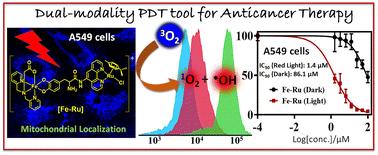
We developed a novel red light activable hetero-bimetallic [Fe(III)–Ru(II)] complex by combining hydroxyl radical-generating Fe(III)–catecholate as a type I PDT agent and the singlet oxygen generating Ru(II)–paracymene complex as a type II PDT agent and it potentially functions as a dual-modality PDT tool for enhanced phototherapeutic applications. 2-Amino-3-(3,4-dihydroxyphenyl)-N-(1,10-phenanthrolin-5-yl)propenamide (L2) acted as a bridging linker. The single-pot synthesis of the hetero-bimetallic [Fe(III)–Ru(II)] complex was carried out through acid–amine coupling. Various photophysical assays confirmed the photo-activated production of (˙OH) radicals and (1O2) oxygen generation upon activation of the [Fe(III)–Ru(II)] complex with red light (600–720 nm, 30 J cm−2), which resulted in enhanced cytotoxicity with a photo-index of ∼45. The complex, [Fe(III)–Ru(II)], potentially bonded to the DNA through the ruthenium moiety was responsible for minimal dark toxicity. The cytotoxic potential of the complex under red light was a result of the photo-induced accumulation of reactive oxygen species through both type I and type II photodynamic therapy (PDT) mechanisms in A549 and HeLa cells, while non-cancerous HPL1D cells remained unaffected. We probed the caspase 3/7-dependent apoptosis of the complex, [Fe(III)–Ru(II)], in vitro. Overall, the hetero-bimetallic [Fe(III)–Ru(II)] complex is an ideal example of a red light activable dual-modality next-generation PDT tool for phototherapeutic anticancer therapy.
期刊介绍:
Dalton Transactions is a journal for all areas of inorganic chemistry, which encompasses the organometallic, bioinorganic and materials chemistry of the elements, with applications including synthesis, catalysis, energy conversion/storage, electrical devices and medicine. Dalton Transactions welcomes high-quality, original submissions in all of these areas and more, where the advancement of knowledge in inorganic chemistry is significant.




 京公网安备 11010802042870号
京ICP备2023020795号-1
京公网安备 11010802042870号
京ICP备2023020795号-1

 分享
分享
 求助内容:
求助内容: 应助结果提醒方式:
 扫码关注我们
