Study on the dissolved inorganic carbon cycling and carbon emission during the wet season across cascade hydropower stations on the Jinsha River, southwestern China
Dan Zhang , Yufei Bao , Jingjie Feng , Yu Xu , Yuchun Wang , Ran Li , Yanliang Du , Zhuo Chen , Shanze Li , Jie Wen , Meng Sun
{"title":"Study on the dissolved inorganic carbon cycling and carbon emission during the wet season across cascade hydropower stations on the Jinsha River, southwestern China","authors":"Dan Zhang , Yufei Bao , Jingjie Feng , Yu Xu , Yuchun Wang , Ran Li , Yanliang Du , Zhuo Chen , Shanze Li , Jie Wen , Meng Sun","doi":"10.1016/j.gr.2024.12.008","DOIUrl":null,"url":null,"abstract":"<div><div>The Jinsha River Basin, situated in the arid and warm upper reaches of the Yangtze River in China, presents distinctive challenges for investigating dissolved inorganic carbon (DIC) due to its regional geography and climate. This study explored the spatial distribution and cycling of DIC during the wet season at four cascade power stations: Wudongde (WDD), Baihetan (BHT), Xiluodu (XLD), and Xiangjiaba (XJB). The results indicate that the primary sources of DIC at these stations are the result of carbonate rocks weathering by carbonic acid and sulfuric/nitric acids. Specifically, DIC production from weathering at WDD significantly surpasses that at the other stations (BHT, XLD, XJB) under the sulfuric/nitric acid weathering conditions (<em>p</em> < 0.05). In the cascade reservoirs of the Jinsha River, biochemical processes predominantly facilitate the precipitation of calcium carbonate. Among these reservoirs, XLD exhibits the highest efficiency in converting DIC into calcite, with a transformation rate of ΔDIC<sub>trans</sub> reaching 2.62 Tg/year. During the wet season, the combined effects of air temperature, wind speed, and partial pressure result in higher average CO<sub>2</sub> emissions from the cascade power stations in the Jinsha River and Yellow River basins compared to other cascade power stations, comparable to emissions from the Three Gorges Reservoir. Specifically, XLD exhibits the highest CO<sub>2</sub> emission rate (<em>F</em>CO<sub>2</sub> = 102.38 ± 94.71 mmol/m2/d). Nevertheless, these levels are lower than those observed in most natural rivers globally. Buffer factor analysis indicates that the carbonate buffering capacity of the Jinsha River cascade reservoirs is relatively weak, with an average Revelle coefficient of approximately 41.4. These results enhance our understanding of carbon cycling in the Jinsha River’s cascade power stations and provide crucial insights.</div><div>for preserving the long-term stability of river ecosystems.</div></div>","PeriodicalId":12761,"journal":{"name":"Gondwana Research","volume":"140 ","pages":"Pages 229-243"},"PeriodicalIF":7.2000,"publicationDate":"2025-01-10","publicationTypes":"Journal Article","fieldsOfStudy":null,"isOpenAccess":false,"openAccessPdf":"","citationCount":"0","resultStr":null,"platform":"Semanticscholar","paperid":null,"PeriodicalName":"Gondwana Research","FirstCategoryId":"89","ListUrlMain":"https://www.sciencedirect.com/science/article/pii/S1342937X2500005X","RegionNum":1,"RegionCategory":"地球科学","ArticlePicture":[],"TitleCN":null,"AbstractTextCN":null,"PMCID":null,"EPubDate":"","PubModel":"","JCR":"Q1","JCRName":"GEOSCIENCES, MULTIDISCIPLINARY","Score":null,"Total":0}
引用次数: 0
Abstract
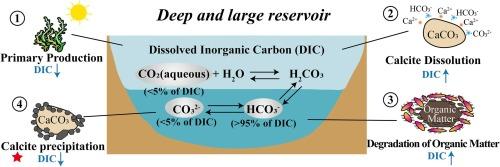
The Jinsha River Basin, situated in the arid and warm upper reaches of the Yangtze River in China, presents distinctive challenges for investigating dissolved inorganic carbon (DIC) due to its regional geography and climate. This study explored the spatial distribution and cycling of DIC during the wet season at four cascade power stations: Wudongde (WDD), Baihetan (BHT), Xiluodu (XLD), and Xiangjiaba (XJB). The results indicate that the primary sources of DIC at these stations are the result of carbonate rocks weathering by carbonic acid and sulfuric/nitric acids. Specifically, DIC production from weathering at WDD significantly surpasses that at the other stations (BHT, XLD, XJB) under the sulfuric/nitric acid weathering conditions (p < 0.05). In the cascade reservoirs of the Jinsha River, biochemical processes predominantly facilitate the precipitation of calcium carbonate. Among these reservoirs, XLD exhibits the highest efficiency in converting DIC into calcite, with a transformation rate of ΔDICtrans reaching 2.62 Tg/year. During the wet season, the combined effects of air temperature, wind speed, and partial pressure result in higher average CO2 emissions from the cascade power stations in the Jinsha River and Yellow River basins compared to other cascade power stations, comparable to emissions from the Three Gorges Reservoir. Specifically, XLD exhibits the highest CO2 emission rate (FCO2 = 102.38 ± 94.71 mmol/m2/d). Nevertheless, these levels are lower than those observed in most natural rivers globally. Buffer factor analysis indicates that the carbonate buffering capacity of the Jinsha River cascade reservoirs is relatively weak, with an average Revelle coefficient of approximately 41.4. These results enhance our understanding of carbon cycling in the Jinsha River’s cascade power stations and provide crucial insights.
for preserving the long-term stability of river ecosystems.
期刊介绍:
Gondwana Research (GR) is an International Journal aimed to promote high quality research publications on all topics related to solid Earth, particularly with reference to the origin and evolution of continents, continental assemblies and their resources. GR is an "all earth science" journal with no restrictions on geological time, terrane or theme and covers a wide spectrum of topics in geosciences such as geology, geomorphology, palaeontology, structure, petrology, geochemistry, stable isotopes, geochronology, economic geology, exploration geology, engineering geology, geophysics, and environmental geology among other themes, and provides an appropriate forum to integrate studies from different disciplines and different terrains. In addition to regular articles and thematic issues, the journal invites high profile state-of-the-art reviews on thrust area topics for its column, ''GR FOCUS''. Focus articles include short biographies and photographs of the authors. Short articles (within ten printed pages) for rapid publication reporting important discoveries or innovative models of global interest will be considered under the category ''GR LETTERS''.



 京公网安备 11010802042870号
京ICP备2023020795号-1
京公网安备 11010802042870号
京ICP备2023020795号-1

 分享
分享
 求助内容:
求助内容: 应助结果提醒方式:
 扫码关注我们
