Gaspareantonio Fabio Greco BS , Zayd Al-Asadi BS , Adam M. Belcher PhD , Elaine Mattox EdD , Michael V. Korona MD , Amy R. Deipolyi MD, PhD
{"title":"Ketamine/Midazolam versus Fentanyl/Midazolam Sedation for Interventional Radiology Procedures: A Prospective Registry","authors":"Gaspareantonio Fabio Greco BS , Zayd Al-Asadi BS , Adam M. Belcher PhD , Elaine Mattox EdD , Michael V. Korona MD , Amy R. Deipolyi MD, PhD","doi":"10.1016/j.jvir.2025.01.050","DOIUrl":null,"url":null,"abstract":"<div><h3>Purpose</h3><div>To assess whether sedation with ketamine/midazolam was more effective than fentanyl/midazolam at reducing periprocedural pain scores for interventional radiology (IR) procedures.</div></div><div><h3>Materials and Methods</h3><div>Data on preprocedural, intraprocedural, and postprocedural pain scores, procedure duration, and moderate or worse adverse events (AEs) were collected as part of a prospective quality improvement registry before and after the introduction of a ketamine/midazolam sedation program at a single academic center, including 292 procedures performed on adult patients from April 2024 to August 2024. All IR staff were surveyed before and after the introduction of ketamine regarding their observations on sedation, with 23 respondents at baseline survey and 22 at follow-up.</div></div><div><h3>Results</h3><div>Compared with fentanyl/midazolam sedation, ketamine/midazolam sedation was associated with lower intraprocedural (<em>P</em> ≤ .001) and postprocedural (<em>P</em> ≤ .05) pain scores, without prolonging procedure duration (<em>P</em> = .436) or increasing AEs (<em>P</em> > .999). The effect on pain scores was observed for biopsy and drainage, but not for venous port procedures. Staff reported that ketamine/midazolam sedation provided adequate comfort more often than fentanyl/midazolam sedation (<em>P</em> ≤ .01), and at study conclusion, most (82%) reported that they would choose ketamine/midazolam sedation for themselves.</div></div><div><h3>Conclusions</h3><div>Compared with fentanyl/midazolam, ketamine/midazolam sedation was superior regarding reduction of patient discomfort and preference by IR staff, with no added procedural duration or AEs when administered in the absence of anesthesiology providers. Findings suggest further investigation into incorporating ketamine into routine use in IR programs.</div></div>","PeriodicalId":49962,"journal":{"name":"Journal of Vascular and Interventional Radiology","volume":"36 6","pages":"Pages 1002-1010.e1"},"PeriodicalIF":2.6000,"publicationDate":"2025-06-01","publicationTypes":"Journal Article","fieldsOfStudy":null,"isOpenAccess":false,"openAccessPdf":"","citationCount":"0","resultStr":null,"platform":"Semanticscholar","paperid":null,"PeriodicalName":"Journal of Vascular and Interventional Radiology","FirstCategoryId":"3","ListUrlMain":"https://www.sciencedirect.com/science/article/pii/S1051044325001447","RegionNum":3,"RegionCategory":"医学","ArticlePicture":[],"TitleCN":null,"AbstractTextCN":null,"PMCID":null,"EPubDate":"2025/2/3 0:00:00","PubModel":"Epub","JCR":"Q2","JCRName":"PERIPHERAL VASCULAR DISEASE","Score":null,"Total":0}
引用次数: 0
Abstract
Purpose
To assess whether sedation with ketamine/midazolam was more effective than fentanyl/midazolam at reducing periprocedural pain scores for interventional radiology (IR) procedures.
Materials and Methods
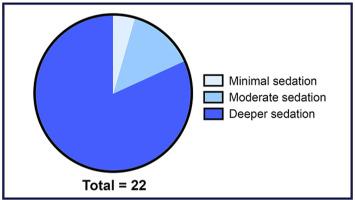
Data on preprocedural, intraprocedural, and postprocedural pain scores, procedure duration, and moderate or worse adverse events (AEs) were collected as part of a prospective quality improvement registry before and after the introduction of a ketamine/midazolam sedation program at a single academic center, including 292 procedures performed on adult patients from April 2024 to August 2024. All IR staff were surveyed before and after the introduction of ketamine regarding their observations on sedation, with 23 respondents at baseline survey and 22 at follow-up.
Results
Compared with fentanyl/midazolam sedation, ketamine/midazolam sedation was associated with lower intraprocedural (P ≤ .001) and postprocedural (P ≤ .05) pain scores, without prolonging procedure duration (P = .436) or increasing AEs (P > .999). The effect on pain scores was observed for biopsy and drainage, but not for venous port procedures. Staff reported that ketamine/midazolam sedation provided adequate comfort more often than fentanyl/midazolam sedation (P ≤ .01), and at study conclusion, most (82%) reported that they would choose ketamine/midazolam sedation for themselves.
Conclusions
Compared with fentanyl/midazolam, ketamine/midazolam sedation was superior regarding reduction of patient discomfort and preference by IR staff, with no added procedural duration or AEs when administered in the absence of anesthesiology providers. Findings suggest further investigation into incorporating ketamine into routine use in IR programs.
期刊介绍:
JVIR, published continuously since 1990, is an international, monthly peer-reviewed interventional radiology journal. As the official journal of the Society of Interventional Radiology, JVIR is the peer-reviewed journal of choice for interventional radiologists, radiologists, cardiologists, vascular surgeons, neurosurgeons, and other clinicians who seek current and reliable information on every aspect of vascular and interventional radiology. Each issue of JVIR covers critical and cutting-edge medical minimally invasive, clinical, basic research, radiological, pathological, and socioeconomic issues of importance to the field.



 京公网安备 11010802042870号
京ICP备2023020795号-1
京公网安备 11010802042870号
京ICP备2023020795号-1

 分享
分享

 求助内容:
求助内容: 应助结果提醒方式:
 扫码关注我们
