{"title":"Long-Term Outcomes of Elective Endovascular Aneurysm Repair for Abdominal Aortic Aneurysm in Japanese Elderly Patients.","authors":"Toshiya Nishibe, Masaki Kano, Shinobu Akiyama, Toru Iwahashi, Shoji Fukuda","doi":"10.5761/atcs.oa.24-00185","DOIUrl":null,"url":null,"abstract":"<p><strong>Purpose: </strong>Our primary concern was the risk of overtreating elderly patients with endovascular aneurysm repair (EVAR) for abdominal aortic aneurysm. We investigated the association between age at the time of EVAR and all-cause mortality in Japan's aging population by stratifying patients into age groups.</p><p><strong>Methods: </strong>Data from 175 patients who underwent elective EVAR from 2012 to 2016 were analyzed. Patients were categorized into 3 age groups: <75 years, 75-84 years, and ≥85 years, based on Japan's healthy life expectancy and average life expectancy. Survival rates and risk factors for mortality were assessed across these patient groups.</p><p><strong>Results: </strong>Among 175 patients, 3- and 5-year survival rates were significantly lower in elderly patients, with rates of 74.6% and 64.2% for those aged 75-84 years and 51.9% and 39.7% for those aged ≥85 years. Multivariate analysis identified age ≥85 years, chronic kidney disease, chronic obstructive pulmonary disease, and active cancer as independent adverse predictors of all-cause mortality, whereas obesity was identified as an independent protective predictor.</p><p><strong>Conclusions: </strong>Adjusting guidelines to incorporate not only comorbidities but also age could optimize outcomes and healthcare resource allocation by prioritizing EVAR for patients most likely to benefit in Japan's super-aging society.</p>","PeriodicalId":93877,"journal":{"name":"Annals of thoracic and cardiovascular surgery : official journal of the Association of Thoracic and Cardiovascular Surgeons of Asia","volume":"31 1","pages":""},"PeriodicalIF":1.3000,"publicationDate":"2025-01-01","publicationTypes":"Journal Article","fieldsOfStudy":null,"isOpenAccess":false,"openAccessPdf":"https://www.ncbi.nlm.nih.gov/pmc/articles/PMC11873598/pdf/","citationCount":"0","resultStr":null,"platform":"Semanticscholar","paperid":null,"PeriodicalName":"Annals of thoracic and cardiovascular surgery : official journal of the Association of Thoracic and Cardiovascular Surgeons of Asia","FirstCategoryId":"1085","ListUrlMain":"https://doi.org/10.5761/atcs.oa.24-00185","RegionNum":0,"RegionCategory":null,"ArticlePicture":[],"TitleCN":null,"AbstractTextCN":null,"PMCID":null,"EPubDate":"","PubModel":"","JCR":"","JCRName":"","Score":null,"Total":0}
引用次数: 0
Abstract
Purpose: Our primary concern was the risk of overtreating elderly patients with endovascular aneurysm repair (EVAR) for abdominal aortic aneurysm. We investigated the association between age at the time of EVAR and all-cause mortality in Japan's aging population by stratifying patients into age groups.
Methods: Data from 175 patients who underwent elective EVAR from 2012 to 2016 were analyzed. Patients were categorized into 3 age groups: <75 years, 75-84 years, and ≥85 years, based on Japan's healthy life expectancy and average life expectancy. Survival rates and risk factors for mortality were assessed across these patient groups.
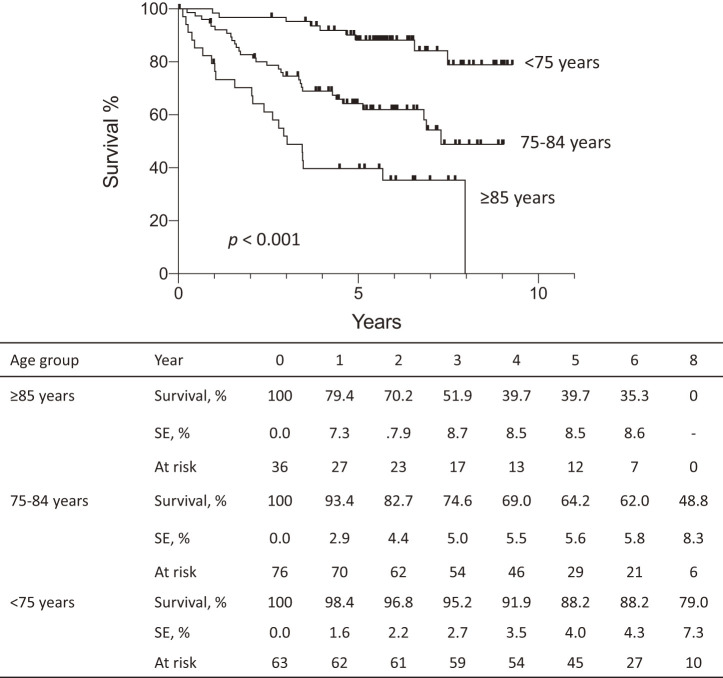
Results: Among 175 patients, 3- and 5-year survival rates were significantly lower in elderly patients, with rates of 74.6% and 64.2% for those aged 75-84 years and 51.9% and 39.7% for those aged ≥85 years. Multivariate analysis identified age ≥85 years, chronic kidney disease, chronic obstructive pulmonary disease, and active cancer as independent adverse predictors of all-cause mortality, whereas obesity was identified as an independent protective predictor.
Conclusions: Adjusting guidelines to incorporate not only comorbidities but also age could optimize outcomes and healthcare resource allocation by prioritizing EVAR for patients most likely to benefit in Japan's super-aging society.



 京公网安备 11010802042870号
京ICP备2023020795号-1
京公网安备 11010802042870号
京ICP备2023020795号-1

 分享
分享

 求助内容:
求助内容: 应助结果提醒方式:
 扫码关注我们
