Songlin Yan, Weihong Liu, Jianjun Long, Kun Wang, Qilu Yao, Gang Feng and Zhang-Hui Lu
{"title":"Photothermal conversion enhances selective hydrogenation over MOF-derived Cu–MoO2 interfaces under ambient conditions†","authors":"Songlin Yan, Weihong Liu, Jianjun Long, Kun Wang, Qilu Yao, Gang Feng and Zhang-Hui Lu","doi":"10.1039/D4QI03188A","DOIUrl":null,"url":null,"abstract":"<p >The selective hydrogenation of nitroaromatic compounds to produce phenylamines plays a crucial role in various industrial processes. Here, we introduce a Cu–MoO<small><sub>2</sub></small>@C catalyst, which is synthesized by pyrolyzing a polyoxometalate-based metal–organic framework (POMOF), exhibiting remarkable catalytic efficiency in the selective hydrogenation of nitroaromatics. Specifically, nearly 100% conversion and 97% selectivity in hydrogenation of 4-nitrostyrene (4-NS) to 4-aminostyrene (4-AS) were achieved over the Cu–MoO<small><sub>2</sub></small>@C catalyst under light irradiation. This promoted yield of 4-AS is ascribed to the plasmonic photothermal effect of Cu nanoparticles (NPs), which facilitate efficient photothermal conversion, as well as the strong electronic interactions at Cu/MoO<small><sub>2</sub></small> interfaces, which facilitate the selective reduction of the N<img>O bond while minimizing the reduction of the C<img>C bond. Furthermore, the Cu–MoO<small><sub>2</sub></small>@C catalyst demonstrates outstanding stability, maintaining high catalytic activity over eight cycles with minimal performance degradation. Its versatility was evidenced by the effective hydrogenation of a variety of nitroaromatic substrates containing different reducible functional groups. This study underscores the potential of Cu–MoO<small><sub>2</sub></small>@C as an efficient, stable, and adaptable catalyst for the selective hydrogenation of nitroaromatic compounds, presenting a promising solution for industrial applications.</p>","PeriodicalId":79,"journal":{"name":"Inorganic Chemistry Frontiers","volume":" 7","pages":" 2709-2718"},"PeriodicalIF":6.4000,"publicationDate":"2025-02-07","publicationTypes":"Journal Article","fieldsOfStudy":null,"isOpenAccess":false,"openAccessPdf":"","citationCount":"0","resultStr":null,"platform":"Semanticscholar","paperid":null,"PeriodicalName":"Inorganic Chemistry Frontiers","FirstCategoryId":"92","ListUrlMain":"https://pubs.rsc.org/en/content/articlelanding/2025/qi/d4qi03188a","RegionNum":1,"RegionCategory":"化学","ArticlePicture":[],"TitleCN":null,"AbstractTextCN":null,"PMCID":null,"EPubDate":"","PubModel":"","JCR":"Q1","JCRName":"CHEMISTRY, INORGANIC & NUCLEAR","Score":null,"Total":0}
引用次数: 0
Abstract
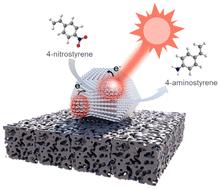
The selective hydrogenation of nitroaromatic compounds to produce phenylamines plays a crucial role in various industrial processes. Here, we introduce a Cu–MoO2@C catalyst, which is synthesized by pyrolyzing a polyoxometalate-based metal–organic framework (POMOF), exhibiting remarkable catalytic efficiency in the selective hydrogenation of nitroaromatics. Specifically, nearly 100% conversion and 97% selectivity in hydrogenation of 4-nitrostyrene (4-NS) to 4-aminostyrene (4-AS) were achieved over the Cu–MoO2@C catalyst under light irradiation. This promoted yield of 4-AS is ascribed to the plasmonic photothermal effect of Cu nanoparticles (NPs), which facilitate efficient photothermal conversion, as well as the strong electronic interactions at Cu/MoO2 interfaces, which facilitate the selective reduction of the NO bond while minimizing the reduction of the CC bond. Furthermore, the Cu–MoO2@C catalyst demonstrates outstanding stability, maintaining high catalytic activity over eight cycles with minimal performance degradation. Its versatility was evidenced by the effective hydrogenation of a variety of nitroaromatic substrates containing different reducible functional groups. This study underscores the potential of Cu–MoO2@C as an efficient, stable, and adaptable catalyst for the selective hydrogenation of nitroaromatic compounds, presenting a promising solution for industrial applications.




 京公网安备 11010802042870号
京ICP备2023020795号-1
京公网安备 11010802042870号
京ICP备2023020795号-1

 分享
分享
 求助内容:
求助内容: 应助结果提醒方式:
 扫码关注我们
