Giovanni Soleti;Paolo Roberto Massenio;Julian Kunze;Gianluca Rizzello
{"title":"Model-Based Robust Position Control of an Underactuated Dielectric Elastomer Soft Robot","authors":"Giovanni Soleti;Paolo Roberto Massenio;Julian Kunze;Gianluca Rizzello","doi":"10.1109/TRO.2025.3539184","DOIUrl":null,"url":null,"abstract":"Achieving accurate closed-loop position control of soft robots remains an ongoing research problem, due to the challenges posed by underactuation, elastic nonlinearities, and material creep. Although soft driving technologies relying on tendons and smart material transducers (e.g., dielectric elastomers, shape memory alloys) offer more ease of controllability compared to pneumatics, the corresponding controller design problem becomes even more challenging because of additional nonlinear effects. Those include a configuration-dependent actuation matrix, that stems from the kinematics of the actuation, and control input saturation, which is especially critical for smart material actuators. In this article, we investigate for the first time the closed-loop position control of a soft-robotic system driven by dielectric elastomer actuators. The objective is to regulate the robot state to a constant setpoint, accounting for the effects of open-loop instability, underactuation, control input saturation, and constant external disturbances. To achieve this goal, we propose a model-based feedback scheme, which combines a stabilizing energy-shaping controller with a robustifying PI-like law. After presenting the general theory, a linear matrix inequalities algorithm is proposed to practically address the controller design in spite of strong model nonlinearities. Experimental validation conducted on a prototype of the soft-robotic system confirms the effectiveness of the proposed control approach.","PeriodicalId":50388,"journal":{"name":"IEEE Transactions on Robotics","volume":"41 ","pages":"1693-1710"},"PeriodicalIF":10.5000,"publicationDate":"2025-02-06","publicationTypes":"Journal Article","fieldsOfStudy":null,"isOpenAccess":false,"openAccessPdf":"https://ieeexplore.ieee.org/stamp/stamp.jsp?tp=&arnumber=10876768","citationCount":"0","resultStr":null,"platform":"Semanticscholar","paperid":null,"PeriodicalName":"IEEE Transactions on Robotics","FirstCategoryId":"94","ListUrlMain":"https://ieeexplore.ieee.org/document/10876768/","RegionNum":1,"RegionCategory":"计算机科学","ArticlePicture":[],"TitleCN":null,"AbstractTextCN":null,"PMCID":null,"EPubDate":"","PubModel":"","JCR":"Q1","JCRName":"ROBOTICS","Score":null,"Total":0}
引用次数: 0
Abstract
Achieving accurate closed-loop position control of soft robots remains an ongoing research problem, due to the challenges posed by underactuation, elastic nonlinearities, and material creep. Although soft driving technologies relying on tendons and smart material transducers (e.g., dielectric elastomers, shape memory alloys) offer more ease of controllability compared to pneumatics, the corresponding controller design problem becomes even more challenging because of additional nonlinear effects. Those include a configuration-dependent actuation matrix, that stems from the kinematics of the actuation, and control input saturation, which is especially critical for smart material actuators. In this article, we investigate for the first time the closed-loop position control of a soft-robotic system driven by dielectric elastomer actuators. The objective is to regulate the robot state to a constant setpoint, accounting for the effects of open-loop instability, underactuation, control input saturation, and constant external disturbances. To achieve this goal, we propose a model-based feedback scheme, which combines a stabilizing energy-shaping controller with a robustifying PI-like law. After presenting the general theory, a linear matrix inequalities algorithm is proposed to practically address the controller design in spite of strong model nonlinearities. Experimental validation conducted on a prototype of the soft-robotic system confirms the effectiveness of the proposed control approach.
期刊介绍:
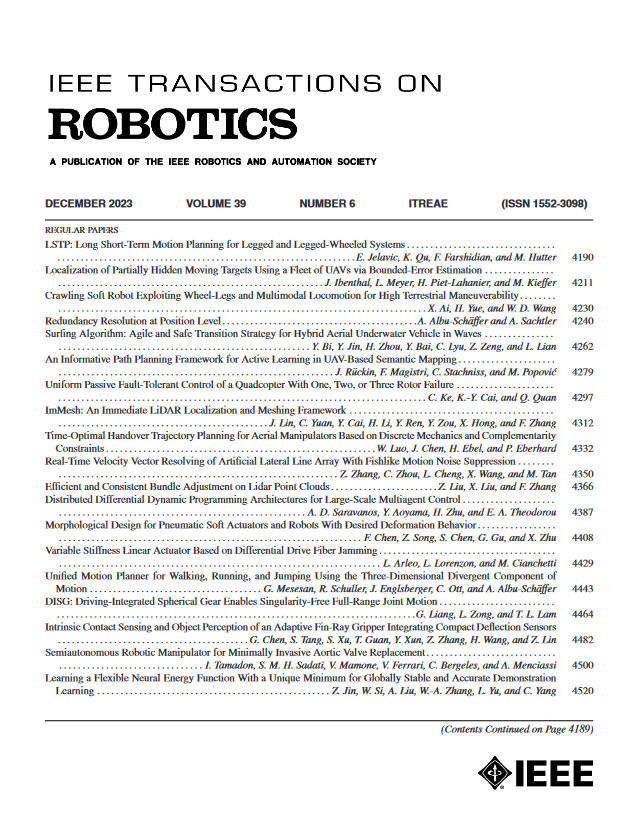
The IEEE Transactions on Robotics (T-RO) is dedicated to publishing fundamental papers covering all facets of robotics, drawing on interdisciplinary approaches from computer science, control systems, electrical engineering, mathematics, mechanical engineering, and beyond. From industrial applications to service and personal assistants, surgical operations to space, underwater, and remote exploration, robots and intelligent machines play pivotal roles across various domains, including entertainment, safety, search and rescue, military applications, agriculture, and intelligent vehicles.
Special emphasis is placed on intelligent machines and systems designed for unstructured environments, where a significant portion of the environment remains unknown and beyond direct sensing or control.



 京公网安备 11010802042870号
京ICP备2023020795号-1
京公网安备 11010802042870号
京ICP备2023020795号-1

 分享
分享
 求助内容:
求助内容: 应助结果提醒方式:
 扫码关注我们
