Hadil Jubair Mayouf , Mohammed Faiad Naief , Samar Naser Mohammed , Ahmed Mishaal Mohammed
{"title":"Synthesize and characterization of Fe2O3 nanoparticles and its potential as a photocatalyst","authors":"Hadil Jubair Mayouf , Mohammed Faiad Naief , Samar Naser Mohammed , Ahmed Mishaal Mohammed","doi":"10.1016/j.jorganchem.2025.123543","DOIUrl":null,"url":null,"abstract":"<div><div>Methylene blue (MB) is used extensively in medicine; nevertheless, excessive dosages (≥7 mg/kg) of MB can oxidize hemoglobin directly, resulting in methemoglobinemia. Especially in newborns, hemolysis is linked to doses of >15 mg/kg. It may also impede the clinical manifestations of cyanosis and discolor mucosal membranes and secretions. In this work, iron oxide nanoparticles (Fe<sub>2</sub>O<sub>3</sub>NPs) were synthesized utilizing green chemistry methods using fresh leaves of red cabbage (Brassica oleracea L. var. capitata f, rubra) extract and calcined at 700 °C temperatures to get the hematite phases. In this approach, biomolecules such as alkaloids, steroids, flavonoids, terpenoids, phenolic, flavonoids, anthocyanins, and glucosinolates presence in the red cabbage extract have been shown to work as encapsulating agents for Fe<sub>2</sub>O<sub>3</sub>NPs. The various physical and chemical characteristics of synthesized Fe<sub>2</sub>O<sub>3</sub>NPs with spherical solid shapes and having a diameter ranging from 29.03 to 49.13 nm were characterized using FESEM, TEM, XRD, FTIR, and UV–visible spectroscopy techniques. The photocatalytic activity of synthesized Fe<sub>2</sub>O<sub>3</sub>NPs was tested against methylene blue (MB) under UV-visible light. The photocatalyst degraded approximately 65.5 % of the original MB dye at a rate of 0.0043 min<sup>−1</sup> during 240 min of irradiation.</div></div>","PeriodicalId":374,"journal":{"name":"Journal of Organometallic Chemistry","volume":"1029 ","pages":"Article 123543"},"PeriodicalIF":2.1000,"publicationDate":"2025-04-01","publicationTypes":"Journal Article","fieldsOfStudy":null,"isOpenAccess":false,"openAccessPdf":"","citationCount":"0","resultStr":null,"platform":"Semanticscholar","paperid":null,"PeriodicalName":"Journal of Organometallic Chemistry","FirstCategoryId":"92","ListUrlMain":"https://www.sciencedirect.com/science/article/pii/S0022328X25000373","RegionNum":3,"RegionCategory":"化学","ArticlePicture":[],"TitleCN":null,"AbstractTextCN":null,"PMCID":null,"EPubDate":"2025/1/31 0:00:00","PubModel":"Epub","JCR":"Q3","JCRName":"CHEMISTRY, INORGANIC & NUCLEAR","Score":null,"Total":0}
引用次数: 0
Abstract
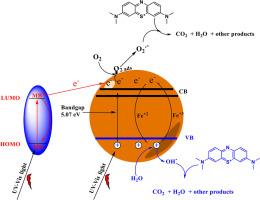
Methylene blue (MB) is used extensively in medicine; nevertheless, excessive dosages (≥7 mg/kg) of MB can oxidize hemoglobin directly, resulting in methemoglobinemia. Especially in newborns, hemolysis is linked to doses of >15 mg/kg. It may also impede the clinical manifestations of cyanosis and discolor mucosal membranes and secretions. In this work, iron oxide nanoparticles (Fe2O3NPs) were synthesized utilizing green chemistry methods using fresh leaves of red cabbage (Brassica oleracea L. var. capitata f, rubra) extract and calcined at 700 °C temperatures to get the hematite phases. In this approach, biomolecules such as alkaloids, steroids, flavonoids, terpenoids, phenolic, flavonoids, anthocyanins, and glucosinolates presence in the red cabbage extract have been shown to work as encapsulating agents for Fe2O3NPs. The various physical and chemical characteristics of synthesized Fe2O3NPs with spherical solid shapes and having a diameter ranging from 29.03 to 49.13 nm were characterized using FESEM, TEM, XRD, FTIR, and UV–visible spectroscopy techniques. The photocatalytic activity of synthesized Fe2O3NPs was tested against methylene blue (MB) under UV-visible light. The photocatalyst degraded approximately 65.5 % of the original MB dye at a rate of 0.0043 min−1 during 240 min of irradiation.
期刊介绍:
The Journal of Organometallic Chemistry targets original papers dealing with theoretical aspects, structural chemistry, synthesis, physical and chemical properties (including reaction mechanisms), and practical applications of organometallic compounds.
Organometallic compounds are defined as compounds that contain metal - carbon bonds. The term metal includes all alkali and alkaline earth metals, all transition metals and the lanthanides and actinides in the Periodic Table. Metalloids including the elements in Group 13 and the heavier members of the Groups 14 - 16 are also included. The term chemistry includes syntheses, characterizations and reaction chemistry of all such compounds. Research reports based on use of organometallic complexes in bioorganometallic chemistry, medicine, material sciences, homogeneous catalysis and energy conversion are also welcome.
The scope of the journal has been enlarged to encompass important research on organometallic complexes in bioorganometallic chemistry and material sciences, and of heavier main group elements in organometallic chemistry. The journal also publishes review articles, short communications and notes.




 京公网安备 11010802042870号
京ICP备2023020795号-1
京公网安备 11010802042870号
京ICP备2023020795号-1

 分享
分享
 求助内容:
求助内容: 应助结果提醒方式:
 扫码关注我们
