{"title":"The performance of metal carbon-based quantum dots as an anti-bacterial factor in green conditions","authors":"Payam Ansari , Mahdieh Ghobadifard , Sajjad Mohebbi , Morahem Ashengroph","doi":"10.1016/j.jorganchem.2024.123495","DOIUrl":null,"url":null,"abstract":"<div><div>Carbon quantum dots and metal-doped carbon quantum dots (N-CQDs and M-CQDs) were prepared by the hydrothermal method. The samples were characterized by EDS, UV–Vis, FT-IR, XRD, and PL techniques. FT-IR investigation demonstrates that M-CQDs have a shift of the peak associated with C-O and C=O oxygen bonds due to doping metals into carbon quantum dots, and a band at 550 cm<sup>-1</sup>, which is related to M-O bonds. N-CQDs and M-CQDs exhibited impressive <span><span>PL</span><svg><path></path></svg></span> behavior as an <span><span>antibacterial</span><svg><path></path></svg></span> factor against representative Gram-negative and Gram-positive bacterial strains. According to the findings and comparisons of the average halo zone of the anti-bactericidal activity of the prepared samples and MIC methods, N-CQDs and M-CQDs demonstrate excellent prevention versus bacteria with the best MIC of 0.5 mg/L. Co-CQDs had the greatest inhibitory effect against S. aureus with an average halo zone diameter of 15 mm, and E. coli with an average halo zone diameter of 13 mm. This toxicity is due to the generation of reactive oxygen species and the interaction between the M-CQDs and cells.</div></div>","PeriodicalId":374,"journal":{"name":"Journal of Organometallic Chemistry","volume":"1026 ","pages":"Article 123495"},"PeriodicalIF":2.1000,"publicationDate":"2025-02-15","publicationTypes":"Journal Article","fieldsOfStudy":null,"isOpenAccess":false,"openAccessPdf":"","citationCount":"0","resultStr":null,"platform":"Semanticscholar","paperid":null,"PeriodicalName":"Journal of Organometallic Chemistry","FirstCategoryId":"92","ListUrlMain":"https://www.sciencedirect.com/science/article/pii/S0022328X2400490X","RegionNum":3,"RegionCategory":"化学","ArticlePicture":[],"TitleCN":null,"AbstractTextCN":null,"PMCID":null,"EPubDate":"2024/12/30 0:00:00","PubModel":"Epub","JCR":"Q3","JCRName":"CHEMISTRY, INORGANIC & NUCLEAR","Score":null,"Total":0}
引用次数: 0
Abstract
Carbon quantum dots and metal-doped carbon quantum dots (N-CQDs and M-CQDs) were prepared by the hydrothermal method. The samples were characterized by EDS, UV–Vis, FT-IR, XRD, and PL techniques. FT-IR investigation demonstrates that M-CQDs have a shift of the peak associated with C-O and C=O oxygen bonds due to doping metals into carbon quantum dots, and a band at 550 cm-1, which is related to M-O bonds. N-CQDs and M-CQDs exhibited impressive PL behavior as an antibacterial factor against representative Gram-negative and Gram-positive bacterial strains. According to the findings and comparisons of the average halo zone of the anti-bactericidal activity of the prepared samples and MIC methods, N-CQDs and M-CQDs demonstrate excellent prevention versus bacteria with the best MIC of 0.5 mg/L. Co-CQDs had the greatest inhibitory effect against S. aureus with an average halo zone diameter of 15 mm, and E. coli with an average halo zone diameter of 13 mm. This toxicity is due to the generation of reactive oxygen species and the interaction between the M-CQDs and cells.
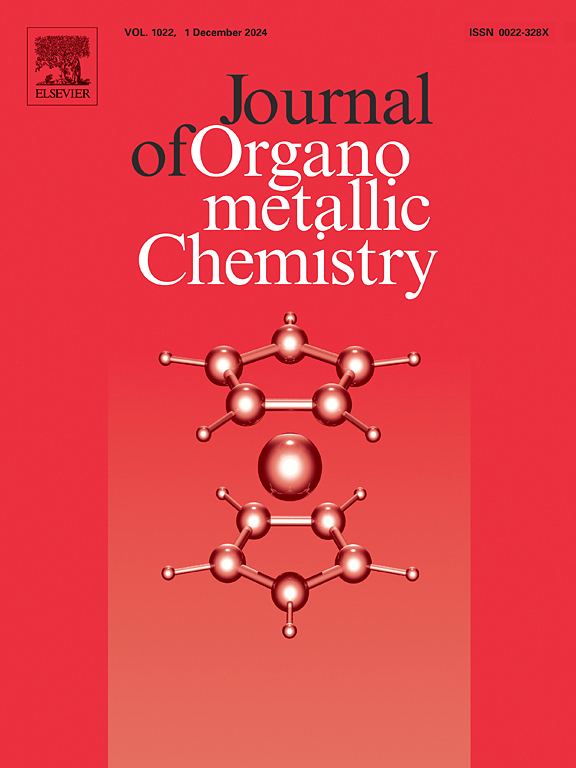
期刊介绍:
The Journal of Organometallic Chemistry targets original papers dealing with theoretical aspects, structural chemistry, synthesis, physical and chemical properties (including reaction mechanisms), and practical applications of organometallic compounds.
Organometallic compounds are defined as compounds that contain metal - carbon bonds. The term metal includes all alkali and alkaline earth metals, all transition metals and the lanthanides and actinides in the Periodic Table. Metalloids including the elements in Group 13 and the heavier members of the Groups 14 - 16 are also included. The term chemistry includes syntheses, characterizations and reaction chemistry of all such compounds. Research reports based on use of organometallic complexes in bioorganometallic chemistry, medicine, material sciences, homogeneous catalysis and energy conversion are also welcome.
The scope of the journal has been enlarged to encompass important research on organometallic complexes in bioorganometallic chemistry and material sciences, and of heavier main group elements in organometallic chemistry. The journal also publishes review articles, short communications and notes.




 京公网安备 11010802042870号
京ICP备2023020795号-1
京公网安备 11010802042870号
京ICP备2023020795号-1

 分享
分享
 求助内容:
求助内容: 应助结果提醒方式:
 扫码关注我们
