Comparative transcriptomic analysis and identification of candidate genes related to Verticillium wilt resistance in Gossypium barbadense and Gossypium hirsutum
Jieyin Zhao , Xingui Hu , Yuxiang Wang, Jiaxin Lu, Wenju Gao, Xuening Su, Quanjia Chen, Yanying Qu
{"title":"Comparative transcriptomic analysis and identification of candidate genes related to Verticillium wilt resistance in Gossypium barbadense and Gossypium hirsutum","authors":"Jieyin Zhao , Xingui Hu , Yuxiang Wang, Jiaxin Lu, Wenju Gao, Xuening Su, Quanjia Chen, Yanying Qu","doi":"10.1016/j.stress.2025.100759","DOIUrl":null,"url":null,"abstract":"<div><div>The resistance to Verticillium wilt in <em>Gossypium barbadense</em> is generally greater than that in <em>Gossypium hirsutum</em>, and analyzing the differences in the mechanism and regulatory genes involved in Verticillium wilt resistance between G<em>. barbadense</em> and G<em>. hirsutum</em> is particularly important. Here, we report a transcriptomic study for phenotypic evaluation of Verticillium wilt resistance in G<em>. hirsutum</em> (TM-1) and G<em>. barbadense</em> (Hai7124) and a comparison of the transcriptomes at 7 time points after <em>Verticillium dahliae</em> inoculation. Phenotypic evaluation revealed that, compared with TM-1, Hai7124 was more resistant to Verticillium wilt. A total of 18,138 differentially expressed genes (DEGs), including 1470 transcription factors (TFs). Further analysis of the expression of hormone biosynthesis- and signal transduction-related genes revealed that most of the genes in the salicylic acid (SA), jasmonic acid (JA) and ethylene (ET) biosynthesis pathways were highly expressed in Hai7124; the expression of SA and JA biosynthesis genes began to be significantly upregulated in the early stage of Verticillium wilt stress, while the expression of ET biosynthesis genes was upregulated mainly in the later stage. WGCNA-based binding sequence comparison revealed that MYB14 had nonsynonymous single nucleotide polymorphisms (SNPs) in 5 highly Verticillium wilt-resistant G<em>. barbadense</em> varieties compared to 5 highly Verticillium wilt-susceptible G<em>. hirsutum</em> varieties. Expression analysis revealed that <em>GbMYB14</em> responded more rapidly to Verticillium wilt stress than the same gene in G<em>. hirsutum</em>. The resistance of G<em>. barbadense</em> and G<em>. hirsutum</em> to Verticillium wilt decreased after MYB14 silencing via virus induced gene silencing (VIGS), and leaf yellowing and necrosis in the <em>GbMYB14</em>-silenced plants were more obvious. Compared with those in G<em>. hirsutum</em>, the expression levels and of lignin biosynthesis pathway genes and the lignin content in <em>GbMYB14</em>-silenced plants were lower. In conclusion, our results provide a theoretical basis for an in-depth understanding of the molecular mechanism underlying the difference in Verticillium wilt resistance between G<em>. barbadense</em> and G<em>. hirsutum</em> and provide a new genetic resource for the study of cotton resistance to Verticillium wilt.</div></div>","PeriodicalId":34736,"journal":{"name":"Plant Stress","volume":"15 ","pages":"Article 100759"},"PeriodicalIF":6.8000,"publicationDate":"2025-02-05","publicationTypes":"Journal Article","fieldsOfStudy":null,"isOpenAccess":false,"openAccessPdf":"","citationCount":"0","resultStr":null,"platform":"Semanticscholar","paperid":null,"PeriodicalName":"Plant Stress","FirstCategoryId":"1085","ListUrlMain":"https://www.sciencedirect.com/science/article/pii/S2667064X25000247","RegionNum":0,"RegionCategory":null,"ArticlePicture":[],"TitleCN":null,"AbstractTextCN":null,"PMCID":null,"EPubDate":"","PubModel":"","JCR":"Q1","JCRName":"PLANT SCIENCES","Score":null,"Total":0}
引用次数: 0
Abstract
The resistance to Verticillium wilt in Gossypium barbadense is generally greater than that in Gossypium hirsutum, and analyzing the differences in the mechanism and regulatory genes involved in Verticillium wilt resistance between G. barbadense and G. hirsutum is particularly important. Here, we report a transcriptomic study for phenotypic evaluation of Verticillium wilt resistance in G. hirsutum (TM-1) and G. barbadense (Hai7124) and a comparison of the transcriptomes at 7 time points after Verticillium dahliae inoculation. Phenotypic evaluation revealed that, compared with TM-1, Hai7124 was more resistant to Verticillium wilt. A total of 18,138 differentially expressed genes (DEGs), including 1470 transcription factors (TFs). Further analysis of the expression of hormone biosynthesis- and signal transduction-related genes revealed that most of the genes in the salicylic acid (SA), jasmonic acid (JA) and ethylene (ET) biosynthesis pathways were highly expressed in Hai7124; the expression of SA and JA biosynthesis genes began to be significantly upregulated in the early stage of Verticillium wilt stress, while the expression of ET biosynthesis genes was upregulated mainly in the later stage. WGCNA-based binding sequence comparison revealed that MYB14 had nonsynonymous single nucleotide polymorphisms (SNPs) in 5 highly Verticillium wilt-resistant G. barbadense varieties compared to 5 highly Verticillium wilt-susceptible G. hirsutum varieties. Expression analysis revealed that GbMYB14 responded more rapidly to Verticillium wilt stress than the same gene in G. hirsutum. The resistance of G. barbadense and G. hirsutum to Verticillium wilt decreased after MYB14 silencing via virus induced gene silencing (VIGS), and leaf yellowing and necrosis in the GbMYB14-silenced plants were more obvious. Compared with those in G. hirsutum, the expression levels and of lignin biosynthesis pathway genes and the lignin content in GbMYB14-silenced plants were lower. In conclusion, our results provide a theoretical basis for an in-depth understanding of the molecular mechanism underlying the difference in Verticillium wilt resistance between G. barbadense and G. hirsutum and provide a new genetic resource for the study of cotton resistance to Verticillium wilt.
期刊介绍:
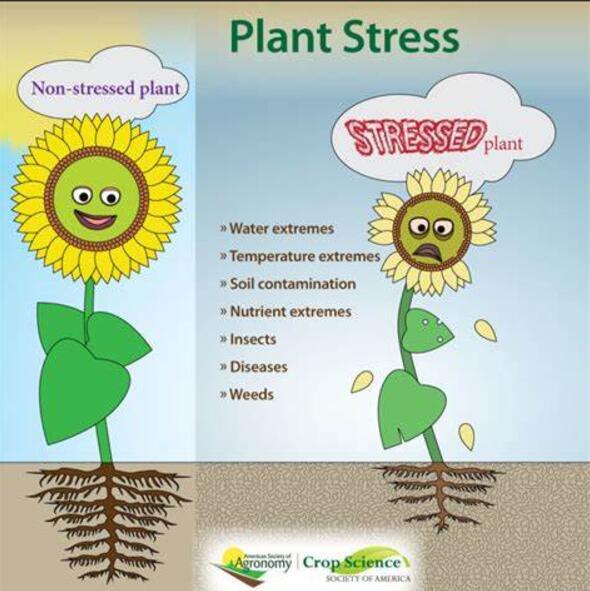
The journal Plant Stress deals with plant (or other photoautotrophs, such as algae, cyanobacteria and lichens) responses to abiotic and biotic stress factors that can result in limited growth and productivity. Such responses can be analyzed and described at a physiological, biochemical and molecular level. Experimental approaches/technologies aiming to improve growth and productivity with a potential for downstream validation under stress conditions will also be considered. Both fundamental and applied research manuscripts are welcome, provided that clear mechanistic hypotheses are made and descriptive approaches are avoided. In addition, high-quality review articles will also be considered, provided they follow a critical approach and stimulate thought for future research avenues.
Plant Stress welcomes high-quality manuscripts related (but not limited) to interactions between plants and:
Lack of water (drought) and excess (flooding),
Salinity stress,
Elevated temperature and/or low temperature (chilling and freezing),
Hypoxia and/or anoxia,
Mineral nutrient excess and/or deficiency,
Heavy metals and/or metalloids,
Plant priming (chemical, biological, physiological, nanomaterial, biostimulant) approaches for improved stress protection,
Viral, phytoplasma, bacterial and fungal plant-pathogen interactions.
The journal welcomes basic and applied research articles, as well as review articles and short communications. All submitted manuscripts will be subject to a thorough peer-reviewing process.



 京公网安备 11010802042870号
京ICP备2023020795号-1
京公网安备 11010802042870号
京ICP备2023020795号-1

 分享
分享
 求助内容:
求助内容: 应助结果提醒方式:
 扫码关注我们
